
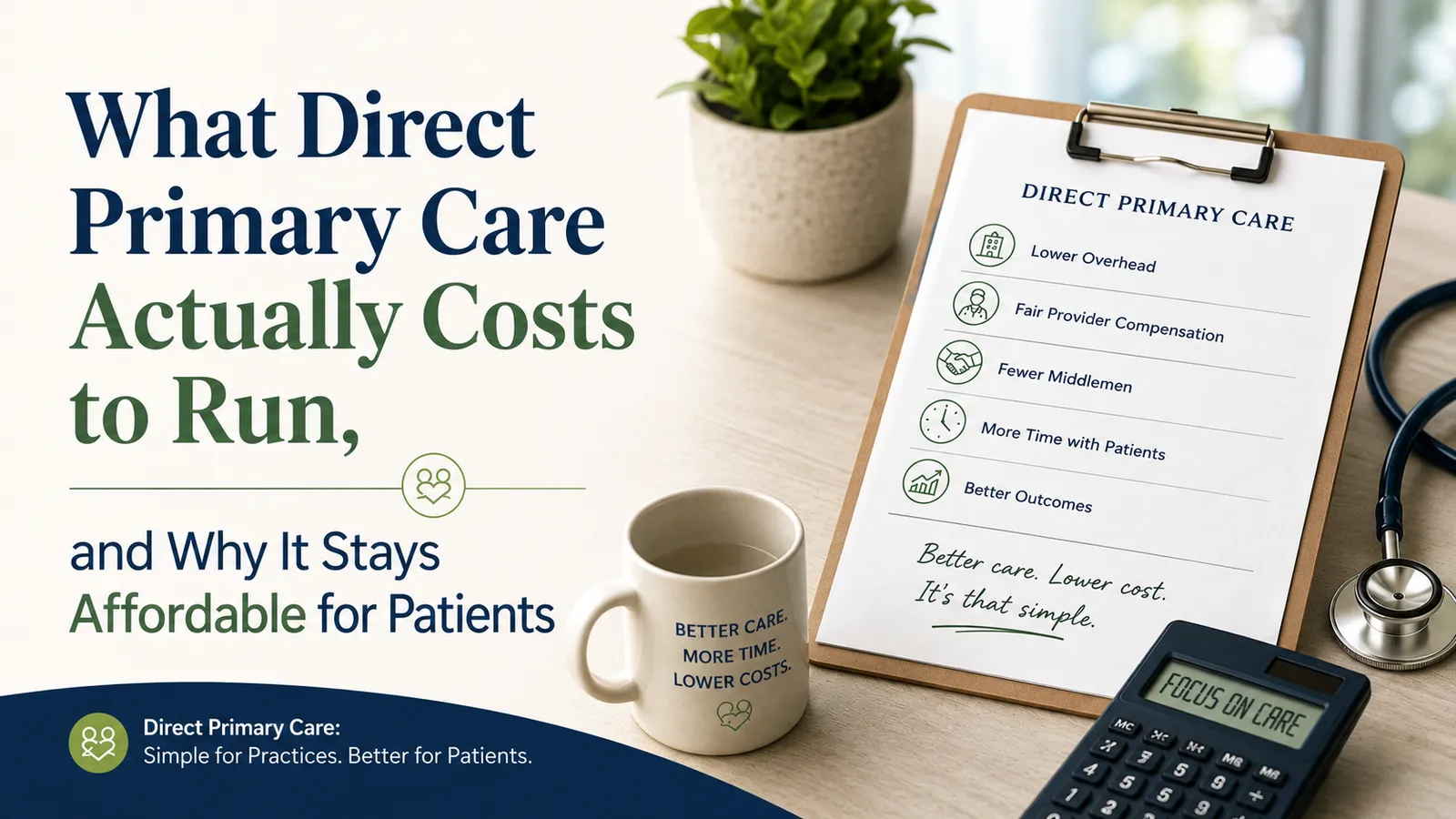

A typical primary care practice in the United States spends about $82,975 per physician every year just interacting with health insurers [1].
That money pays for the staff and software that submit claims, fight denials, chase prior authorizations, and reconcile payments. Patients never see it, but it is built into the price of every visit.
Direct primary care (DPC) practices spend close to none of it, because they do not bill insurance at all. Patients pay a flat monthly membership, usually $50 to $200 a month for an individual [4], and that fee covers their primary care.
When you remove the cost of dealing with insurers, you can charge patients far less and still run a healthy practice.
Below, we break down what it actually costs to run a DPC practice, and why those costs let the patient price stay low.
What Direct Primary Care Means
Direct primary care is a membership model for primary care. The patient pays the practice directly, usually monthly, and in return gets visits, basic procedures, messaging access, and care coordination with no copays and no insurance claims. It is not insurance, and most members keep a separate plan for hospital stays, specialists, and emergencies.
The numbers that define the model are consistent across the country [4]:
Monthly fee: about $50 to $200 per month for an individual ($600 to $2,400 a year), higher for families and older adults [4][6]
Panel size: up to about 800 patients per doctor, averaging around 413
Visit length: 30 to 60 minutes
Access: text, email, and phone, often the same day
For comparison, a traditional primary care doctor carries a panel of 2,000 to 2,500 patients and runs 10 to 15 minute visits [4]. The difference in panel size is the first clue to how the cost structure works. We cover the full side-by-side in our complete guide to direct primary care.
The Single Biggest Cost DPC Deletes: Insurance Billing
The largest fixed cost in a normal primary care office is not rent or equipment. It is the machinery of getting paid by insurers.
A standard practice needs billers and coders, claims software, and staff time to handle denials and prior authorizations. These fees end up costing over $80k per year on average.
A DPC practice removes that entire function. There are no claims to file, no codes to assign, no denials to appeal, and no prior authorizations to chase. One charge happens once a month, on a card, the same way a gym membership or a streaming subscription works. That single change is what frees up the budget that funds everything else in the model.
Where the Rest of the Money Goes
Running a DPC practice still costs money. The bill is just shorter. A typical cost stack looks like this:
Rent for a small clinical space, often a few exam rooms rather than a large suite.
One or two support staff instead of the larger front-desk and billing teams a claims practice needs.
An electronic health record (EHR) and a membership-billing platform, frequently built for DPC and priced per member.
Malpractice insurance, which tends to run lower for primary care than for procedural specialties.
Labs and medications bought at wholesale, which we explain below.
Because the panel is smaller, the practice does not need the volume of staff, space, and systems that a 2,500-patient office requires. Umbehr describes a mature Atlas MD office as roughly 700 to 1,000 square feet per doctor, one full-time nurse or medical assistant, and one exam room per physician, with total overhead around 20% to 25% of revenue [2]. A leaner cost base is what makes a smaller panel financially workable in the first place.
How Low Overhead Turns Into Low Patient Prices
Here is the arithmetic that ties it together. Take an illustrative DPC doctor with a panel of 600 members paying an average of $125 a month, a blended figure across individual, family, and older-adult memberships. That is $900,000 a year in predictable, recurring revenue before expenses. The revenue arrives whether or not the patient comes in, so the doctor is not paid to generate visits. They are paid to keep a defined group of people healthy.
A traditional practice has to reach roughly the same revenue from 2,000 to 2,500 patients routed through insurance, after the billing overhead takes its cut [1]. To do that, it books short, high-volume appointments. The DPC practice reaches a sustainable number from far fewer people, which is why it can offer 30 to 60 minute visits and same-day access without charging concierge-level fees.
This is also why DPC and concierge medicine are not the same thing. Concierge practices often keep insurance billing and layer an annual retainer on top, which is why concierge fees run from $3,000 to over $40,000 a year. DPC strips billing out entirely and keeps the membership low. We compare the two models in detail in our concierge vs. DPC breakdown.
Wholesale Labs and Direct Dispensing
DPC practices pass through two costs that traditional offices mark up: lab tests and medications.
Without an insurance layer in the middle, a DPC office can buy lab panels and generic drugs at wholesale and charge patients at or near that price. Hint Health reports that a comprehensive metabolic panel averaging $48 nationally can run about $3.31 through a DPC practice, roughly 93% lower [3]. Many common generic medications can be dispensed for a few dollars a month, and Umbehr describes getting a dermatology consult for about $30 in a day or two rather than a months-long referral [2]. Atlas MD, the Wichita, Kansas practice that helped popularize the model, charges $10 a month for children and $50 to $100 a month for adults depending on age, and built much of its reputation on this kind of transparent, near-cost pricing [2][6].
For the patient, the membership and the wholesale pricing stack together. The monthly fee covers the doctor's time, and labs and prescriptions cost a fraction of the retail price on top of it.
What This Means for Patients and Employers
Lower overhead produces measurable results. A Society of Actuaries and Milliman evaluation found DPC patients visited the emergency room 40.51% less often and had 12.64% lower total healthcare costs than comparable patients in traditional plans [5]. Fewer ER trips and earlier problem-catching are what you would expect when a doctor has time to answer a message before a small issue becomes a crisis.
Employers have noticed. In one employer case study in Hint Health's 2025 report, a real-estate firm's DPC cohort cost $282 per member per month versus $592 for a comparison group, a 52% difference, while DPC members saw their physician about 3.5 times a year versus 1.6 times for the national fee-for-service average [3]. A separate peer-reviewed JAMA Network Open study of 23,518 employees found that an employer-sponsored comprehensive primary care model was associated with roughly 45% lower total medical spending [7]. That combination, lower spend and more contact with a doctor, is why 63% of DPC practices now hold at least one employer contract [4]. We cover the benefits angle in our piece on DPC and concierge medicine as an employee perk.
The Limits Worth Naming
DPC keeps primary care cheap by doing one job well. It does not cover hospitalization, surgery, specialist care, or imaging beyond the basics. Most members pair their membership with a high-deductible or catastrophic insurance plan to cover the rare, expensive events. The membership handles the frequent, low-cost care that makes up most of a person's medical life, and insurance handles the catastrophes. As our DPC vs. traditional cost comparison lays out, DPC is not cheaper because it cuts corners. It is cheaper because it removes insurance overhead from routine care.
FAQ
Why is direct primary care so much cheaper than a concierge doctor?
DPC removes insurance billing entirely and keeps a low monthly membership, usually $50 to $100 a month for an individual [4]. Most concierge practices keep insurance billing and add an annual retainer on top, which pushes their fees from $3,000 to over $40,000 a year.
Does the low price mean lower-quality care?
No. The savings come from removing billing overhead and seeing fewer patients per doctor, not from cutting clinical services. DPC patients had 40.51% fewer ER visits and 12.64% lower total costs in one large evaluation [5].
How can a DPC doctor make a living with a smaller panel?
The revenue is recurring. An illustrative panel of 600 members at $125 a month produces $900,000 a year before expenses, and with overhead around 20% to 25% the physician keeps the large majority as income [2]. There are no claims staff or coding systems to fund [1].
Do I still need health insurance with a DPC membership?
Yes, in almost all cases. DPC covers routine primary care, but not hospital stays, surgery, or specialists. Members typically keep a high-deductible or catastrophic plan for those events.
Can my employer pay for a DPC membership?
Increasingly, yes. A growing share of DPC practices hold employer contracts, and employers report lower per-member spending and higher primary care use under the model [3][4].
Find a Direct Primary Care Practice
You can search for direct primary care and concierge practices by city, compare monthly pricing, and view doctor credentials at nextmd.ai/search. To start with one market, browse direct primary care practices in Kansas.
Sources
Morra, D., Nicholson, S., Levinson, W., Gans, D. N., Hammons, T., & Casalino, L. P. (2011). US Physician Practices Versus Canadians: Spending Nearly Four Times As Much Money Interacting With Payers. Health Affairs, 30(8), 1443-1450. Read on Health Affairs
Medical Economics. (2026). "A shoestring and a stethoscope": Atlas MD's Josh Umbehr, M.D., on the real economics of direct primary care. Read on Medical Economics
Hint Health. (2025). Employer Trends in Direct Primary Care. Read the Hint Health report
American Academy of Family Physicians. (2024). Direct Primary Care. Read on AAFP
Busch, F., Grzeskowiak, D., & Huth, E. (2020). Direct Primary Care: Evaluating a New Model of Delivery and Financing. Society of Actuaries / Milliman. Read the SOA/Milliman report (PDF)
Atlas MD. (2026). Monthly Membership Fees. Wichita, KS: children 0-19 $10/month; adults 20-44 $50/month; 45-64 $75/month; 65+ $100/month. Published at atlas.md/wichita/our-fees (accessed June 2026).
Basu, S., Phillips, R. S., Phillips, R., Peterson, L. E., & Landon, B. E. (2020). Utilization and Cost of an Employer-Sponsored Comprehensive Primary Care Delivery Model. JAMA Network Open, 3(4):e202666. n=23,518 employees; 45% lower total spending. Read on JAMA Network