
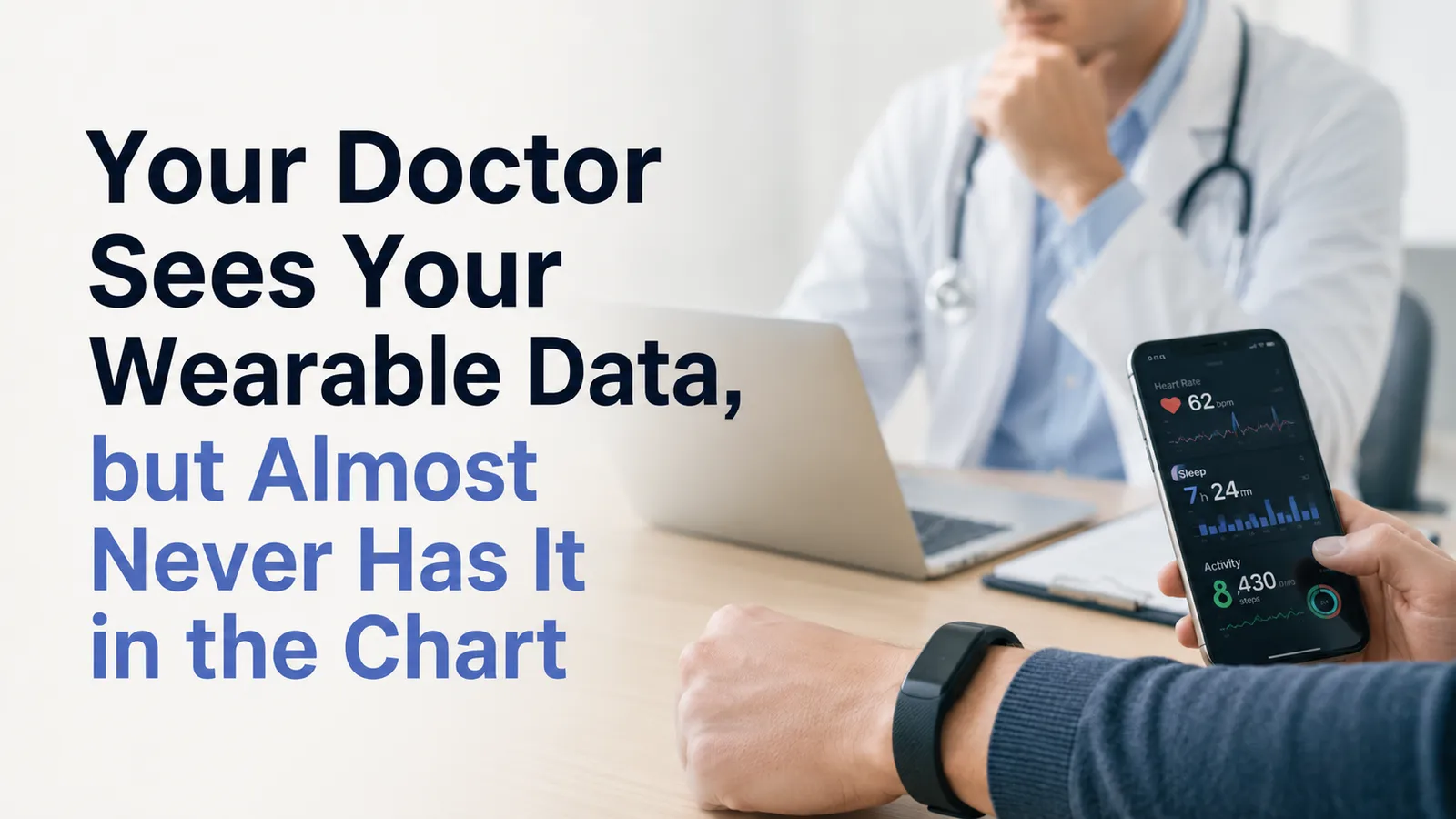

Eighty-six percent of U.S. physicians review some form of consumer wearable data at least occasionally. Only 6% have integrated that data into their clinical workflow.[1]
That difference explains a familiar appointment. You open an app, scroll through six months of sleep and heart-rate graphs, and hand your phone to the doctor. The doctor looks at the screen, asks a few questions, and may write a sentence about it in the visit note. The underlying measurements usually stay on your phone.
Doctors are interested. In the same American Medical Association survey, 77% of U.S. physicians said wearable data offered at least some clinical advantage. The missing pieces are usable data, reliable measurements, time, payment, and a safe process for deciding what deserves action.[1]
Here is why the gap persists, which measurements are worth bringing to an appointment, and how to turn a large data history into something your doctor can evaluate.
Doctors Already Look at Wearable Data
The American Medical Association and Medscape surveyed 2,222 physicians across six countries from January through early March 2026. The U.S. group included 720 physicians. The study covered consumer devices such as Apple Watch, Garmin, Fitbit, Oura, WHOOP, and over-the-counter biosensors. It excluded prescription medical devices and formal diagnostic tools.[1]
Among U.S. physicians, the data categories reviewed at least sometimes included:
Activity and physical function: 67%
Heart physiology: 62%
Events and alerts: 55%
Sleep: 54%
Glucose and metabolic data: 49%
Oxygen and breathing: 46%[1]
Patients are also initiating these conversations. Thirty-two percent of U.S. physicians said patients asked them to review wearable data at least weekly, and 28% said wearable review led to a clinical action at least weekly.[1]
Doctors are therefore seeing the data and sometimes acting on it. Integration means something more specific.
Looking at Your Phone Is Different From Having Data in the Chart
A phone screen lets a doctor see a graph. Clinical integration gives the care team a repeatable way to receive, identify, review, store, and act on the measurement.
Useful integration should answer basic questions:
Which device and sensor produced the number?
Was it a single reading or a sustained change?
What date and time did it occur?
What were your symptoms, activity, medications, and health conditions?
Can the doctor compare the measurement with prior data?
Does the result require confirmation with a medical test?
Where will the data and the doctor's interpretation live in the medical record?
U.S. hospitals have made progress on the technical side. In 2024, about two-thirds of hospitals allowed some form of patient-generated health data submission to the electronic health record. About half used standards-based application programming interfaces for those submissions.[2]
Those numbers measure whether a hospital can receive patient-generated data. They do not show that a primary care doctor gets a useful summary before your visit. The American Medical Association's 6% workflow-integration figure shows how much work remains at the physician level.[1]
Five Reasons Your Wearable Data Stays Outside the Medical Record
1. Consumer devices mix wellness features with medical features
A single watch can contain several regulatory categories. Its step counter, recovery score, and general sleep insights may be wellness features. An electrocardiogram feature or an irregular-rhythm notification may have separate Food and Drug Administration review.
The FDA's January 2026 guidance says low-risk products that encourage a healthy lifestyle can fall under its general-wellness policy when they are unrelated to diagnosing, treating, or preventing a disease.[3] That distinction matters. A medical feature inside a consumer device does not turn every score generated by the device into a medical measurement.
Patients can use NextMD's guide to what “FDA cleared” means for a health app to check a product's specific claim. Look for the named feature, intended use, and cleared device rather than relying on the product's general health branding.
2. Accuracy depends on the device, metric, person, and setting
Consumer wearables do not measure every signal equally well. A 2026 systematic review found that heart rate was the most studied and generally the most accurate smartwatch measurement. Results varied across brands and outcomes, and much of the validation research involved healthy people in laboratory settings.[4]
A separate systematic review of real-world disease detection found encouraging results for some applications, including atrial fibrillation and abnormal-pulse detection. The authors still found uncertainty around diagnostic precision, false positives, false negatives, privacy, and security.[5]
This is why a doctor may treat a wearable alert as a reason to ask questions or order a validated test. The alert provides evidence to investigate. It does not establish a diagnosis by itself.
3. A continuous stream creates a review problem
A wearable can produce heart rate, activity, sleep, temperature, oxygen, recovery, stress, and other estimates every day. A physician needs to identify the measurement that relates to your question.
Sending a year of raw data without a date, symptom, or clinical question transfers the filtering work to the doctor. The American Medical Association survey found that U.S. physicians rated medical-legal risk, accuracy, data overload, and electronic-record upload among the barriers to routine use. Forty-three percent rated medical-legal liability as a major concern, while 33% gave the same rating to accuracy concerns.[1]
A focused summary works better than a complete archive.
4. Reviewing consumer data usually has no dedicated payment pathway
Medicare covers remote patient monitoring when a clinician establishes a monitoring plan and the patient uses a connected device that meets the FDA's definition of a medical device. The device must digitally upload the readings, and the clinician must use the information to manage an acute or chronic condition.[6]
Your personal fitness watch usually sits outside that structure. The American Medical Association found no dedicated U.S. reimbursement pathway for reviewing ordinary consumer-wearable data. Existing remote-monitoring billing codes generally require an eligible medical device and a clinician-directed workflow.[1]
The distinction explains why a practice may run a formal blood-pressure monitoring program but lack a process for importing a patient's recovery score.
5. Your app and your doctor's record can follow different privacy rules
Health information held by a physician or hospital generally receives protection under the Health Insurance Portability and Accountability Act. A consumer app may sit outside that law when it is neither a covered healthcare entity nor its business associate. The U.S. Department of Health and Human Services states that once a patient directs information to an independent app, the app's subsequent use of that information may no longer fall under HIPAA.[7]
Before connecting an app to your medical record, check what it imports, what it exports, whether it shares data with third parties, and how you can delete the account. Technical integration can make data more useful. It also creates another place where sensitive information may be stored.
What Wearable Data Is Worth Showing Your Doctor?
The most useful wearable data connects a measurement to a specific health question. Bring the source, time period, symptoms, and relevant context.
Wearable information | What to bring | What your doctor still needs to determine |
|---|---|---|
Heart-rate or rhythm alert | Timestamp, duration, device and feature name, symptoms, and an exported tracing if available | Whether the signal is reliable and whether a medical electrocardiogram or other monitoring is appropriate |
Resting heart-rate trend | Baseline, size and duration of the change, illness, medication changes, and training load | Whether the change is meaningful in your clinical context |
Sleep trend | Bedtime, wake time, trend duration, daytime symptoms, and relevant medication or alcohol changes | Whether symptoms suggest a sleep disorder and whether formal testing is needed |
Oxygen estimate | Device and model, repeated pattern, elevation, illness, and breathing symptoms | Whether a medical pulse oximeter or clinical assessment should confirm the finding |
Activity or recovery score | Change from your usual level, recent injury or illness, exercise volume, and the question you want answered | Whether the proprietary score maps to a clinical decision |
Wearable trends can add context to personalized medical care. The doctor still has to connect the measurement with your history, symptoms, examination, medications, and appropriate medical testing.
How to Prepare Wearable Data for an Appointment
1. Start with one question
“Can you review my wearable data?” leaves the scope open. A specific question helps the doctor decide which measurement and time period matter.
Examples include:
“My resting heart rate rose from a usual 58 to 72 beats per minute for nine days after I changed medication. Does that need follow-up?”
“My watch recorded three irregular-rhythm alerts during episodes of palpitations. What should we do next?”
“My sleep duration has fallen below six hours on most work nights for a month, and I am falling asleep during afternoon meetings. Should we evaluate this further?”
2. Select a useful time window
Bring enough history to show the pattern without asking the doctor to review every day you have owned the device. Two to four weeks often works for a recent change. A longer summary may help when the question involves a seasonal or gradual trend.
Show your normal baseline and the period that concerns you. A change from your usual measurement is often easier to interpret than a single score produced by the app.
3. Document the event in clinical detail
Write down the date, time, duration, symptoms, and relevant context. For example:
On July 18 from 2:10 to 2:35 a.m., my watch showed a heart rate between 124 and 131 while I was lying down. I felt palpitations and lightheadedness. I had taken 60 mg of pseudoephedrine at 9 p.m. and had no alcohol.
That note gives the doctor more to evaluate than a screenshot labeled “high heart rate.”
4. Export a summary before the visit
Use a PDF, report, secure portal attachment, or a small set of screenshots when your device supports them. Include the device model and the name of the measured feature.
Ask the office whether it wants the information before the appointment. In the American Medical Association survey, a U.S. neurologist said having the data available before the visit would reduce the time required to obtain and interpret it during an already busy appointment.[1]
5. Bring your medication and symptom timeline
A wearable graph cannot show every relevant change. Note new prescriptions, dose changes, over-the-counter medicines, illness, travel, alcohol, exercise, and symptoms when they line up with the measurement.
The goal is to give your doctor enough context to decide whether the pattern needs reassurance, observation, confirmation, or treatment.
6. Ask what happens after the review
Before leaving, ask:
Will the summary or tracing go into my medical record?
Does this require a medical test?
Which measurement should I continue tracking?
What change should prompt me to contact the office?
When will we review the data again?
A review becomes clinically useful when it produces a documented decision and a follow-up plan.
Longer Visits Help, but Workflow Still Matters
Time can improve the conversation. It does not automatically create data integration.
Concierge and direct primary care practices often build their care around longer visits, ongoing communication, and preventive planning. Those features can make focused wearable review easier. A practice still needs a process for receiving the report, deciding who reviews it, documenting the interpretation, and responding to concerning measurements.
Some practices are building that process directly into their service. Peak Concierge Care in Lone Tree, Colorado, uses an app that connects to members' wearable devices and applies the data to nutrition, exercise, and recovery guidance. Patients comparing options in the region can also browse concierge and direct primary care practices in Colorado.
When interviewing any physician, ask one concrete question: “If I send you a wearable report before an appointment, who reviews it, where does it go, and what happens next?”
The answer tells you more than a website's promise of data-driven care.
The Useful Future Is a Shorter Summary
Wearables have succeeded at collecting data. Clinical care needs selection, context, validation, and follow-up.
The American Medical Association survey shows that physicians already engage with these measurements. The next step involves turning a phone screen into a manageable clinical workflow. That means fewer raw data points, clearer questions, reliable device information, appropriate payment, and a place in the medical record for the doctor's decision.
Until that system becomes routine, you can improve the appointment yourself. Bring the measurement that matters, the dates, the symptoms, the device, and the question you want answered.
Frequently Asked Questions
Can my doctor see my Apple Watch, Fitbit, Garmin, Oura, or WHOOP data automatically?
Usually not. Some health systems and practices support app connections or patient-generated data uploads, but only 6% of U.S. physicians in the 2026 American Medical Association survey reported full workflow integration.[1]
Is wearable data part of my official medical record?
It becomes part of the medical record when the practice receives and stores it in the chart or documents its clinical interpretation. Data that remains only inside your consumer app is separate from the physician's record.
Are wearable health measurements medically accurate?
Accuracy depends on the device, feature, person, and setting. Heart rate has more validation evidence than many other smartwatch measurements, while sleep, energy expenditure, and proprietary recovery scores have more variable evidence.[4]
Will Medicare pay my doctor to review smartwatch data?
Medicare remote patient monitoring generally requires a connected device that meets the FDA's definition of a medical device, digital data transmission, and a clinician-directed monitoring plan. Ordinary consumer-watch review does not automatically qualify.[6]
What should I bring from my wearable to an appointment?
Bring one clinical question, a focused date range, your baseline, the event or trend, symptoms, medication changes, and the device and feature name. Export a tracing or summary before the visit when the app allows it.
Can a wearable alert diagnose a medical condition?
A consumer wearable alert can support a clinical evaluation, but it should not serve as a diagnosis by itself. Your doctor may need to confirm the finding with a medical device, examination, laboratory test, or other diagnostic study.[3][5]
Find a Doctor Who Will Use the Data
Ask practices how they receive wearable reports, whether a physician reviews them, and how the interpretation enters your medical record. You can search NextMD for concierge and direct primary care physicians, compare services, and contact practices before joining.
Sources
American Medical Association. (2026). AMA Multi-Country Study on Consumer Wearable Data in Clinical Practice. AMA Center for Digital Health and AI and Medscape. Read the full AMA study
Assistant Secretary for Technology Policy / Office of the National Coordinator for Health Information Technology. (2026). Hospital Use of APIs to Enable Data Sharing Between EHRs and Third-Party Technology. Read the ASTP/ONC data brief
U.S. Food and Drug Administration. (2026). General Wellness: Policy for Low Risk Devices. Read the FDA guidance
Sicbaldi, M., Bartoli, L., Albites-Sanabria, J., et al. (2026). Is My Smartwatch a Valid Witness? A Systematic Review and Meta-Analysis. Forensic Science International, 384, 112901. Find the study on PubMed
Singh, B., Chastin, S., Miatke, A., et al. (2024). Real-World Accuracy of Wearable Activity Trackers for Detecting Medical Conditions: Systematic Review and Meta-Analysis. JMIR mHealth and uHealth, 12, e56972. Read the systematic review
Centers for Medicare & Medicaid Services. (2026). Remote Patient Monitoring. Read the CMS coverage and billing guidance
U.S. Department of Health and Human Services, Office for Civil Rights. (2025). The Access Right, Health Apps, and APIs. Read the HHS health-app privacy guidance