
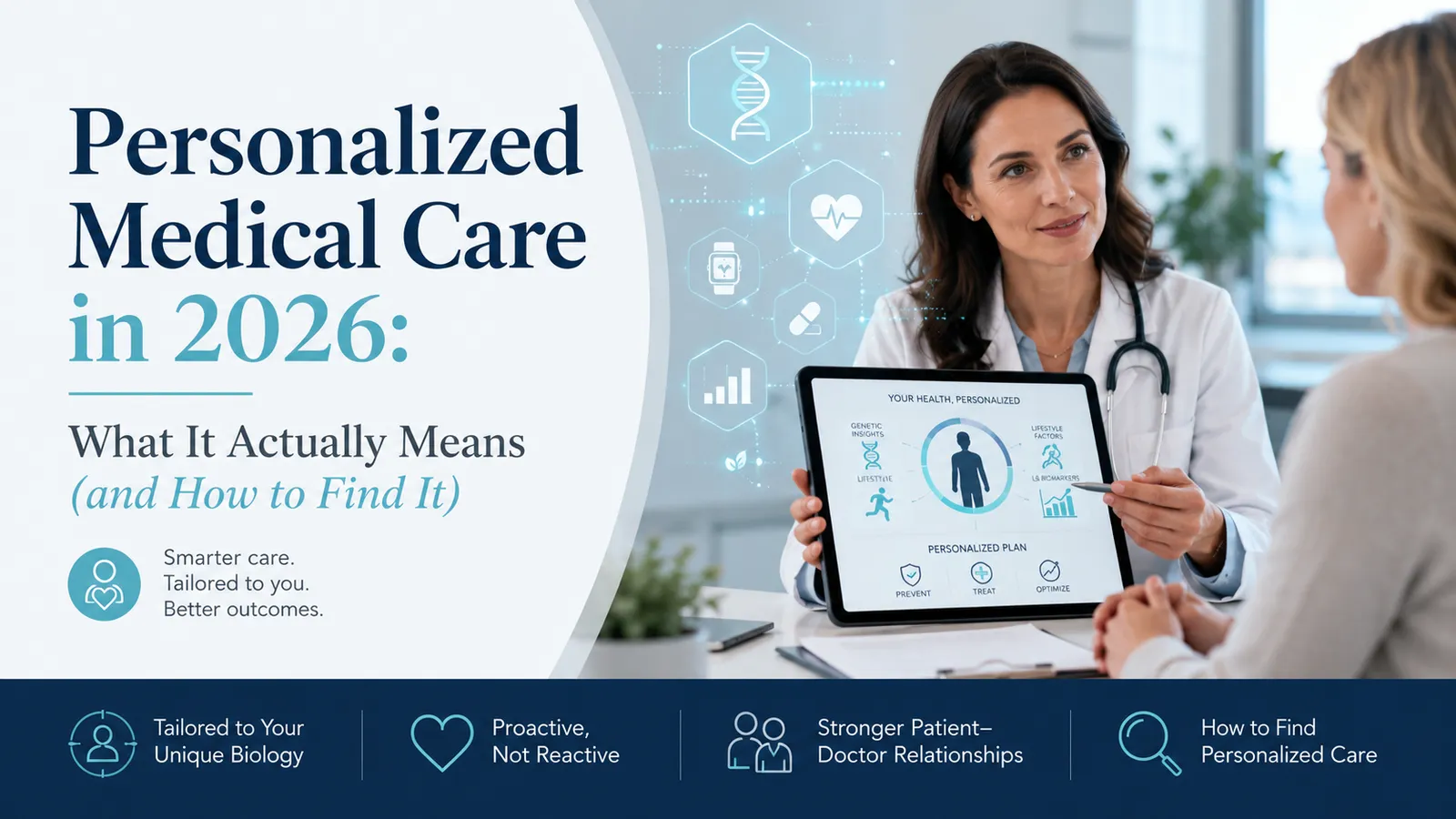

"Personalized care" is on almost every healthcare website in 2026. Hospital systems, urgent care chains, telehealth apps, and traditional primary care groups all use the phrase. It has become a marketing word.
The trouble is that real personalization has structural requirements. A doctor who carries 2,000 patients and sees 30 of them in a single day barely offer any personalization beyond what charts say.[1]
The phrase only matches the experience when the structure underneath it has been rebuilt.
Here is what personalized care actually means in 2026, what real personalization looks like in a primary care relationship, and where to find it.
What "Personalized Care" Means in 2026
The honest definition has three parts.
A doctor who knows you. Not your chart. You. Your family history, your stress level, your sleep, the medications you have tried and quit, the surgery you had ten years ago that still affects your gait. Personalized care starts when one physician is responsible for your whole picture and has the time to remember it.
Decisions made for your situation, not the average. Standard guidelines are written for the population. Personalized care uses those guidelines as a baseline, then adjusts based on your specifics. A blood pressure target for a 72 year old marathon runner is not the same as for a 72 year old who has never exercised.
Tools that match the patient, not the schedule. In 2026, that increasingly means continuous data from wearables, deeper labs ordered selectively rather than annually, and selective use of genomic information for medication choice and cancer screening. None of these tools deliver personalization on their own. They need a doctor with enough time to read the data and act on it.
Why the Phrase Has Become Marketing
Three forces have hollowed out "personalized care" in mainstream primary care.
Visit length collapsed. A 2020 analysis of more than 21 million primary care visits on the athenahealth platform found the average exam length was about 18 minutes, with face time often shorter than the scheduled duration once charting and screening prompts are accounted for.[5] The face time the patient actually gets is meaningfully shorter than the visit on the calendar.
Panel sizes grew. The average traditional primary care doctor carries between 2,000 and 2,500 patients.[1] In Mount Sinai's own analysis of the market, a typical primary care doctor sees 30 to 50 patients per day compared to 4 to 6 in a concierge model.[2]
Continuity broke. Patients change insurers, doctors change groups, and the original "your doctor" relationship rarely survives a few years. Studies of primary care continuity have linked weaker continuity to higher emergency room (ER) use and worse chronic disease control.[1]
When personalization is described in marketing copy but visits are 14 minutes long and the doctor changes every two years, the phrase loses its meaning.
The Four Real Ingredients of Personalized Care
When personalization is structural rather than rhetorical, four ingredients show up together.
Time per visit. Personalized care happens in 30 to 60 minute visits, not 14. There is room to ask the second question and the third.
Smaller panels. Concierge practices typically cap panels at under 300 patients per doctor, with ultra-premium practices running panels of 50 to 100. Direct primary care (DPC) doctors usually keep panels up to 800. Traditional primary care often runs 2,000 to 2,500.[1] Math determines availability before scheduling ever enters the picture.
Direct access. A patient who can text or call their doctor catches problems early. In the Society of Actuaries / Milliman direct primary care evaluation, DPC patients visited the ER 40.51% less often than matched traditional patients, and roughly two thirds of that gap appeared to be driven by the model itself rather than baseline health differences.[1]
Continuity. Same doctor, every visit, year after year. Continuity is the multiplier on every other ingredient. A doctor who has seen you for five years recognizes a small change that a new doctor would not.
These four ingredients are how personalization moves from a slogan to a real service.
How AI, Wearables, and Genomics Fit In
The technology layer in 2026 is more useful than it was even two years ago, but it does not replace the doctor relationship. It depends on it.
Wearables. Continuous heart rate, sleep, oxygen saturation, and activity data are now standard for many patients. The data is only useful if a clinician reviews it and acts. A primary care doctor with a 14 minute visit cannot review six months of overnight heart rate variability. A concierge or DPC doctor with a 45 minute visit can.
At-home and on-demand labs. Patients increasingly order quarterly metabolic panels, lipid panels, and inflammation markers between annual visits. The lab itself is not the personalization. The personalization is the doctor interpreting the trend over time.
Genomics and pharmacogenomics. Genetic testing for medication response (pharmacogenomics) and for hereditary cancer risk is more accessible than it has been before. These tests inform decisions; they do not make them. A doctor who knows your family history and your medication trial history gets more out of the same panel than a doctor seeing you for the first time.
Artificial intelligence (AI) in the visit. AI scribes are now common in primary care offices. They free the doctor from typing during the visit, which gives back eye contact and recall. AI does not personalize the encounter. It removes a barrier so the doctor can.
The pattern is consistent. New tools sharpen personalized care for patients who already have a real primary care relationship. They do not create one where none exists.
Why Traditional Primary Care Cannot Deliver It
Personalization is blocked by the math of the traditional model, not by any individual doctor's effort.
A primary care doctor with 2,200 patients in panel sees roughly 30 patients per day.[2] A typical visit runs 13 to 16 minutes, of which a significant share goes to electronic health record clicks and insurance documentation.[1][2] The doctor spends meaningful time outside the room on paperwork rather than with patients.
Even excellent doctors trapped in this structure cannot deliver continuous, attentive personalization. The hours do not exist.
This is why personalized care today is associated with concierge medicine and DPC: the models removed the structural barriers first.
Where Personalized Care Lives Today: Concierge and DPC
In 2026, the two physician-led models that have rebuilt the structure are concierge medicine and direct primary care.
Concierge medicine. A membership fee gives patients a smaller panel, 24/7 access to their physician (often by personal cell phone), 30 to 60 minute visits, and an expanded preventive program. Annual fees range from about $3,000 at the entry tier to over $40,000 at the ultra premium tier.
Direct primary care (DPC). A simpler monthly fee, usually $50 to $200 per month or $600 to $2,400 per year, replaces insurance billing for primary care. The result is same-day access, longer visits, and a doctor who can actually return your messages.
There is academic support for the model. Two peer-reviewed studies of MDVIP, the largest concierge network in the United States, analyzed a cohort of 10,186 Medicare Advantage beneficiaries and found that the MDVIP personalized preventive care model was associated with lower total healthcare expenditures and improved preventive screening compliance compared with a matched non-MDVIP cohort.[3] (Andrea Klemes, a co-author, is MDVIP's Chief Medical Officer; the studies analyzed MDVIP's own patient population.)
Hint Health, the largest DPC software platform, reports that DPC members on its platform see their physician about 3.5 times per year compared with roughly 1.6 times nationally under fee-for-service insurance, and receive about six times more total clinician time per year.[4] More time with the same doctor is the mechanism behind everything else.
Both models exist across the country. Pricing tiers are real and visible: at the entry level, practices like The Cove Concierge Medicine in Castle Rock, Colorado operate at $2,500 to $5,000 per year; in the premium tier, practices like WVL Synergy in Naples, Florida sit in the $5,000 to $12,000 range; in the ultra premium tier, practices like Private Medical operate in major metros at $15,000 and up, commonly over $40,000 per year.
What To Look For in a Personalized Care Practice
When evaluating a practice that markets "personalized care," ask four direct questions.
How many patients does each doctor carry? A concierge answer is under 300. A DPC answer is up to 800. A traditional answer is 2,000 or more, regardless of what the website says about personalization.
How long is a typical visit? 30 to 60 minutes is the personalized range. Under 20 minutes is not.
Can I reach my doctor directly? Phone, text, or email access to the same physician (not an after-hours service) is the access standard.
Will I see the same doctor every time? Continuity is what makes the data, the labs, and the relationship compound year over year.
The answers separate practices that have rebuilt the structure from those that have rewritten the homepage.
Cost, Honestly
Personalized primary care has a price. For DPC, the range is $50 to $200 per month, or roughly $600 to $2,400 per year. For concierge, the range is wider: $3,000 at the entry tier, $5,000 to $12,000 in the premium tier, and over $40,000 at the ultra premium tier.
Health insurance is still required for hospitalizations, surgeries, specialists, and prescriptions. The membership covers the relationship, not the catastrophic coverage.
For a sense of the trade off: a single ER visit in the United States averages about $2,200 before insurance.[1] In the Society of Actuaries / Milliman analysis, DPC patients visited the ER 40.51% less often and had 12.64% lower total healthcare costs than matched traditional patients.[1] For many patients, the membership pays back through avoided utilization.
How do I find a doctor who actually offers personalized care?
Search by city or specialty at nextmd.ai/search, or browse concierge and direct primary care practices by state at pages like nextmd.ai/state/fl and nextmd.ai/state/ny. Filter for the four real ingredients: panel size, visit length, direct access, and continuity. For background on why this model produces different outcomes, see Why Concierge Medicine Patients Visit the ER 40% Less Often.
NextMD helps you find and compare concierge medicine and direct primary care practices across the United States. Browse practices by city, compare pricing, and find a doctor who has time for you at nextmd.ai/search.
Sources
Busch, F., Grzeskowiak, D., & Huth, E. (2020). Direct Primary Care: Evaluating a New Model of Delivery and Financing. Society of Actuaries / Milliman. Read on SOA.org
Mount Sinai Solutions. (2023). Employer-Sponsored Health Care: Concierge Care Isn't Just a Luxury. Mount Sinai Health System. Find on Mount Sinai Solutions (verify exact URL before publishing)
Musich, S., Klemes, A., Kubica, M. A., Wang, S., & Hawkins, K. (2014). Personalized preventive care reduces healthcare expenditures among Medicare Advantage beneficiaries. American Journal of Managed Care. Read on PubMed. See also Musich, S., Wang, S., Hawkins, K., & Klemes, A. (2016). The Impact of Personalized Preventive Care on Health Care Quality, Utilization, and Expenditures. Population Health Management. Read on Sage Journals
Hint Health. (2025). Employer Trends in Direct Primary Care: 2025 Industry Report. Based on data from 7,200+ employers, 2,400+ clinicians, and 1.2M members on the Hint platform. Read the Hint Industry Report
Neprash, H. T., Everhart, A., McAlpine, D., Smith, L. B., Sheridan, B., & Cross, D. A. (2020). Measuring Primary Care Exam Length Using Electronic Health Record Data. Medical Care, 61(7), 414-422. Analysis of 21,010,780 primary care visits from athenahealth EHR data. Read on PubMed