
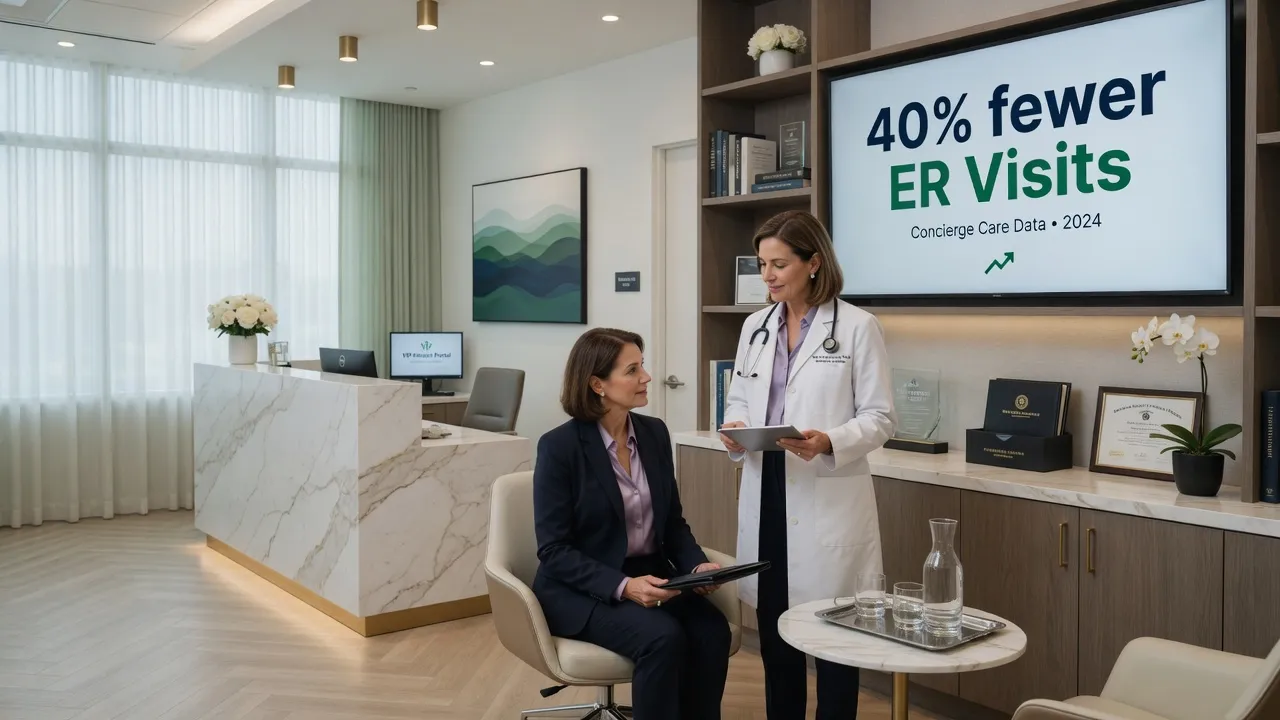

Every year, over 130 million people visit an emergency room in the United States. The average ER visit costs roughly $2,200,[3] often takes several hours, and in many cases the issue could have been addressed by a primary care doctor.
The problem is that getting in to see a primary care doctor isn't easy. According to a Forbes Health survey, a new patient in a large metropolitan area waits an average of 24 days for an appointment.[3] When something feels urgent on a Tuesday night, most people aren't going to wait. They go to the ER.
Concierge and direct primary care patients tend to have a very different experience. And a growing body of data supports that.
The 40% Number Is Real, And It's Risk-Adjusted
In 2020, the Society of Actuaries commissioned Milliman, one of the most respected actuarial firms in healthcare, to conduct one of the first rigorous studies comparing DPC patients to traditional insurance patients using real employer claims data.
The results were striking:
40.51% fewer emergency room visits for DPC patients compared to traditional patients[1]
12.64% lower total healthcare costs across all services[1]
52.50% lower ER-related costs specifically[1]
This was a risk-adjusted actuarial study, meaning they controlled for differences in age, gender, and health status between the two groups. Even after accounting for the fact that healthier patients may be more likely to choose DPC, the reductions held with strong statistical significance (p < .001 for ER visits).[1]
The study estimated that roughly one-third of the observed cost difference was explained by differences in health status between the groups. The remaining two-thirds appeared to be driven by the DPC model itself.[1] It's worth noting this was a single-employer study. More research across different populations would strengthen these findings.
Why This Happens: It's About Access, Not Avoidance
DPC patients aren't visiting the ER less because they're ignoring health problems. They're visiting less because they have a better option.
Here's what a typical DPC or concierge medicine membership actually gives you:
Same-day or next-day appointments. Not in three weeks. Today.
Direct access to your doctor via text, phone, or email. Many concierge doctors share their personal cell phone number with patients.
Visits that last 30 to 60 minutes. Your doctor actually has time to figure out what's going on.
24/7 availability. If something happens at 10pm, you can call your doctor instead of driving to the ER.
When you can text your doctor at 9pm about chest tightness and hear back quickly, you may not need to sit in an emergency room for hours to find out it was acid reflux.
When your child spikes a 103-degree fever on a Saturday morning and your pediatrician picks up the phone, you may be able to handle it without a trip to a crowded ER.
The Math Behind The Model
The reason concierge and DPC doctors can offer this level of access is simple math.
A traditional primary care doctor manages a panel of 2,000 to 2,500 patients.[1] They see 30 to 50 patients a day,[5] in appointments that average 13 to 16 minutes.[1] A significant portion of that time isn't even face time. It's spent clicking through electronic health records and dealing with insurance documentation.[5]
A concierge doctor typically manages 200 to 600 patients. They see 4 to 6 patients a day.[5] Appointments run 30 to 60 minutes of actual face time.[1]
That's the difference between a doctor who has very little margin to call you back and a doctor who has the time to.
Traditional Primary Care | Concierge / DPC | |
|---|---|---|
Patient panel | 2,000 - 2,500 | 200 - 600 |
Patients seen daily | 30 - 50 | 4 - 6 |
Average visit length | 13 - 16 minutes | 30 - 60 minutes |
Wait for appointment | 24 days average | Same day or next day |
After-hours access | Call an answering service | Text or call your doctor directly |
Annual ER visits | Baseline | 40% fewer |
When your doctor has significantly fewer patients, they're more likely to be available when you need them. And when your doctor is available, the ER becomes less necessary for non-emergency issues.
What This Means For Your Wallet
Let's do the math on what unnecessary ER visits actually cost.
The average emergency room visit in the United States costs approximately $2,200.[3] Even with insurance, the out-of-pocket cost after copays and deductibles often runs $500 to $1,500 per visit.
If a DPC membership costs $75 to $150 per month, and it helps you avoid even one ER visit per year, the financial math starts to work in your favor.
And that's before you factor in the time. Several hours in an ER waiting room is not just expensive. It's time you don't get back.
Preventive Care Catches Problems Earlier
There's a second, less obvious reason DPC patients use the ER less: they catch problems before they become emergencies.
According to the Hint Health 2025 report, DPC members see their physician 3.5 times per year compared to 1.6 times for the national average under fee-for-service. DPC appointments also tend to be about twice as long. Hint Health estimates this adds up to roughly 6x more total clinician time per year for DPC patients.[2]
More time with your doctor creates more opportunities to identify issues early, whether that's elevated blood pressure, an abnormal lab result, or a medication that needs adjusting.
The SOA study found a related pattern: DPC patients had 35.5% lower costs for preventive physician services.The study's authors hypothesized this may be because DPC providers integrate preventive care into regular visits rather than relying on a separate annual physical, though they noted more research is needed to confirm this.[1]
This Is The Future of Primary Care
A recent survey found that 82% of Wisconsin physicians report some level of professional burnout. Nationally, over half of physicians say their work environment feels chaotic, and the percentage satisfied with their work-life balance has dropped to around 40%.[4]
The traditional primary care model is under real strain. Doctors are stretched thin, patients have trouble getting timely access, and the emergency room often fills the gap.
Concierge medicine and DPC offer a different structure: smaller panels, longer visits, direct access, and a membership model that gives doctors the ability to spend more time on each patient.
The 40% ER reduction found in the SOA study makes sense when you look at it through that lens. When patients can reach their doctor, many of them simply don't need the emergency room.[1]
NextMD helps you find and compare concierge medicine and direct primary care practices across the United States. Browse practices by city, compare pricing, and find a doctor who has time for you at nextmd.ai/search.
Sources
Busch, F., Grzeskowiak, D., & Huth, E. (2020). Direct Primary Care: Evaluating a New Model of Delivery and Financing. Society of Actuaries / Milliman.
Hint Health. (2025). Employer Trends in Direct Primary Care. Based on data from 2,400+ clinicians and 1.2M members on the Hint platform. hint.com
Robinson-Walker, D. Concierge Medicine. Forbes Health. Referenced for 24-day average wait time for new patients in large metropolitan areas.
Carlasare, L.E. (2018). Defining the Place of Direct Primary Care in a Value-Based Care System. Wisconsin Medical Journal, 117(3), 106-110. Referenced for physician burnout data (82% of Wisconsin physicians).
Mount Sinai Solutions. (2023). Employer-Sponsored Health Care: Concierge Care Isn't Just a Luxury. Referenced for daily patient volume comparison (4-6 vs 30-50).