

A Direct-to-Consumer Health Stack Just Got Bigger
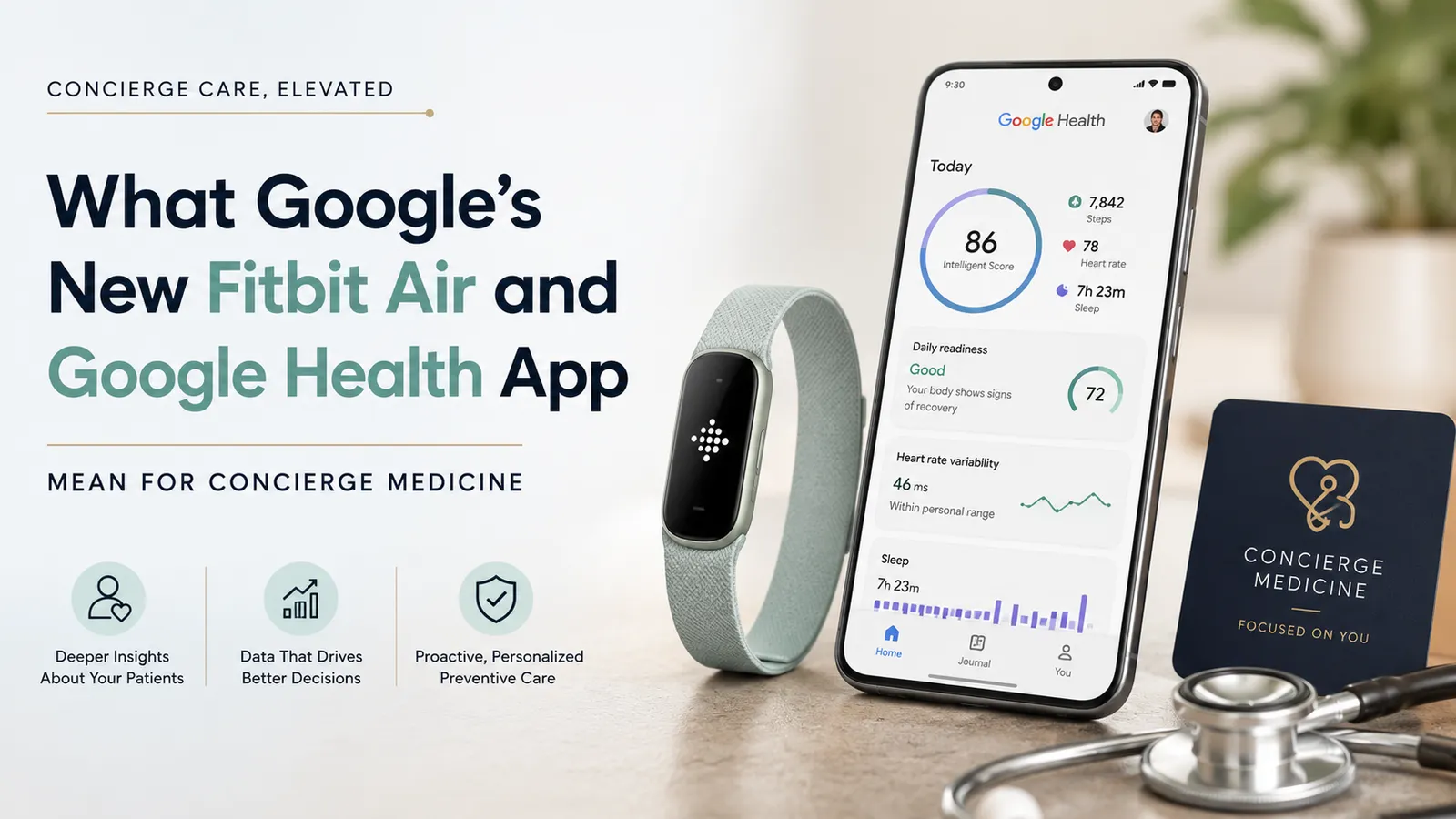
On May 8, 2026, Google announced the screenless, buttonless Fitbit Air, a $99.99 wearable that tracks heart rate, sleep stages, blood oxygen, skin temperature, heart rate variability, and irregular heart rhythm including atrial fibrillation, called a-fib for short [1]. On the same day, Google rebranded the Fitbit app as the Google Health app, a centralized platform that pulls together wearable data, third-party fitness apps, and a user's own medical records, powered by an artificial intelligence (AI) coach built on Gemini AI [1] [2].
The launch landed in the same 48-hour window as Hims & Hers debuting an AI lab-interpretation agent and Amazon Pharmacy adding Ozempic direct delivery. Three large companies, three direct-to-consumer healthcare moves, all aimed at the patient currently choosing between traditional insurance and concierge medicine. The right question is not "is this better than my doctor." It is what each tool actually does, where it stops, and how the math changes if you already have a concierge or direct primary care relationship.
What Google Actually Launched
Fitbit Air ($99.99, on shelves May 26, 2026). Free basic tracking. AI coaching sits behind Google Health Premium at $9.99 per month or $99.99 per year, with a three-month free trial. A $129 Stephen Curry Special Edition ships the same day. Compatible with Android and iOS [1].
Google Health app (rolling out May 19, 2026). Pulls in data from Peloton, MyFitnessPal, Dexcom, Abbott, Apple Health, and any platform connected through Health Connect. U.S. users can upload medical records by logging into their healthcare provider's portal after identity verification through partners like Clear and Athenahealth. The Google Health Coach can then answer questions referencing a user's own medical history, and a QR code in Google Wallet lets users share that summary with providers in seconds [1] [2]. Continuous glucose monitor data flows in through Health Connect, feeding live blood-sugar trends to the AI coach [2]. It is the most coherent direct-to-consumer health stack any single company has shipped.
Where Fitbit Air and Google Health Help You
For a healthy adult tracking sleep, fitness, and basic cardiovascular signals, the Fitbit Air at $99.99 is one of the cheapest credible health-tracking entry points on the market. A-fib detection alone has caught real cardiac arrhythmias in earlier wearable studies, including in patients who had no idea anything was wrong.
The Google Health app adds three useful things on top of that: a single dashboard for scattered data from Peloton, MyFitnessPal, Dexcom, and Fitbit; AI explanations that turn heart rate variability and sleep trends into plain English; and a QR code that hands a doctor a summary of your current state in seconds.
These are real wins. They are also each a single feature.
Where Fitbit Air and Google Health Stop
Concierge medicine is a relationship, not a feature. The pitch comes down to three things: same-day access, 30 to 60 minute appointments, and a doctor who knows your full clinical picture. None of those are wearable problems.
A concierge physician carries a panel of under 300 patients, with ultra-premium tiers running 50 to 100. A direct primary care (DPC) doctor carries up to 800. A traditional primary care doctor often carries 2,000 to 2,500 patients, which is the underlying reason you wait weeks for an appointment and get seven minutes when you arrive.
The Fitbit Air can spot an irregular heart rhythm. It cannot examine you, order a confirmatory test, adjust your medication, or coordinate care across specialists. The Google Health Coach can summarize what your labs mean. It cannot decide whether your borderline thyroid panel needs a re-test in six weeks or a referral to endocrinology this month.
The Society of Actuaries' 2020 evaluation of DPC found patients visited the emergency room 40.5% less often than insurance-only patients [3]. The mechanism is access plus relationship, not better dashboards. Wearable data is most useful when a clinician who knows you can interpret it. That clinician is the part Google did not ship.
How Concierge Doctors Actually Use Wearable Data
Most concierge practices treat patient-generated wearable data as a useful input, not a substitute for clinical judgment. A concierge doctor with 30 to 60 minute appointments has time to walk through six or twelve months of sleep, heart rate variability, and resting heart rate trends. A 7-minute insurance visit does not. When a patient sees a Fitbit a-fib alert and texts their concierge doctor directly, a same-day appointment usually follows. Practices like The Cove Concierge Medicine at the Entry tier and WVL Synergy at the Premium tier fold wearable data into preventive programs alongside biomarker panels and lifestyle coaching.
Concierge medicine costs $3,000 to over $40,000 per year (Entry $2,500-$5,000, Premium $5,000-$12,000, Ultra Premium $15,000 and up). Direct primary care runs $50 to $200 per month, or $600 to $2,400 per year. A Fitbit Air plus Google Health Premium runs $200 in year one. The two are not substitutes. They sit at different points on the same care stack.
The 2026 Patient Calculation
For most patients, the right move is some combination, not either-or. If you are healthy and want better data on yourself, a $99.99 Fitbit Air plus the free Google Health app is hard to argue with. If you have a chronic condition, a complex history, or you simply cannot get on your doctor's calendar, the Fitbit Air will not solve any of that, but a concierge or DPC relationship will. If you have both, the wearable becomes a useful input into a real clinical relationship instead of a stream of data nobody is reading.
The mistake to avoid is treating an AI coach as a doctor. Google was careful to call the Google Health Coach a coach, not a clinician. That distinction matters.
What To Watch Next
Expect Fitbit Air and the Google Health app to keep closing the gap with the cheapest end of concierge tooling over the next 12 to 24 months [2]. What will not change is that none of these products examine you, build a longitudinal relationship with you, or take responsibility for your care. Compare concierge practices and prices in New York and Los Angeles, or read the full cost guide for 2026. Wearables are tools. A physician relationship is the operating system.
Find a Concierge Doctor
Wearables tell you what is happening in your body. A concierge doctor tells you what to do about it. Use NextMD to find concierge and direct primary care practices in your city and compare prices.
Search concierge doctors near you on NextMD →
Sources
Hagen, J. (2026). Google unveils screenless Fitbit Air, new Google Health app. MobiHealthNews. Read on MobiHealthNews
Hagen, J. (2026). Google unveils medical records integration in Fitbit app at Check Up event. MobiHealthNews. Read on MobiHealthNews
Busch, F., Grzeskowiak, D., & Huth, E. (2020). Direct Primary Care: Evaluating a New Model of Delivery and Financing. Society of Actuaries / Milliman. Read the SOA report (PDF)