
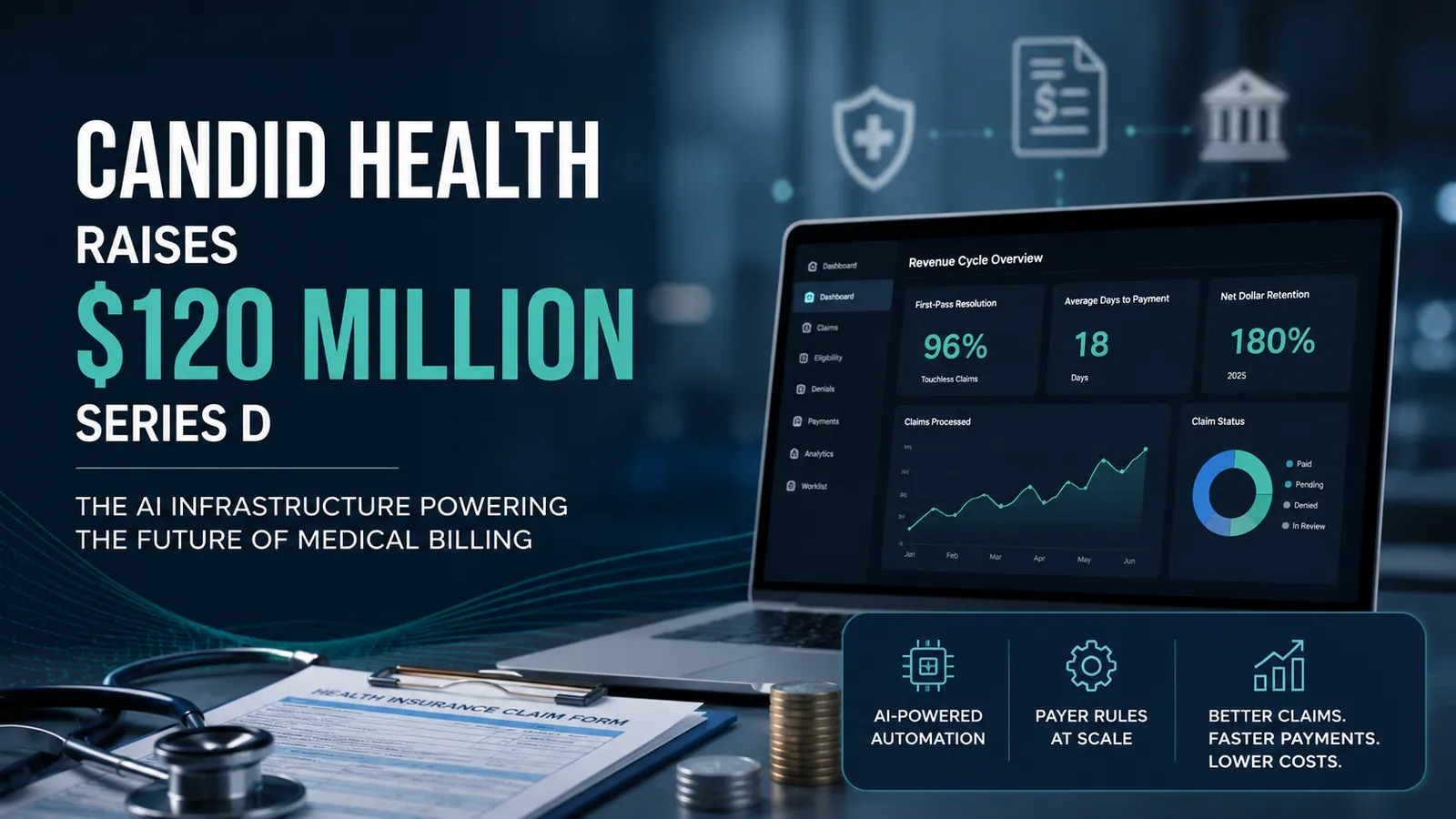

Candid Health raised a $120 million Series D on July 22, 2026, to automate the financial machinery behind American healthcare. Sixth Street Growth led the round, with Oak HC/FT, 8VC, and Y Combinator participating.[1]
The company did not disclose its new valuation. It did say the figure is three times what investors assigned Candid during its February 2025 Series C. Candid also reported that annual contracted run-rate revenue grew 190% year over year and that it now serves more than 200 healthcare organizations.[1]
Those are company-reported figures, not independently audited results. Even with that caveat, the round says something important about where healthcare artificial intelligence is going. The next contest is not only about putting a chatbot beside an old billing system. Investors are funding companies that want to replace the underlying system, unify the data, encode payer rules, and automate the claim from the first submission through payment.
That makes medical billing an infrastructure war.
What Candid Health Actually Does
Revenue cycle management (RCM) is the process that turns a medical visit into money received by a healthcare provider. It includes checking insurance eligibility, translating care into billing codes, preparing and submitting a claim, correcting errors, working denials, posting payments, and collecting the patient's share.
Candid is building a central platform for that work. It brings clinical, billing, and provider data into one model. A rules engine checks the claim against payer requirements, while software agents handle structured tasks that billing teams previously completed by hand. The system also records the remaining manual work so the provider can see which steps might be automated next.[1]
The important word is context. An AI model cannot reliably work a claim if it sees only a rejected form. It needs to know the provider roster, the patient's coverage, the payer's rules, the fee schedule, the service delivered, prior claim activity, and what happened after similar submissions.
Sixth Street says Candid has reverse-engineered billing requirements across more than 1,000 U.S. payers. It reports that Candid customers achieve 95% to 99% first-pass "touchless" claim resolution, average payment in fewer than 20 days, and about 40% less manual work in the cost of collecting revenue.[2] Those performance figures come from Candid as of April 2026. They are useful indicators, but readers should treat them as vendor-reported until independently validated.
The idea is simple even if the implementation is not: submit the claim correctly the first time instead of building a larger team to repair it later.
Who Built Candid Health
Candid Health was founded in 2019 and joined Y Combinator's Winter 2020 batch.[3] The current round announcement identifies Nick Perry as co-founder and chief executive officer and Doug Proctor as co-founder and chief operating officer.[1] Candid's other company materials have also named Adam Reis as a co-founder, although the Series D announcement does not assign him a current operating role.[4]
Perry and Proctor met at Palantir. Perry led commercial healthcare work there, while Proctor built and led product and business teams serving the U.S. Army and Special Forces.[2] They approached medical billing as a difficult data-infrastructure problem: gather fragmented information, map the rules that govern it, and build software that can make repeatable decisions.
Candid's funding accelerated quickly. In September 2024, it raised a $29 million Series B led by 8VC, bringing total capital at the time to $47 million.[5] Six months later, Oak HC/FT led a $52.5 million Series C, bringing the reported total to $99.5 million.[6] Adding the new round brings disclosed funding to approximately $219.5 million.
The progression matters. Candid went from a $29 million Series B to a $120 million Series D in less than two years. The capital is following a company that has moved beyond proving that billing automation can work and into a race to become the system providers build their financial operations around.
Why Investors Put $120 Million Into the Billing Layer
Candid and its investors frame RCM as a $280 billion annual industry.[1][2] The precise market estimate matters less than the underlying reality: providers must spend heavily to navigate hundreds of payers, changing rules, documentation requirements, coding, denials, and collections.
That work is also unusually attractive to an AI infrastructure company for four reasons.
1. The workflow is mandatory
A provider can delay adopting a new patient-engagement tool. It cannot ignore getting paid. Billing sits directly in the daily operating path of an insured medical group.
2. The data can improve the system
Every processed claim produces information about what a payer accepted, rejected, or changed. Candid's argument is that this creates a feedback loop. More claims produce more structured knowledge about payer behavior, which can improve future submissions.[2]
3. Switching becomes difficult
Once a platform holds payer rules, provider records, fee schedules, claim histories, and payment workflows, replacing it is not like changing a meeting app. It becomes core infrastructure. That embedded position can produce the retention investors want to see. Candid reported 180% net dollar retention in 2025, meaning its existing customer base substantially increased spending after accounting for losses and contraction.[1]
4. The labor pool is large
Billing departments and outsourced vendors perform an enormous amount of repetitive work. Automating even part of it creates a large economic opportunity. This is the same trend behind Commure's $70 million raise at a $7 billion valuation and the broader wave of AI tools running the back office at independent medical practices.
The winner will need more than a good language model. It will need clean data, reliable integrations, security, payer-specific rules, measurable collection results, and a process for handing unusual cases to people.
What the Round Means for Independent Practices
Candid says it serves enterprise healthcare providers, medical groups, management services organizations, and digital health companies.[1][2] A small independent office should not assume that a $120 million enterprise platform is available, affordable, or appropriate for it today.
The direction still matters. Administrative cost is one of the forces pushing independent physicians toward hospital employment or larger groups. If billing platforms reduce manual work and help practices collect what they are owed, remaining independent becomes more operationally viable.
For an insured practice, better RCM can mean fewer claims sitting in queues, less time spent correcting preventable errors, and faster cash flow. A physician-owned group still needs to compare the vendor's fees with actual labor savings, verify integrations with its electronic health record, examine denial performance by payer, and understand who is responsible when automation makes a mistake.
Concierge and direct primary care practices sit in a different place on this spectrum. A pure direct primary care (DPC) practice charges patients a membership and generally does not submit insurance claims for primary care. It removes much of the revenue cycle rather than automating it. Our guide to what direct primary care costs to operate explains why that simpler payment model can support lower overhead.
Many concierge practices use a hybrid model: the patient pays a membership fee for enhanced access and the practice continues billing insurance for covered medical services. Those practices still carry the claims, coding, denial, and collection work Candid targets.
What Patients Should Expect, and What They Should Not
Patients rarely see the RCM platform itself. They see its consequences.
A well-run system could reduce avoidable denials, shorten the time between a visit and a bill, and give staff a clearer view of what the insurer paid and what the patient owes. Fewer manual handoffs can also reduce the number of times a patient has to call the practice about the same claim.
Automation does not guarantee a fair or affordable bill. A claim can be processed quickly and still leave a patient with a high deductible, coinsurance, a coverage exclusion, or a disputed service. Candid's customer is the provider, and its stated goals include lowering the provider's cost to collect and increasing net collection rates.[1] Those goals may overlap with a cleaner patient experience, but they are not the same as lowering the patient's medical costs.
The distinction is worth keeping. Faster billing is operational improvement. It is not healthcare-financing reform.
The Metrics to Watch Next
The $120 million round gives Candid capital to hire, build more AI capabilities, and expand across large provider organizations. It also raises the standard of proof.
Four developments will show whether Candid is becoming durable healthcare infrastructure:
Independent performance data. Can customers validate touchless-claim rates, payment speed, and collection gains outside vendor case studies?
Results across specialties and payers. Billing rules differ sharply by medical service and insurance plan. Broad performance matters more than one strong customer example.
Movement into smaller practices. Enterprise success does not automatically produce a product an independent office can afford or implement.
Patient billing quality. Faster provider payment should be measured alongside billing accuracy, dispute resolution, and the patient's experience.
Candid has raised enough money to compete for the center of the healthcare payment stack. The question now is whether its automation reduces the waste around medical care or simply makes a complicated system move faster.
Frequently Asked Questions
How much did Candid Health raise?
Candid Health raised a $120 million Series D announced on July 22, 2026. Sixth Street Growth led the round, with Oak HC/FT, 8VC, and Y Combinator participating.[1]
What is Candid Health's valuation?
Candid did not disclose a dollar valuation. The company said the Series D valuation was three times its valuation at the February 2025 Series C.[1]
How much funding has Candid Health raised in total?
Candid reported $99.5 million in total funding after its Series C.[6] Adding the $120 million Series D brings disclosed capital raised to approximately $219.5 million.
What does Candid Health do?
Candid builds an AI-first revenue cycle management platform. It combines clinical, billing, provider, and payer information, checks claims against payer rules, automates structured billing work, and tracks the tasks that still require people.[1][2]
Who founded Candid Health?
Candid Health was founded in 2019. Current round materials identify Nick Perry, chief executive officer, and Doug Proctor, chief operating officer, as co-founders. Other Candid company materials have also named Adam Reis as a co-founder.[1][3][4]
Does Candid Health serve concierge or direct primary care practices?
Candid describes its customers as enterprise providers, medical groups, management services organizations, and digital health companies.[1][2] A concierge practice that bills insurance performs RCM work, while a pure DPC practice generally removes insurance claims from primary care. The Series D announcement does not identify a dedicated small-practice or DPC product.
Find an Independent Doctor
Billing software may help a practice spend less time chasing claims. A simpler payment model can remove some claims entirely. NextMD helps patients compare both concierge and direct primary care practices. Search by city and find a physician-led practice near you.
Sources
Candid Health and Sixth Street Growth. (2026). Candid Health Raises $120M Led by Sixth Street Growth to Fuel Autonomous Revenue Cycle Management in Healthcare. Read the Series D announcement
Katz, A., & Gavai, N. (2026). Why We Invested in Candid Health: Powering Modern Infrastructure for a More Efficient Healthcare System. Sixth Street Growth. Read the investment thesis
Y Combinator. (2026). Candid Health: The Revenue Cycle Automation Platform. View the Y Combinator company profile
Candid Health. (2026). Candid Health Named to the 2026 New York Digital Health 100. Read the company announcement
Candid Health. (2024). Candid Health Announces $29 Million Series B Led by 8VC to Transform Revenue Cycle Automation. Read the Series B announcement
Candid Health. (2025). Candid Health Raises $52.5 Million Series C to Enhance GenAI Features, Expand Revenue Cycle Automation Platform to More Providers. Read the Series C announcement