
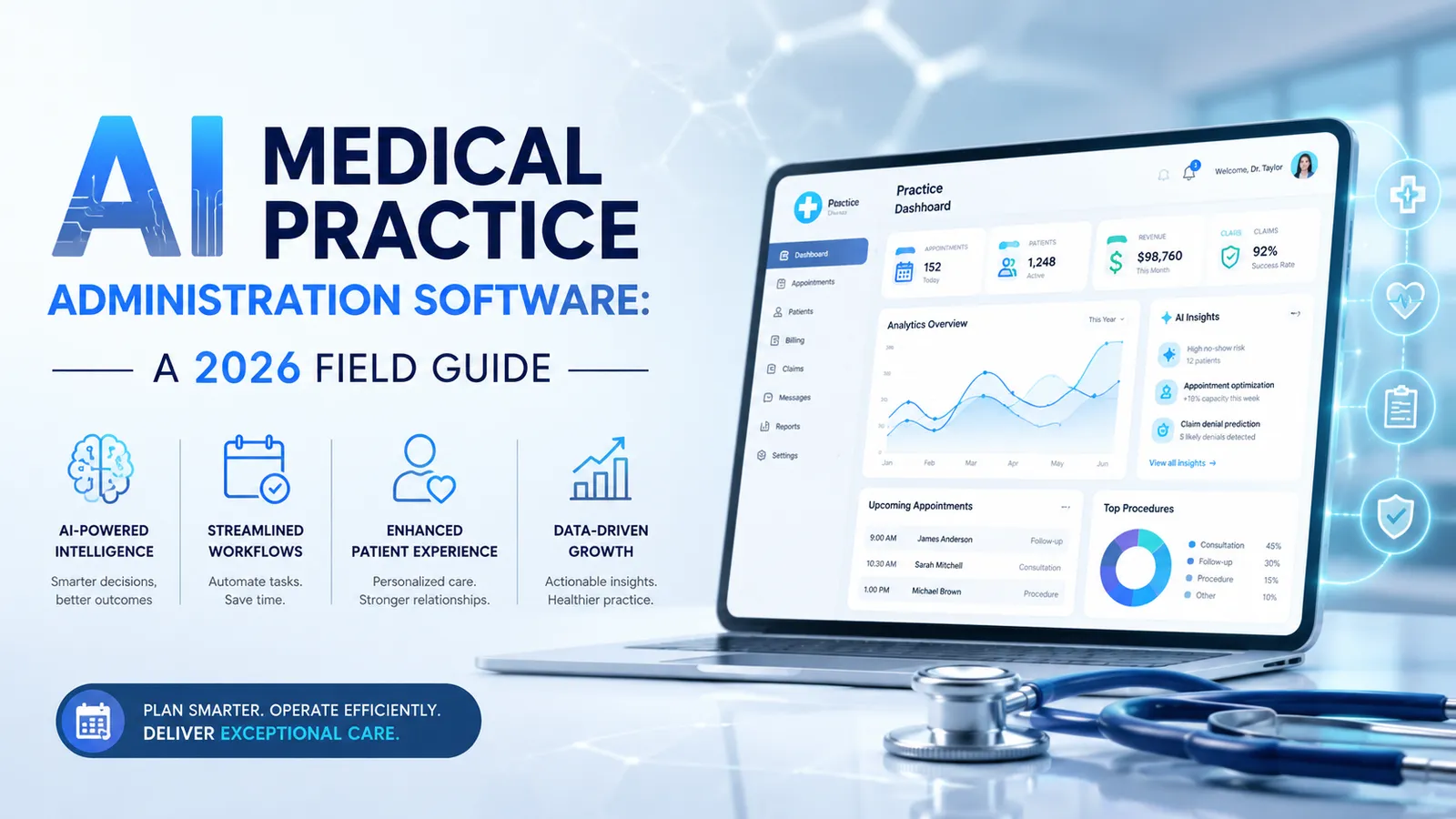

Recently Prosper AI just raised $30 million to build software for doctor offices to help eliminate front end office work. From answering phones with voice agents to scheduling appointments. Prosper is one of the many AI driven tech companies helping doctor's focus more on their patients and less on administrative work.
Prosper is one of many hot startups helping handle the administrative burden of small practice medicine.
The Cost of Administrative Work
In the United States health care administrative spending runs about $1 trillion a year, the cost of processing more than 9 billion insurance claims [3][10]. That sits on top of $5.3 trillion in total health spending in 2024, which was 18% of the entire US economy [4]. Most of that paperwork is still done by hand. The market for software that actually automates it, a category called revenue cycle management (RCM), is only around $73 billion [5]. The distance between what gets spent on administration and what gets automated is the opening every company in this guide is chasing.
For a small practice, those macro numbers show up as hours and salaries. Front-desk and billing staff are expensive and hard to keep, and the administrative load is a common reason a doctor sells the practice to a hospital system or never opens one. When those costs come down, the independent, physician-led practice gets easier to sustain. That is the throughline connecting the funding events below.
Four AI Tools Doctors are Using For Administrative Work in 2026
Company | What it automates | Built for | Latest funding |
|---|---|---|---|
Prosper AI | The voice front office: scheduling, insurance eligibility, prior authorization, billing calls | Large specialty groups | $30M Series A (a16z), June 2026 [1][2] |
Lassie | Back-office billing: pulls reimbursements, reconciles payments, flags denied claims | Small practices, dental first | $35M Series A (a16z), June 2026 [6] |
Commure | End-to-end medical billing: reads visit notes, codes the claim, files it, fights denials | Hospitals and doctors' offices | $70M at a $7B valuation, 2026 [7] |
Elation Health (with Aster) | The records system, plus a front-office voice agent and AI chart summaries | Independent primary care | Acquired Aster, June 2026 [8] |
Prosper AI: the phones and the prior authorizations
Prosper AI runs the voice-heavy front office. Its agents place and take the calls a receptionist would, scheduling visits, verifying insurance eligibility and benefits, submitting prior authorizations, and chasing claim status, then hand off to a person only when the agent cannot finish the task [1][2]. It is built for large specialty groups with many locations and hundreds of appointment types, and it connects to more than 80 electronic health record (EHR) and billing systems [1][2]. Prosper says its revenue grew fivefold since its seed round and that it now reaches more than 150,000 providers, figures the company reports itself [2].
Lassie: the billing and the reconciliation
Lassie runs the back-office money work, starting with dental practices. Its AI agent logs into insurance portals, pulls reimbursements, reconciles them against the practice's records, posts the result, and flags the claims that need a human [6]. Lassie raised a $35 million Series A led by a16z on June 3, 2026, and says it now operates in more than 700 practices across 49 states, returning more than 250,000 hours of labor a year to its customers [6].
Commure: the billing, end to end
Commure automates the insurance billing for a visit from start to finish. After a patient is seen, its software reads the visit notes, assigns the billing codes, files the claim, fights the claim when an insurer denies it, and records the payment, doing more than 85% of that work without a person [7]. It is built for hospitals and larger practices rather than solo offices. Commure raised $70 million at a $7 billion valuation in 2026 [7].
Elation Health: the records system underneath
Elation Health makes the cloud EHR that many independent primary-care, concierge, and direct primary care practices already run on. In 2026 it has been adding AI to that base. On June 2, 2026, it acquired Aster, an AI-native women's-health EHR company whose product includes a front-office voice agent called Atlas [8]. Earlier in the year Elation embedded Anthropic's Claude into its EHR to summarize patient charts, a feature it calls Clinical Insights [9]. The system a practice already uses for records is starting to handle the front desk and the chart review too.
Who Built Prosper AI
Prosper AI was founded in 2023 and is based in New York [2]. Its two co-founders Xavier de Gracia and Josep Mingot[1]. Xavier grew up inside his family's medical practice and later ran large call-center operations at Handy, the home-services company acquired by Angi [1][2]. Josep is a former researcher at the Massachusetts Institute of Technology's computer science lab and led product at CoverWallet, an insurance startup acquired by Aon [1][2].
The company raised a $5 million seed in September 2025 led by Emergence Capital, then the $30 million Series A in June 2026 led by a16z, with Base10, Emergence Capital, Y Combinator, and Company Ventures also investing [2]. Jay Rughani of a16z joined the board [1].
Why This Matters for Concierge and Direct Primary Care
The reason this matters for the practices NextMD lists is the cost of staying independent. Administrative overhead is a major cost behind doctors joining hospital systems, and these tools take direct aim at it. Direct primary care keeps prices low precisely because it removes insurance billing from the practice entirely.
Across the 1,800+ direct primary care practices NextMD verifies nationwide, the ones that list a price charge a median of $99 a month, and 84% of them fall between $50 and $150 (NextMD directory data).
The tools in this guide come at the same overhead from the other direction, automating the billing and the front desk rather than removing them. Either path makes a small, doctor-owned practice cheaper to run.
This is the same shift we have tracked across health technology. Commure raised $70 million at a $7 billion valuation to automate medical billing with AI, and the companies in this guide aim at the same load from different angles. An independent concierge practice like Priority Physicians in Indianapolis carries the same back-office burden as any clinic, and the case for a doctor-owned practice, whether in Texas or anywhere else, gets stronger as that burden shrinks.
The Limits Worth Naming
A few caveats keep this honest. The performance numbers here, Prosper's fivefold revenue growth and Lassie's 700 practices, come from the companies and their investors, not independent audits [2][6]. AI agents handle structured, repetitive paperwork well, but a practice still has to trust software to log into payer portals and move money, and connecting any of these tools to an existing EHR is real work that can go wrong. None of these tools touch the clinical visit itself. They change the overhead around it, the hours a doctor or a staffer spends on the phone and in the billing queue instead of with patients.
FAQ
What does Prosper AI do?
Prosper AI runs the voice-based front office at medical practices. Its AI agents schedule appointments, verify insurance eligibility, submit prior authorizations, and follow up on billing, escalating to staff only when a task needs a human [1][2].
How much did Prosper AI raise, and who led the round?
Prosper AI raised a $30 million Series A led by Andreessen Horowitz in June, 2026, with Base10, Emergence Capital, Y Combinator, and Company Ventures also participating [1][2].
Will AI replace front-desk staff at doctors' offices?
These tools automate specific repetitive tasks like scheduling calls and claims follow-up. They reduce the administrative hours a practice carries, and most are built to hand complex cases to a person rather than remove staff entirely [1][2][6].
Why does practice-automation software matter for concierge and DPC?
Administrative overhead is the main cost of running an independent practice. Software that automates billing, scheduling, and paperwork makes small, physician-led concierge and direct primary care practices cheaper to operate and easier to keep open.
Get Found by the Patients Looking for You
Lower overhead is only half of staying independent. The other half is being found by the patients searching for a doctor who has time for them. NextMD is the free directory of concierge and direct primary care physicians across the country. If you run an independent practice, list it on NextMD so patients in your area can find you. If you are looking for that kind of doctor, you can search by city and compare practices.
Sources
Rughani, J., & Rhee, J. (2026). Investing in Prosper AI. Andreessen Horowitz. Read on a16z
MobiHealthNews. (2026). Prosper AI secures $30M to scale healthcare voice AI agents. Read on MobiHealthNews
Sahni, N. R., Gupta, P., Peterson, M., & Cutler, D. M. (2023). Active steps to reduce administrative spending associated with financial transactions in US health care. Health Affairs Scholar, 1(5), qxad053. Read on Health Affairs Scholar
Centers for Medicare & Medicaid Services. (2025). National Health Expenditure Fact Sheet. Read on CMS.gov
Precedence Research. (2026). U.S. Revenue Cycle Management Market Size, Share, and Trends 2026 to 2034. Read on Precedence Research
Rampell, A., & Moore, O. (2026). Investing in Lassie. Andreessen Horowitz. Read on a16z
Fierce Healthcare. (2026). AI company Commure banks $70M funding round, hits $7B valuation. Read on Fierce Healthcare
Elation Health. (2026). Elation Health Acquires Aster to Expand Agentic Capabilities in Primary Care. BusinessWire. Read on BusinessWire
Fierce Healthcare. (2026). JPM26: Elation Health embeds Anthropic's Claude in EHR to power chart summaries. Read on Fierce Healthcare
Sahni NR, et al. (2023)National institute of health https://pmc.ncbi.nlm.nih.gov/articles/PMC10986268/?utm_source=chatgpt.com