
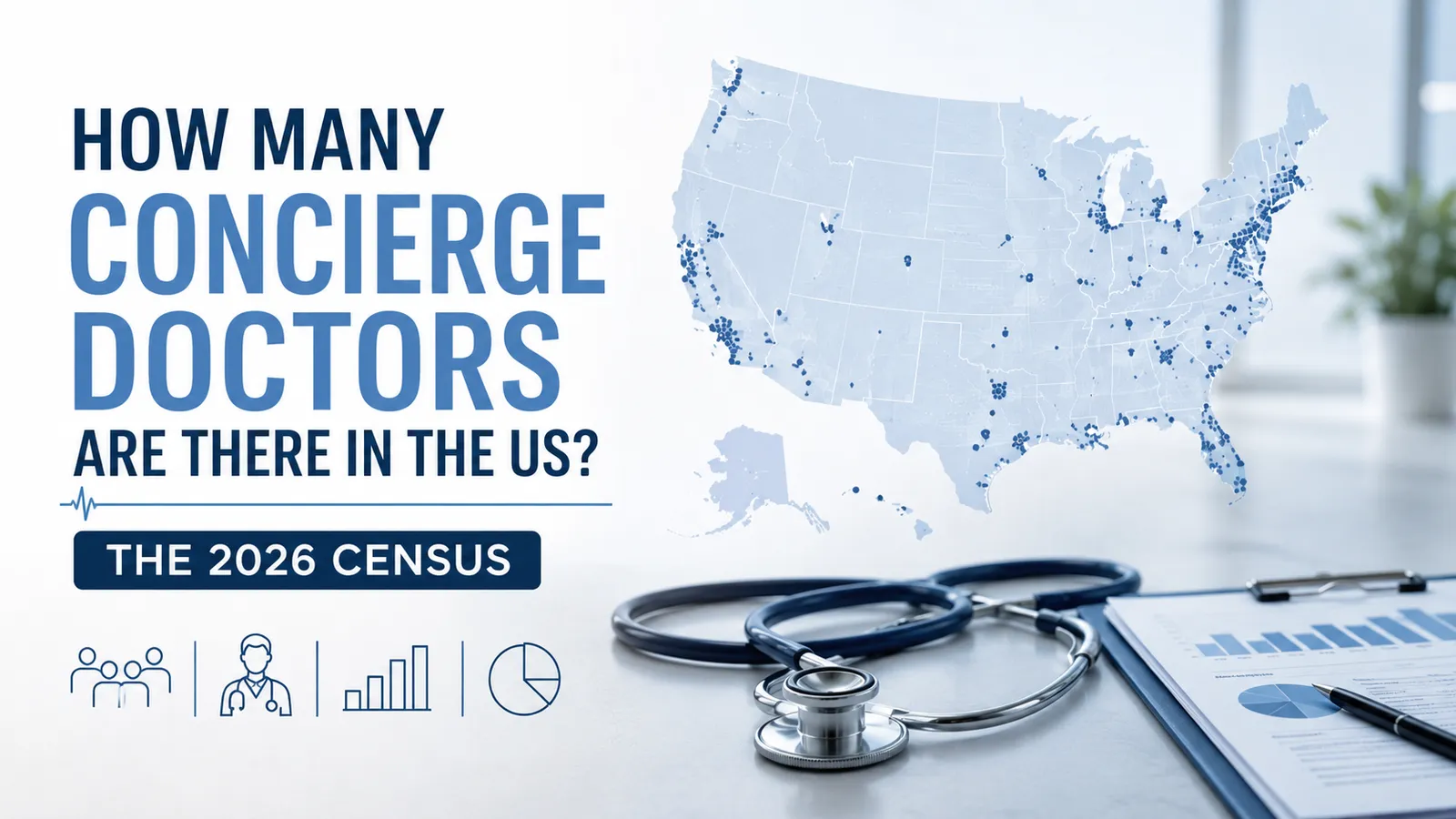

The United States has roughly 9,900 to 10,600 physicians practicing concierge medicine or direct primary care (DPC) in 2026. NextMD's best single estimate is about 10,300. That is under 1 percent of the 1,105,148 professionally active physicians in the country[1]. They work across an estimated 7,300 to 7,700 practices, of which NextMD has verified 6,185 by name.
No government agency counts concierge doctors. There is no license category, no registry, and no annual survey. Any honest answer has to show its math, so this article does. We start with the physicians NextMD has verified one by one, cross-check that census against every other count that exists, and then adjust upward for the practices every directory misses. We put that missing share at 15 to 20 percent, and we explain why.
Question | 2026 estimate |
|---|---|
Physicians practicing concierge, DPC, or hybrid membership medicine | 9,900 to 10,600 (best estimate: ~10,300) |
Physician-led membership practices | 7,300 to 7,700 (best estimate: ~7,500) |
Physicians verified by name in the NextMD directory | 8,744 |
Practices verified in the NextMD directory | 6,185 |
Share of all active US physicians | Under 1 percent |
One definitional note before the math. This census counts physician-led membership medicine as a whole: concierge, DPC, and hybrid models. If you mean the concierge model strictly, about 5,250 of the verified physicians practice under a concierge or hybrid arrangement, which scales to roughly 6,200 to 6,600 concierge doctors nationally.
Why the Published Estimates Disagree
Search this question and you will find answers ranging from under 3,000 to 18,000. The spread comes from counting different things:
Concierge Medicine Today, the trade publication that has covered the industry since 2007, estimates 8,000 to 12,000 concierge and membership-based practices. At its assumption of 1.2 to 1.5 clinicians per practice, that translates to roughly 9,600 to 18,000 clinicians[2]. The count includes practices led by nurse practitioners and physician assistants.
Market research firms count dollars, not doctors. Grand View Research sizes the 2024 US concierge market at $7.35 billion, growing 10.33 percent a year[3]. Useful for investors, no help on headcount.
Registries are self-reported. The DPC Frontier mapper lists 3,087 DPC practices, but practices add themselves, and the list covers DPC only[4].
Platform counts cover one vendor. Hint Health reports 2,700+ DPC clinicians on its platform, serving about 1.4 million members[5]. Real data, but limited to one company's customers, and it includes non-physician clinicians.
Practices get conflated with physicians. Physicians get conflated with clinicians. And self-reported lists undercount by design. A defensible national number has to be built practice by practice.
Start With the Doctors You Can Count by Name
NextMD maintains a directory of 6,185 concierge, DPC, and hybrid practices with 8,744 individual physicians, spanning 1,954 cities in all 50 states plus Washington DC and Puerto Rico (NextMD directory data, June 2026). Every practice is verified to have at least one MD (Doctor of Medicine) or DO (Doctor of Osteopathic Medicine) on staff. The bench breaks down to 7,084 MDs and 1,414 DOs, with 246 physicians whose degree listing is still being verified.
Three facts about that verified population shape the estimate:
80 percent of practices are solo. One doctor, one panel. The average is about 1.4 physicians per practice, and the largest single practice has 42.
Networks are the minority. MDVIP, the largest network in the category with more than 1,400 affiliated physicians and about 450,000 members[6], accounts for 23 percent of listed practices. SignatureMD adds 3.5 percent. Roughly three-quarters of practices are independent, like Coastal Concierge Physicians in San Diego.
Supply concentrates. Florida leads with 699 practices, followed by California at 651 and Texas at 571. The top five states hold 40 percent of the national supply.
The full breakdown of this dataset, including pricing and physician experience, is in our annual data report on the state of private medicine.
What Every Directory Misses
A name-verified census is a floor, and three kinds of practices sit above it:
Practices that avoid the labels. Some physician practices run on memberships but market themselves as "private medicine," "retained practice," or "executive health." A search for concierge or DPC never surfaces them.
Practices with almost no web presence. A solo internist with a full panel of 300 members has little reason to advertise. Some keep a single-page website or none at all. They join directories last, if ever.
Practices that opened recently. Concierge and DPC practice sites grew more than 80 percent between 2018 and 2023, according to a Health Affairs study of national claims data[7]. The DPC Frontier registry has added roughly 1,000 practices since the end of 2023, about one per day[4]. Openings outpace directory refresh cycles.
Evidence that these practices exist keeps arriving. A single NextMD data refresh in June 2026 added 630 newly verified practices, and large imports still surface practices no directory had. In June alone, 40 new accounts registered on NextMD, nearly all of them physicians listing or claiming their own practices (NextMD directory data). When new sources keep producing verified practices at that rate, the reasonable conclusion is that the census still runs 15 to 20 percent short of complete.
The Math, Step by Step
Assume the 6,185 verified practices represent 80 to 85 percent of the true universe:
Practices: 6,185 divided by 0.85 gives 7,276 on the low end. Divided by 0.80, it gives 7,731 on the high end. Call it 7,300 to 7,700 physician-led practices, with a midpoint near 7,500.
The missing practices skew solo. They are hard to find precisely because they are small and unmarketed, so we assume 1.0 to 1.2 physicians each rather than the directory average of 1.4. The missing 1,100 to 1,550 practices therefore add 1,100 to 1,850 physicians.
Physicians: 8,744 verified plus 1,100 to 1,850 unlisted comes to 9,850 to 10,600. Rounded, that is 9,900 to 10,600, with a midpoint near 10,300.
Three independent cross-checks land the estimate in the same zone:
Concierge Medicine Today's field estimate implies 9,600 to 18,000 clinicians[2]. Our 10,300 sits at the conservative end of that band, which is where a physician-only count should sit.
Adding back the nurse-practitioner-led and physician-assistant-led practices we exclude pushes the total to roughly 8,700 membership practices. (In NextMD's analysis of the DPC Frontier registry, 38 percent of self-reported DPC practices had no MD or DO[4].) That total lands inside Concierge Medicine Today's 8,000 to 12,000 practice range[2].
At 10,300 physicians, concierge and DPC medicine accounts for 0.9 percent of the 1,105,148 active US physicians[1]. That matches the industry's long-standing figure of fewer than 2 percent[2].
The Number Is Growing While You Read This
Every count above is a snapshot of a moving target:
Practice sites grew more than 80 percent from 2018 to 2023, and corporate-affiliated sites grew about fivefold[7].
Hint Health's platform went from 2,400+ DPC clinicians in its 2025 report[8] to 2,700+ in 2026[5], a rise of about 12 percent in one year.
The DPC Frontier registry adds about one new self-reported practice per day[4].
Some practices close or return to insurance-based medicine each year, so net growth runs slower than gross openings. The direction is consistent, though. Every source that tracks this market over time shows the number rising, and by this time next year, 10,300 will read as an undercount.
What This Means for Patients
Under 1 percent of American physicians practice this way, and 40 percent of the supply sits in five states. If you live in Florida, Texas, or California, you likely have dozens of options within driving distance. In parts of the Midwest and the rural South, you may have one or two.
If you are starting from zero, what concierge medicine is and what it costs are the two questions to settle first. From there, the practical question is which of the roughly 10,300 doctors practice near you.
NextMD maintains the physician census behind this article. You can search all 6,185 verified concierge and DPC practices by city, compare pricing, and view doctor credentials at nextmd.ai/search.
Sources
KFF (Kaiser Family Foundation). (2025). Total Professionally Active Physicians. State Health Facts, September 2025 data: 1,105,148 professionally active US physicians. KFF State Health Facts: Total Professionally Active Physicians
Concierge Medicine Today. (2026). Media Desk: Industry Statistics. Field estimate of 8,000 to 12,000 US concierge and membership-based practices, 1.2 to 1.5 physicians per practice (roughly 9,600 to 18,000 clinicians), and the fewer-than-2-percent-of-US-physicians figure. Read the CMT media desk
Grand View Research. (2025). U.S. Concierge Medicine Market Size and Outlook Report. Sizes the 2024 US concierge market at $7.35 billion with a 10.33 percent compound annual growth rate through 2030. Read the Grand View market report
DPC Frontier. (2026). DPC Mapper. Self-reported registry of 3,087 US direct primary care practices, up from roughly 2,060 at the end of 2023. NextMD's import analysis found 62 percent of listed practices have at least one MD or DO. DPC Frontier Mapper
Hint Health. (2026). 2026 Direct Primary Care Trends Report. Reports 2,700+ DPC clinicians and roughly 1.4 million members on the Hint platform. Hint Health 2026 DPC Trends announcement
Cohen, P. and Wehrwein, P. (2026). Conversations with Perry and Friends: Larry Kutscher, MBA, CEO and Board Director, MDVIP. Managed Healthcare Executive. Reports 450,000 members and 1,400 physicians in 46 states. Read the interview
Song, Z., et al. (2024). Growth and Characteristics of Concierge and Direct Primary Care Practices, 2018-2023. Health Affairs. Practice sites grew more than 80 percent over the period, and corporate-affiliated sites grew about fivefold. Reported via Concierge Medicine Today's January 2026 analysis. What the 80% growth in concierge medicine is telling us
Hint Health. (2025). Employer Trends in Direct Primary Care: 2025 Industry Report. Reports 2,400+ DPC clinicians on the Hint platform. Read the Hint 2025 Industry Report