

A Service That Disappeared, Then Came Back
In 1930, roughly 40% of all doctor-patient encounters in the United States happened in the patient's home. By 1980, that figure had collapsed to under 1% [1]. Insurance reimbursement made it uneconomical, and the rise of large primary care panels made it logistically impossible.
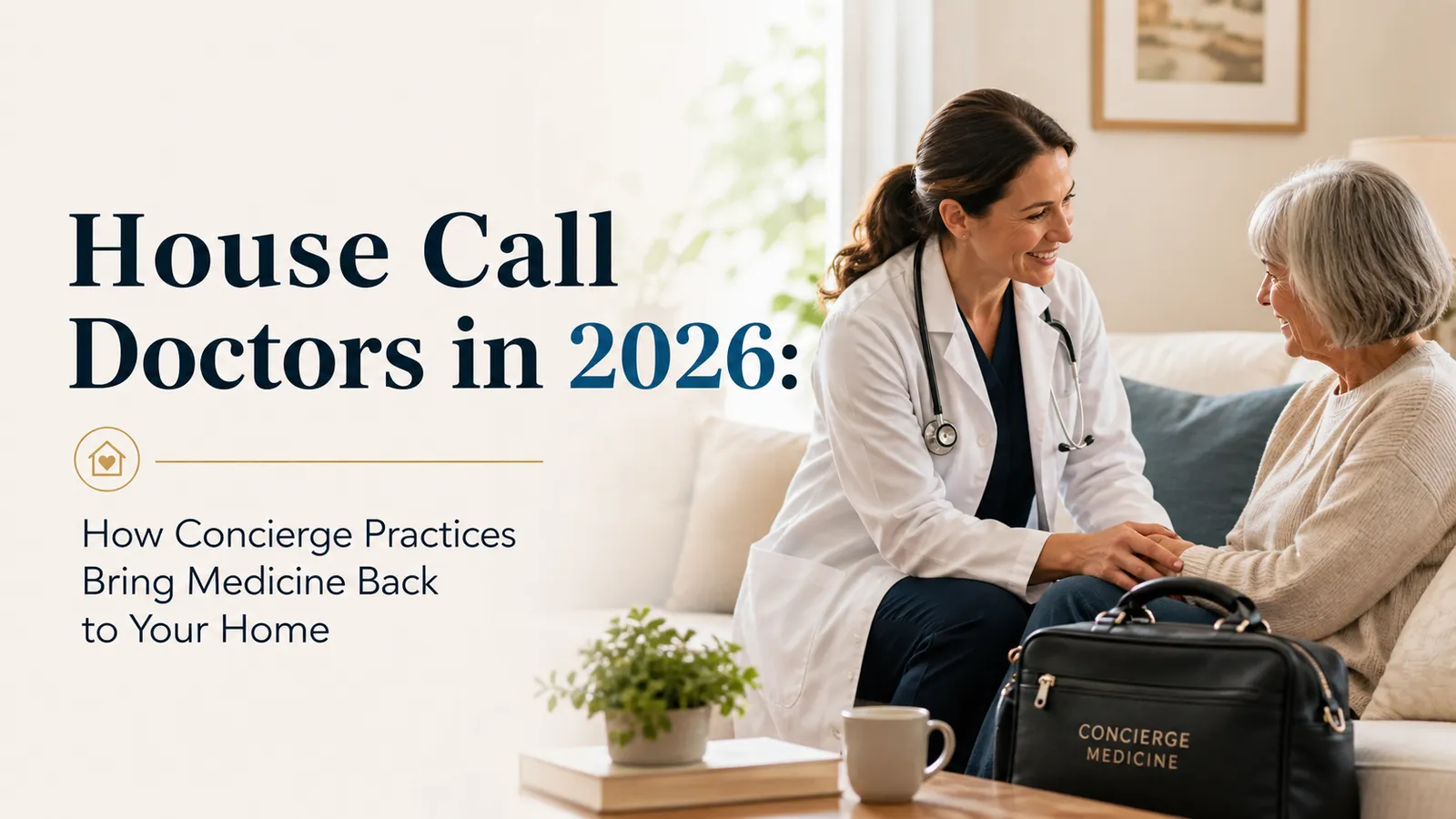
In 2026, the house call is back. Many concierge doctors are willing to make house calls as needed.
What we are seeing via concierge medicine is a higher quality of care that is closely in line with how medicine was practiced 50+ years ago.
What Is a House Call Doctor in 2026?
A house call doctor is a Doctor of Medicine (MD) or Doctor of Osteopathic Medicine (DO) who comes to your home, office, or hotel to provide medical care, instead of requiring you to come to a clinic. In a 2026 concierge practice, a house call covers the same scope as a clinic visit: history, physical exam, point-of-care testing, prescriptions, and care coordination.
The format is enabled by three things. Smaller patient panels give the physician time. Mobile-friendly diagnostics (portable ultrasound, point-of-care blood tests, electrocardiogram, otoscope-on-phone) replicate most of the clinic's tooling in a doctor's bag. Membership pricing removes the per-visit billing problem that killed the format in the first place.
Why House Calls Disappeared, and Why They're Back
The post-1980 collapse had three causes. Reimbursement for a home visit was lower than for an office visit. Medicare's payment formulas treated travel time as unbillable. And as panels grew to 2,000 patients or more, leaving the office for one patient meant 15 to 20 waiting in the clinic [1].
Concierge medicine reverses all three. The doctor is paid by membership, not by the visit. Panels are capped under 300 patients [3]. The Society of Actuaries' 2020 study of direct primary care found ER use fell 40.5% for DPC patients [2], a finding that house call concierge extends by removing the friction of getting to a clinic at all.
What a Concierge House Call Actually Looks Like
A typical concierge house call covers the same clinical territory as a clinic visit. The differences are time, setting, and follow-up.
Visit length: 45 to 90 minutes. Long enough for full history-taking, examination, and a substantive conversation about diagnosis and plan.
Point-of-care testing. Strep, flu, COVID, urinalysis, basic blood draws, electrocardiogram, and pulse oximetry are routinely available.
IV fluids and injections. Hydration, anti-nausea, B12, and similar therapies are common.
Prescriptions and care coordination. Sent electronically; specialist referrals, hospital pre-admission, and post-discharge follow-up are part of the membership.
Family visits. A single house call often covers two or three family members in one stop.
At Work: While it is called a "house call" many busy executives will have their doctor come to their office as well.
Visits are followed by direct text or call access and a 24/7 phone line. See why concierge patients visit the ER 40% less often for the data behind that access.
Who House Call Medicine Serves Best
Five archetypes drive the demand:
Older adults aging in place. The largest group. Mobility issues, multiple chronic conditions, and a strong preference to avoid hospitalization.
Post-surgical patients. Recovery without the friction of a follow-up appointment.
Busy professionals and executives. Time-cost arithmetic favors the doctor traveling, not the patient.
Families with young children. Avoiding waiting rooms during cold and flu season.
Patients with anxiety, autism, or sensory sensitivities. A familiar environment improves the quality of the encounter.
Busy executives. Especially in the premium or ultra premium categories doctors will come to the office of an executive to save them time.
What House Calls Cost in a Concierge Practice
House calls are usually included in the membership fee, not billed per visit. NextMD-listed pricing falls into four bands.
DPC ($50 to $200/mo, $600 to $2,400/yr). HouseCalls, PLC in Charlottesville, Virginia ($50/mo) is the lowest-priced model. Direct primary care (DPC) supports panels up to 800 [3].
Entry Level concierge ($2,500 to $5,000/yr). Concierge MD operates a multi-city house call network at this tier.
Premium concierge ($5,000 to $12,000/yr). Medical House Calls in Franklin, TN ($5,000/yr) and OC Housecalls in Irvine ($3,500/yr hybrid).
Ultra Premium (over $12,000/yr, commonly over $40,000/yr). Mobile Physician Associates in Beverly Hills serves Westside ultra-high-net-worth households.
See the concierge medicine cost guide for the full pricing structure.
Where to Find a House Call Doctor
House call concierge clusters in three regions: Southern California, the New York metro, and Florida. California has the deepest bench, including House Call Doctor Los Angeles, Long Beach House Calls Medical Group, House Calls Doctor in Newport Beach, and Mobile Physician Associates in Beverly Hills. See the full LA metro 2026 market report for context.
The New York metro is anchored by Hudson Valley House Call ($150/mo), KidsHousecalls, and NY Concierge MD. See the NYC metro 2026 market report. Florida adds Prestige House Call Doctors in Miami, House Concierge MD in Orlando, and Wave Concierge MD in Boynton Beach. Outside those three regions: Alpine Mobile Physicians (Edwards, CO), Dahlia Physician Housecalls (Houston), and Concierge MD Detroit.
How to Choose a House Call Doctor
Many concierge physicians may offer house calls even if they don't show it on their website, be sure to ask if they do, and how it works.
Confirm the physician is a board-certified MD or DO.
Ask about service radius. Most practices cap at 15 to 25 miles from a base location.
Ask whether after-hours and weekend visits are included or charged separately.
Confirm the panel cap. House call concierge only works at scale when panels stay under 300.
Match hospital affiliation to specialist needs.
For older adults, prioritize practices with explicit geriatric experience.
See how to choose the right concierge or DPC doctor for a cross-market framework.
Sources
Meyer GS, Gibbons RV. (1997). House calls to the elderly: a vanishing practice among physicians. New England Journal of Medicine. Search PubMed for "Meyer Gibbons house calls 1997" (verify exact URL before publishing).
Busch F, Grzeskowiak D, Huth E. (2020). Direct Primary Care: Evaluating a New Model of Delivery and Financing. Society of Actuaries Research Report, with Milliman. Read the SOA report (verify exact URL before publishing).
Bobrowsky J. (2026). Pricing tiers and model comparison. NextMD internal directory data, derived from practices-master.csv (4,649 listed practices, 2026-04-19 snapshot). Panel size standards: concierge under 300, DPC up to 800, traditional 2,000 to 2,500 [traditional source: AAFP and AMA primary-care benchmarks].