
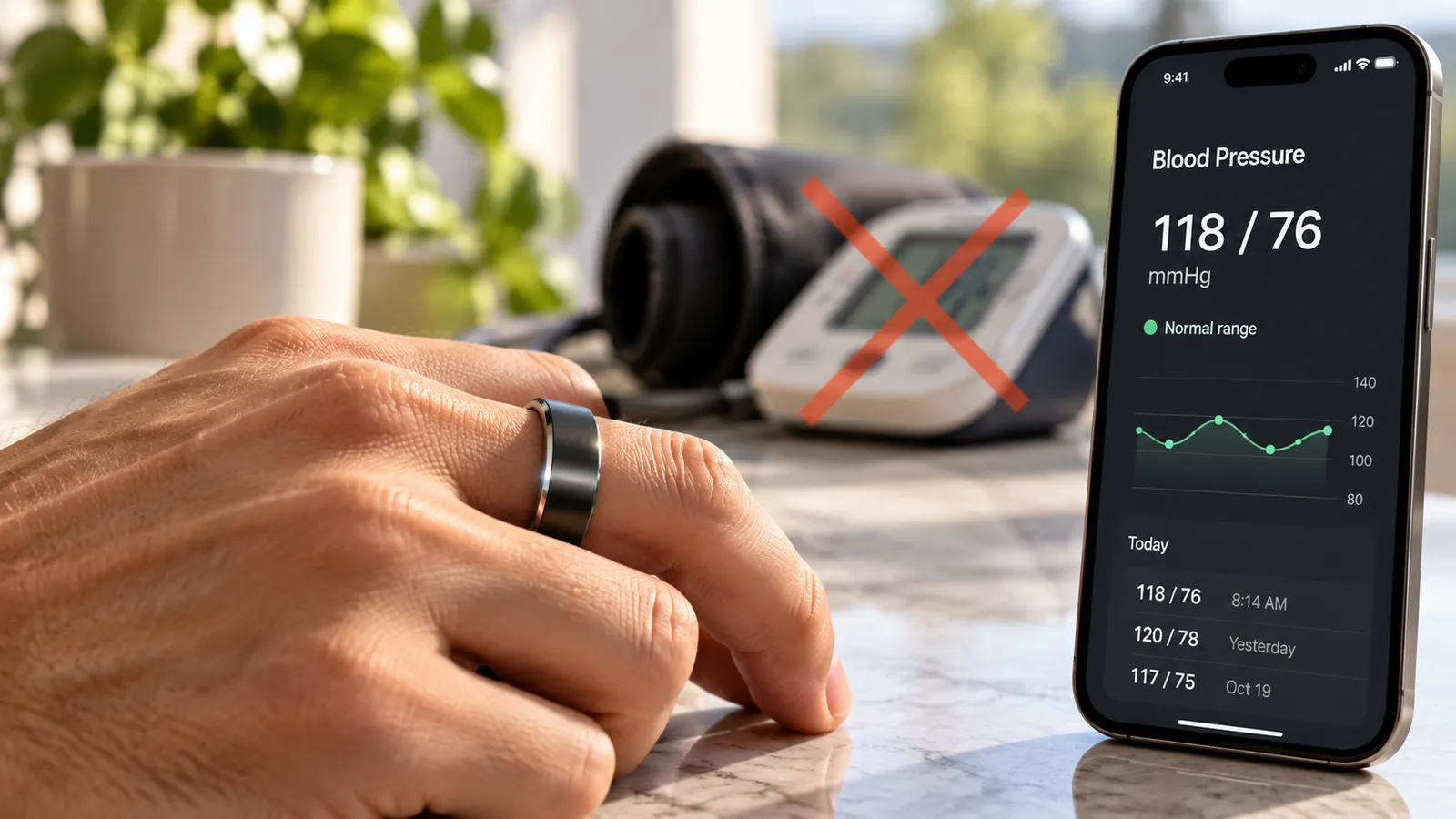

Happy Health now has Food and Drug Administration (FDA) clearance for blood-pressure software that works with its Happy Ring.[2] The FDA’s decision on submission K254000 was dated September 3, 2026.
A ring that measures blood pressure sounds useful until it shows 145/92 and leaves you deciding whom to call. That reading falls in the stage 2 hypertension range, but a diagnosis takes clinical confirmation. The device, how the measurement was taken, and whether you have symptoms all matter.[1]
For patients, the questions are practical: Does the cleared use cover you? Should you keep your arm cuff? And when does a high number need an appointment, an immediate call, or emergency care?
What Happy Health can measure
The software derives systolic and diastolic blood pressure from Happy Ring signals without cuff calibration. Cleared use: spot checks in adults ages 22–50, at home or in clinics. It does not diagnose.[4]
MedCity's coverage describes continuous monitoring, including overnight.[3] The labeling excludes measurement during motion or low blood flow, pregnancy, arrhythmias such as atrial fibrillation, severe vascular disease or radial-artery abnormalities such as Raynaud's syndrome, and use under vasoactive drugs.[4]
Ask your physician whether those restrictions apply to your conditions or medicines before relying on the feature. For someone who is 65 and managing hypertension, the age limit matters.
“No calibration” means you do not have to initialize the device against a cuff reading. Your physician may still want cuff measurements to evaluate an unexpected result or guide treatment.[3][5]
Who built Happy Health
Happy Health was founded in late 2019.[6] Its co-founders include physician Dustin Freckleton, Tinder founder Sean Rad, Sue Smalley, Paul Berns, and Robert Nelsen. Freckleton remains CEO; the company's 2022 launch materials described Rad as executive chairman. Those materials introduced a ring focused on stress, mood, and sleep, and announced $60 million in funding led by ARCH Venture Partners.[7][4]
By October 2026, MedCity described blood-pressure measurement as an addition to a ring primarily used for sleep assessment. The company's direction has expanded from consumer tracking toward measurements patients and physicians can use in care.[3]
What FDA clearance tells you
For K254000, the FDA determined that the device was substantially equivalent to legally marketed devices for its stated use. That permits marketing within the clearance's scope.[2]
Validation included 85 people and 850 arterial-line comparisons. Average errors were 0.81 mmHg systolic and 0.12 mmHg diastolic, with standard deviations of 6.09 and 3.16 mmHg, respectively.[4]
Those averages do not promise every reading is within 1 mmHg. These are measurement results, rather than evidence of stroke prevention.
Our explainer on what FDA cleared actually means covers the distinction between clearance, approval, and registration. For a wearable, check the exact feature and intended user, along with the product name.
How Oura's new metrics differ
Oura introduced Cardio Effort and automatic VO2 Max on October 20.[8][9]
Cardio Effort combines workout intensity and duration to show cardiovascular demand relative to your own baseline. Automatic VO2 Max estimates aerobic fitness from qualifying workouts; the experimental Oura Labs feature produces an initial estimate after five qualifying GPS-enabled activities.[10]
These answer different questions from blood pressure. A workout-effort score describes the demand of exercise. VO2 max describes oxygen-use capacity. Neither supplies a systolic/diastolic blood-pressure reading, and neither inherits Happy Health's clearance.[10][4]
A reassuring fitness score therefore cannot establish that your blood pressure is normal. Keep the actual measurement and the feature that produced it attached to any report you send your doctor.
What to do with a high reading
The following guide uses American Heart Association (AHA) adult categories and emergency advice. Either number can place you in a higher category. The emergency guidance below is for adults who are not pregnant; pregnancy requires a separate plan.[1][11]
Reading or situation | What to do |
|---|---|
Repeated readings of 130–139 systolic or 80–89 diastolic | These are stage 1 values. Arrange a physician discussion and share a properly measured log. Treatment depends on your average and health risks.[1] |
Repeated readings of 140 or higher systolic or 90 or higher diastolic, below the severe range | These are stage 2 values. Contact your clinician for evaluation and a treatment plan. The number alone does not establish an emergency.[1] |
Systolic over 180 or diastolic over 120, without new concerning symptoms | Wait at least one minute and repeat. If still this high, contact your clinician immediately. This needs prompt assessment even if you feel well.[11] |
Systolic over 180 or diastolic over 120, with chest pain, shortness of breath, back pain, numbness, weakness, vision changes, or trouble speaking | Call 911 immediately. Do not wait for the number to fall or for a portal reply.[11] |
For example, repeated 145/92 readings while you feel well belong in a timely conversation with your physician. A reading of 185/95 with chest pain needs emergency care; the bottom number does not have to exceed 120.[1][11]
Possible heart-attack or stroke symptoms warrant calling 911 even if the ring displays a normal number. Do not delay emergency care to find a cuff or troubleshoot an app.[12]
Keep a validated upper-arm cuff available
The AHA recommends a validated automatic upper-arm monitor for home use. A ring's lack of calibration requirements does not change that general recommendation.[5]
For a nonemergency check with your cuff:
Avoid smoking, caffeine, and exercise for 30 minutes beforehand. Empty your bladder.
Rest quietly for at least five minutes. Sit with your back supported and feet flat, and support your bare arm at heart level.
Use the correct cuff size. Take two readings one minute apart and record both.[5]
Bring your monitor to an appointment so the care team can check your technique and compare it with office equipment. Follow your clinician's schedule for monitoring. Do not stop medication or change the dose because of a wearable reading.[5]
Turn the number into a care plan
Before sending a month of screenshots, agree on what your doctor needs. A useful message might be: “My ring showed 145/92 this morning. After resting, my arm cuff showed 142/90 and 140/88. I have no symptoms. Should I keep a log, and when should we review it?”
Include the device and feature name, dates, symptoms, medication changes, and whether the values came from the ring or cuff. Ask how to submit the report, who reviews it, and how quickly to expect a response. Our guide to getting wearable data into your medical care explains how to prepare a focused report.
If you are comparing practices, ask these questions before joining. Our guide to concierge and direct primary care for chronic conditions can help frame that conversation. Establish who handles routine trends, who handles urgent readings, and when to call emergency services.
FAQ
Does Oura's new update measure blood pressure?
The October 20 update adds workout-effort and aerobic-fitness metrics. Those features do not report systolic and diastolic blood pressure.[10]
Can I stop using my cuff?
Agree on that with your physician. The AHA continues to recommend validated upper-arm monitors for home monitoring.[5]
Find a physician who will review the readings
Ask how a practice turns home measurements into follow-up and treatment. You can search NextMD for concierge and direct primary care physicians, compare practices, and ask about their monitoring process before joining.
Sources
American Heart Association. (2025). Top Things to Know: 2025 High Blood Pressure Guideline. Read the guideline summary
U.S. Food and Drug Administration. (2026). 510(k) Premarket Notification: Happy Health Blood Pressure Monitor, K254000. Read the FDA clearance record
Congdon, J. (2026, October 13). Happy Health's Cuffless BP Device Wins FDA Clearance. MedCity News. Read MedCity's reporting
Happy Health / U.S. Food and Drug Administration. (2026). K254000: Clearance Letter and 510(k) Summary. Summary pp. 2, 5, 9–10; PDF pp. 6, 9, 13–14. Read the intended use and validation results
American Heart Association. (2025). Home Blood Pressure Monitoring. Read home-monitoring and measurement instructions
Heater, B. (2022, August 24). Tinder Founder's Latest Play Is a Ring for Quantifying Mental Health. TechCrunch. Read the original company profile
Happy Health. (2022, August 24). The First Real Mood Ring: Happy Health Launches the First Wearable Designed for Your Mind. PR Newswire. Read the launch announcement and founder biographies
Malik, A. (2026, October 20). Oura Adds New Fitness Metrics to Show How Workouts Impact Your Body. TechCrunch. Read the Oura update coverage
Liszewski, A. (2026, October 20). Oura Adds Two New Cardiovascular Health Tracking Features to Its Smart Rings. The Verge. Read The Verge's feature overview
Oura Team. (2026, October 20). Cardio Effort and Automatic VO2 Max: Providing More Context for All Your Oura Activities. The Pulse. Read Oura's feature descriptions
American Heart Association. (2025). When to Call 911 About High Blood Pressure. Read the severe-hypertension and emergency guidance
American Heart Association. (n.d.). Heart Attack, Stroke and Cardiac Arrest Symptoms. Read symptoms that require calling 911