

How Many Patients Does a Concierge Doctor See? Panel Sizes, and What They Mean for Getting In
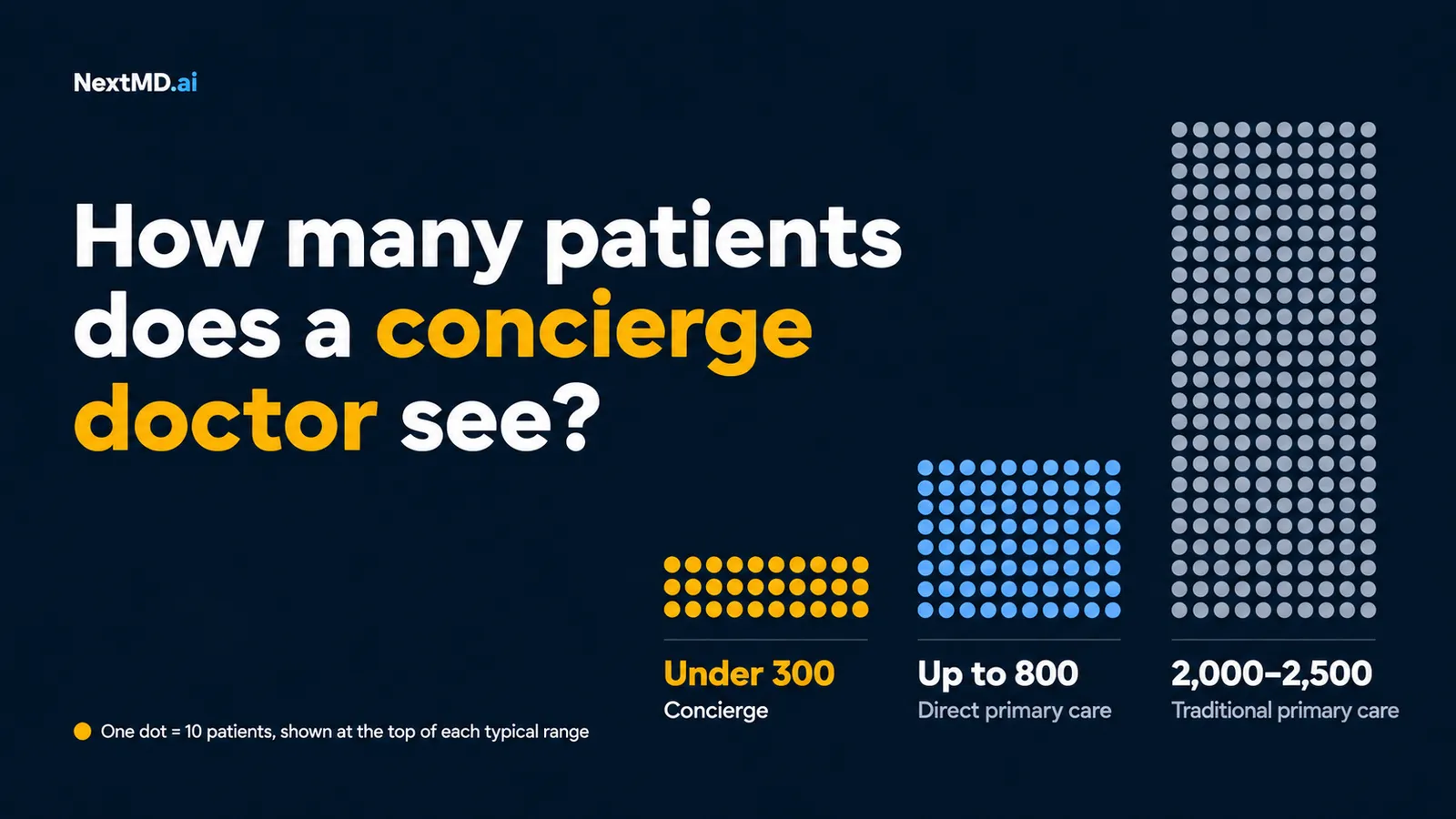
A concierge doctor typically carries fewer than 300 patients. A direct primary care (DPC) doctor carries up to 800. A traditional primary care doctor often carries 2,000 to 2,500.[1] That number is called the doctor's panel, and it has more to do with how fast you get an appointment than anything else a practice advertises.
This article covers what a panel is, how the numbers differ by care model, what one Colorado practice told a national reporter about its own cap, and the questions to ask before you join.
Panel Sizes by Care Model
A panel is the list of patients a doctor is responsible for. Every patient on it can call, message, or book. The doctor's week has a fixed number of hours, so the panel sets how many people share them.
Care model | Typical panel per doctor | Visit length | How you pay |
|---|---|---|---|
Ultra-premium concierge | Under 100 | 60+ minutes | Annual fee, usually above $20,000 a year |
Premium concierge | Under 200 | 30 to 60+ minutes | Annual fee, typically about $10,000 a year |
Concierge medicine | Under 300 | 30 to 60+ minutes | Annual fee, often plus insurance |
Direct primary care | Up to 800 | 30 to 60 minutes | Monthly fee, no insurance billing |
Traditional primary care | 2,000 to 2,500 | 10 to 15 minutes | Insurance |
Concierge medicine has tiers, and the panel shrinks as the fee rises:
Concierge: under 300 patients per doctor.
Premium concierge: usually under 200 patients. The fee is typically about $10,000 a year.
Ultra-premium concierge: usually under 100 patients. The fee is usually above $20,000 a year.
Most DPC practices sit between 300 and 600. Survey data backs that up. In the American Academy of Family Physicians (AAFP) 2026 DPC data brief, the average reported panel was 504 patients in 2025, up from 402 in 2024.[2]
Why the Panel Decides Your Wait
A large panel means a full calendar. In a 2025 survey of 15 large metro areas, new patients waited an average of 23.5 days to see a family medicine physician. That was up 14% since 2022.[3]
Time inside the visit shrinks for the same reason. Researchers estimated how long one doctor would need to deliver all recommended preventive, chronic, and acute care to 2,500 adults. The answer was 26.7 hours per day.[4] No doctor has that many hours, so visits get shorter and some care gets skipped. NextMD covered where the minutes go in why your primary doctor only spends 7 minutes with you.
A smaller panel changes the math. With fewer patients, a doctor can hold open slots each day for whoever needs one. In the AAFP survey, 54% of DPC respondents reported an average in-office visit longer than 30 minutes. Only 4% reported visits under 15 minutes.[2]
One Practice's Numbers: The Cove in Castle Rock
On November 17, 2026, HealthDay published a feature on the family doctor shortage. U.S. News & World Report syndicated it. The story opens with Aaron Block, MD, a family physician who runs The Cove Concierge Medicine in Castle Rock, Colorado.[5]
Aaron Block worked as a family physician for a health network for five years before opening his own practice. He runs it with his husband, John Waters, a nurse practitioner. The practice has been open two years.[5] Here are the numbers he gave:
Current panel: about 131 patients, built from zero.[5]
Target: 700 to 800 patients on his roster.[5]
Comparison: the 2,500 to 3,500 patients he and John Waters would have carried together in a traditional health system.[5]
Messages at his old job: 1.5 to 2 hours a day, unpaid.[5]
He described the cap as an access decision. "The nice thing is that we can determine when it's time to slow down how many new patients we take," he said. "Can our patients get in? Do they feel like they have easy access to us?"[5]
The Cove charges $3,700 a year for an adult membership. Its membership page lists same-day appointments and 24/7 digital access. It does not file insurance claims.[6]
Note the target. At 700 to 800, The Cove plans to run above the typical concierge range and closer to a DPC-sized panel. That is the practice's own number for its own model. It shows why the label on a practice tells you less than the number behind it.
Why the Numbers Vary
Panel figures differ depending on who is counting. In the same HealthDay story, Jennifer Brull, MD, a former AAFP board chair, put a traditional family physician's panel at about 1,200 to 1,500 patients. She put a DPC physician's panel closer to 500.[5] Aaron Block's 2,500 to 3,500 covered two clinicians in a health system. NextMD's reference range for traditional practice is 2,000 to 2,500.[1]
Three things explain most of the spread:
Who is on the panel. Some practices count every patient seen recently. Others count only paying members.
Who shares it. A panel may be split between a physician and a nurse practitioner or physician assistant. A December 2025 study in Health Affairs found that physicians made up 67.3% of clinicians in concierge and DPC practices in 2018. By 2023 they made up 59.7%.[7]
How the practice bills. The AAFP describes DPC as fee-only with no insurance billing. Concierge practices may still bill insurance on top of the membership fee.[8]
For a full side-by-side of the two models, see concierge medicine vs. direct primary care.
A Small Panel Can Still Be Full
A cap protects access only if the practice has room under it. The same Health Affairs study found that concierge and DPC practice sites grew 83.1% from 2018 to 2023, and the clinicians working in them grew 78.4%.[7] Many of those practices are young and still building, like The Cove at 131 patients.
That cuts both ways for a patient. A new practice usually has open spots and short waits. A practice near its cap may start a waitlist or slow new enrollments. In the AAFP survey, 40% of DPC physicians named panel growth as a major challenge.[2] That suggests many DPC practices still have room.
So ask two numbers. Ask the cap, and ask how many patients are on the panel today.
What to Ask a Practice About Its Cap
Before you join, ask these questions. Write down the answers.
What is your panel cap per doctor? Expect under 300 for concierge, under 200 for premium concierge, under 100 for ultra-premium, and up to 800 for DPC. A practice that will not give a number is a warning sign.
How many patients do you have now? A practice at 90% of its cap behaves differently from one at 20%.
Is the cap per physician or shared? Ask whether a nurse practitioner or physician assistant carries part of the panel, and who you will see for routine visits.
What happens when you hit the cap? Ask whether the practice closes enrollment, starts a waitlist, or adds a physician.
How fast can I be seen for something urgent? Ask for the typical time, same day or next day.
Who answers my messages? NextMD's guide to what 24/7 access actually means lists follow-up questions.
FAQ
How many patients does a concierge doctor have?
A concierge doctor typically carries fewer than 300 patients.[1] Premium concierge practices, which typically charge about $10,000 a year, usually keep panels under 200. Ultra-premium practices, which usually charge above $20,000 a year, usually keep panels under 100. Individual practices set their own caps, so ask each one.
How many patients does a direct primary care doctor have?
DPC doctors usually carry up to 800 patients, and most sit between 300 and 600. The AAFP's 2026 survey reported an average of 504 patients in 2025.[2]
How many patients does a regular primary care doctor have?
A traditional primary care doctor often carries 2,000 to 2,500 patients.[1] Estimates vary with how a practice counts its patients. One former AAFP board chair put the figure at 1,200 to 1,500.[5]
Does a smaller panel guarantee a same-day appointment?
No. A smaller panel makes same-day access possible, but a practice near its cap can still run short on slots. Ask how many patients the practice has now, and how fast it sees urgent requests.
Is a concierge practice with a bigger panel worse?
Not on its own. A practice that does not bill insurance may run a larger panel and still keep same-day access. Compare the panel, the visit length, and who sees you.
Find a Practice With Room for You
NextMD lists physician-led (MD/DO) concierge and DPC practices in all 50 states. NextMD directory data counts 194 in Colorado. Compare practices by city, pricing, and credentials at nextmd.ai/search, then ask each one about its cap.
This article provides general educational information and is not medical advice.
Written by Josh Bobrowsky, founder of NextMD.
Sources
Busch, F., Grzeskowiak, D., & Huth, E. (2020). Direct Primary Care: Evaluating a New Model of Delivery and Financing. Society of Actuaries / Milliman. Referenced for traditional, concierge, and DPC panel sizes. Read the SOA/Milliman report
American Academy of Family Physicians. (2026). 2026 Direct Primary Care Data Brief. AAFP. Panel size, visit length, and practice challenges. Read the AAFP 2026 DPC data brief
AMN Healthcare. (2025, May 27). New Survey Shows Physician Appointment Wait Times Surge: 19% Since 2022, 48% Since 2004. AMN Healthcare. Read the AMN wait-time survey release
Porter, J., Boyd, C., Skandari, M. R., & Laiteerapong, N. (2023). Revisiting the Time Needed to Provide Adult Primary Care. Journal of General Internal Medicine, 38(1), 147–155. Find on PubMed
Thompson, D. (2026, November 17). Family Doctor Shortage Spurs New Models Of Care. HealthDay; syndicated by U.S. News & World Report. Read the HealthDay feature
The Cove Concierge Medicine. (Accessed November 17, 2026). Membership. Read The Cove's membership page
Zhu, J. M., Marsh, T., Polsky, D., Huntington, A., & Song, Z. (2025). Growth In Number Of Practices And Clinicians Participating In Concierge And Direct Primary Care, 2018–23. Health Affairs, 44(12), 1473–1481. Read the Health Affairs abstract
American Academy of Family Physicians. (Accessed November 17, 2026). Direct primary care: What to know. AAFP. Read the AAFP DPC overview