
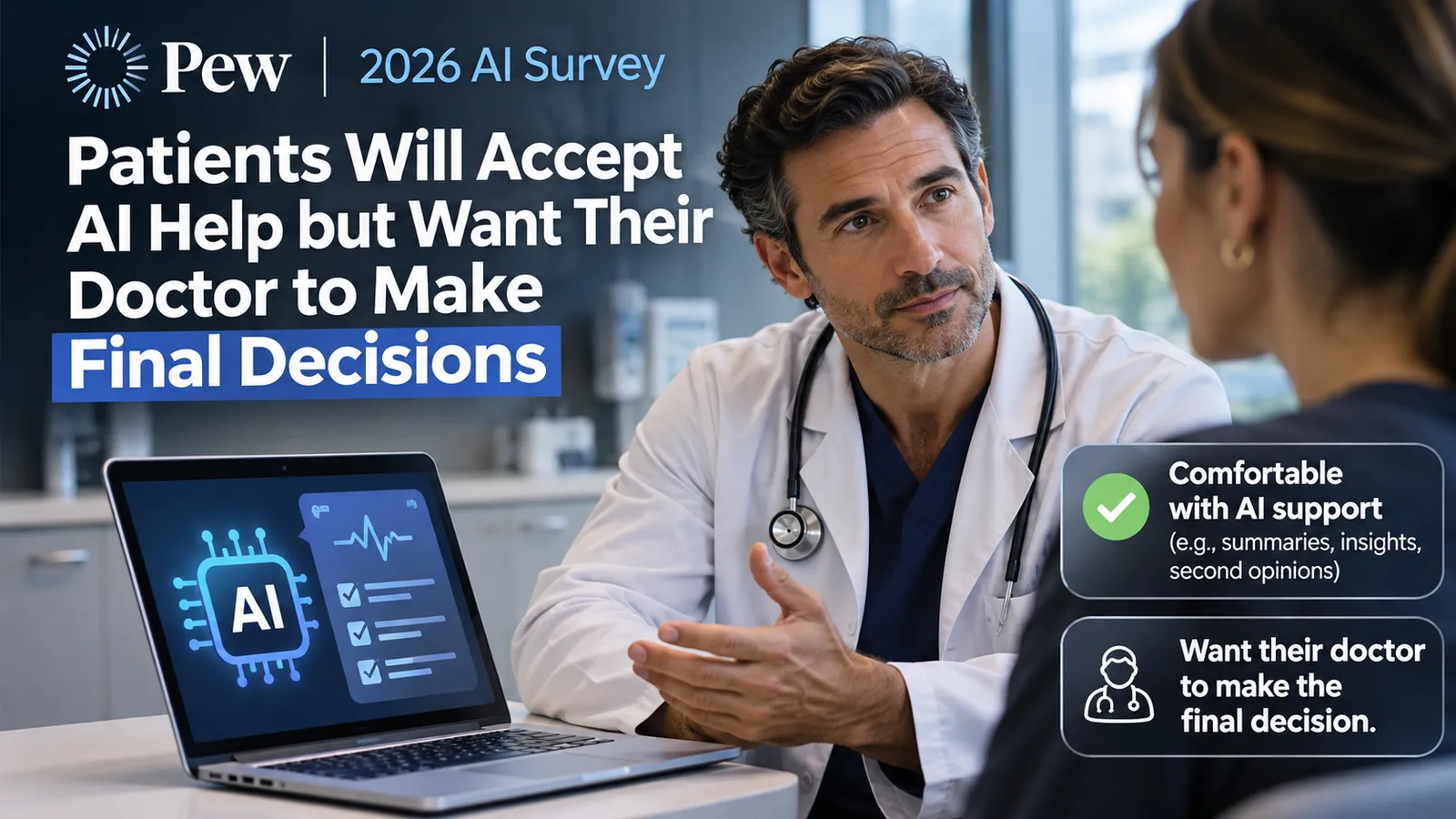

Americans will let artificial intelligence (AI) help at the doctor's office, but most want a human to review its work before it reaches their care. That is the main finding of a Pew Research Center survey released October 29, 2026.[1]
Pew surveyed 3,488 U.S. adults from June 22 to 28, 2026, through its nationally representative American Trends Panel. The margin of error is plus or minus 1.8 percentage points.[2] The results measure stated attitudes, and the pattern is consistent. People welcome AI for paperwork. They resist it near diagnoses and insurance decisions. And they expect it to damage two things: the privacy of their health data and their relationship with their doctor.
What Americans Will Let AI Do
Pew asked about eight tasks. For each, people could accept AI on its own, accept it with a human final review, or reject it.[1]
Task | AI on its own | AI with human final review | Not open |
|---|---|---|---|
Translating for a patient | 26% | 52% | 12% |
Scheduling an appointment | 29% | 44% | 18% |
Ordering prescription refills | 17% | 53% | 21% |
Taking notes during an appointment | 13% | 56% | 23% |
Analyzing medical scans | 6% | 60% | 26% |
Explaining lab results | 8% | 53% | 31% |
Making a diagnosis | 3% | 47% | 41% |
Deciding an insurance claim | 5% | 38% | 46% |
Human review is the top answer for seven of eight tasks. Even for translation, twice as many people want a human check as want AI alone.[1]
Almost nobody wants AI diagnosing alone. Only 3% are open to it.[1]
Insurance claims draw the most resistance. Nearly half (46%) want AI kept out of claim decisions entirely.[1]
Six in Ten Are Uncomfortable With Their Own Doctor Using AI
Asked how they would feel if their own doctor used AI for diagnoses and treatments, 60% said uncomfortable and 30% comfortable. Another 10% were not sure.[1] The 60% figure matches what Pew found in December 2022.[4]
Comfort varies by group:[5]
Income: 43% of upper-income adults are comfortable, against 22% of lower-income adults.
Gender: 65% of women are uncomfortable, against 54% of men.
Age: 68% of adults under 30 are uncomfortable, the highest of any age group.
That age finding is surprising. Adults under 30 use AI chatbots for health questions at more than twice the rate of adults 65 and older (44% vs. 17%).[6] They use the tools themselves but do not want their doctor relying on them.
Young Adults Have Turned More Pessimistic
Overall, the country is split on whether AI will improve patient outcomes: 37% say better, 36% say worse, and 26% say it will not matter much.[1] By age, the picture has reversed since 2022.[1]
Age group | "Better" 2022 | "Better" 2026 | "Worse" 2022 | "Worse" 2026 |
|---|---|---|---|---|
18 to 29 | 44% | 31% | 29% | 45% |
30 to 49 | 39% | 35% | 32% | 39% |
50 to 64 | 33% | 38% | 39% | 35% |
65 and older | 34% | 42% | 33% | 26% |
Adults under 30 went from the most optimistic group to among the most pessimistic. Adults 65 and older moved the other way. Hispanic and Black adults also grew more pessimistic, with the share expecting worse outcomes up 11 and 12 points.[1]
Two Worries: Your Data and Your Doctor
Pew asked how AI will affect five parts of health care. Two lean clearly negative:[1]
Security of personal health information: 51% say worse, 8% say better.
The patient-doctor relationship: 47% say worse, 10% say better.
One leans positive. More people expect AI to improve the availability of care (31%) than worsen it (20%).[1] Americans expect a faster system that feels less personal.
Doctors Are the Most Trusted Referee
Pew asked who people trust to make sure AI is used in patients' best interest.[1]
Who | A great deal or quite a bit | Not too much or none |
|---|---|---|
Doctors | 26% | 25% |
Hospital leadership | 16% | 42% |
AI companies | 16% | 50% |
Their state government | 11% | 50% |
The federal government | 11% | 55% |
Health insurance companies | 11% | 58% |
Doctors are the only group where confidence matches distrust. Insurers rank last, consistent with the resistance to AI deciding claims. People also feel shut out: in Pew's August release, 63% said they want more say over whether their provider uses AI.[3]
What This Means for Patients
The preference is clear: let software handle the paperwork, and let a physician you trust make the call.
Ask your doctor how they use AI. Ask which tools touch your visit, such as an AI scribe, and who reviews the output before it enters your chart. In August, 46% of Americans told Pew they were not sure whether AI had been used in their care.[3]
Bring your own AI research to the visit. About a third of adults (34%) use AI chatbots for health reasons.[6] Those answers can make a visit more productive once a doctor checks them against your history. Our piece on why 230 million people ask ChatGPT about their health every week covers how to use them well.
Choose a doctor with time. The relationship Americans fear losing depends on time. A traditional primary care visit runs 10 to 15 minutes, with panels of 2,000 to 2,500 patients. A concierge physician typically carries under 300 patients, with visits of 30 to 60 minutes or longer.[7] That leaves room to explain what an AI tool found and whether the doctor agrees. See your first 90 days with a concierge doctor for what that looks like.
What This Means for Concierge and Direct Primary Care Practices
Use AI where patients welcome it. Translation, scheduling, refills, and note-taking each win approval from about 70% of adults or more when a human reviews the work.[1] Those tasks also consume staff and physician time. Our coverage of Abridge moving beyond AI scribes into clinical decisions shows where the tools are heading.
Keep the decision visibly human. Say it plainly: "Software drafts my notes. I make every medical decision." Patients cannot see your process unless you describe it.
Disclose before you are asked. In August, 72% told Pew it is extremely or very important that a provider tell them when AI is used.[3] Add a short AI section to your welcome packet, naming each tool and who reviews it. Expect more questions from women, lower-income patients, and adults under 30, who report the most discomfort.[5]
Spend the saved time on the relationship. Longer visits, faster callbacks, and real follow-up answer the harm 47% of Americans expect AI to cause.[1] Tech-forward practices such as Sigma Humans, one of the concierge practices in Chicago, can make that case to patients weighing an app against a physician.
FAQ
What did the 2026 Pew survey find about AI in health care?
Most Americans accept AI help when a human reviews the result. But 60% are uncomfortable with their own doctor using AI for diagnoses and treatments, and 47% expect AI to hurt the patient-doctor relationship.[1]
Do Americans trust AI to diagnose them?
Only 3% are open to AI diagnosing on its own. Another 47% accept it with a human final review, and 41% reject it.[1]
Are younger people more comfortable with AI in health care?
No. Adults under 30 are the most likely to be uncomfortable with their doctor using AI (68%), and the share expecting worse outcomes rose from 29% in 2022 to 45% in 2026.[1][5]
Who do Americans trust to oversee AI in medicine?
Doctors. About 26% have high confidence in doctors to make sure AI serves patients, against 11% for health insurers and the federal government.[1]
Find a Doctor Who Has Time to Explain
Most Americans want a physician who reviews AI's work, explains it, and makes the final call. NextMD lists more than 6,800 physician-led concierge and direct primary care practices with longer visits and direct access to the doctor. Search for a practice near you.
Written by Josh Bobrowsky, founder and CEO of NextMD. This article is general information and is not medical advice.
Sources
Yam, E., Kikuchi, E., & Pasquini, G. (2026, October 29). Americans Are Open to AI in Healthcare, but Want Humans Making Final Calls. Pew Research Center. Read the Pew report
Pew Research Center. (2026, October 29). Methodology: Americans Are Open to AI in Healthcare. Read the survey methodology
Yam, E., Pasquini, G., & Kikuchi, E. (2026, August 25). Americans want transparency when AI is used in their healthcare. Pew Research Center. Read the transparency findings
Tyson, A., Pasquini, G., Spencer, A., & Funk, C. (2023, February 22). 60% of Americans Would Be Uncomfortable With Provider Relying on AI in Their Own Health Care. Pew Research Center. Read the 2022 survey report
Pew Research Center. (2026, October 29). Appendix: Americans Are Open to AI in Healthcare. View the demographic tables
Kikuchi, E., Pasquini, G., & Yam, E. (2026, August 25). From Diagnoses to Treatments, Why Americans Use AI Chatbots for Health. Pew Research Center. Read the chatbot findings
NextMD. Pricing tiers and model comparison; panel size standards. NextMD canonical references for concierge, DPC, and traditional primary care. Compare concierge medicine and other memberships