
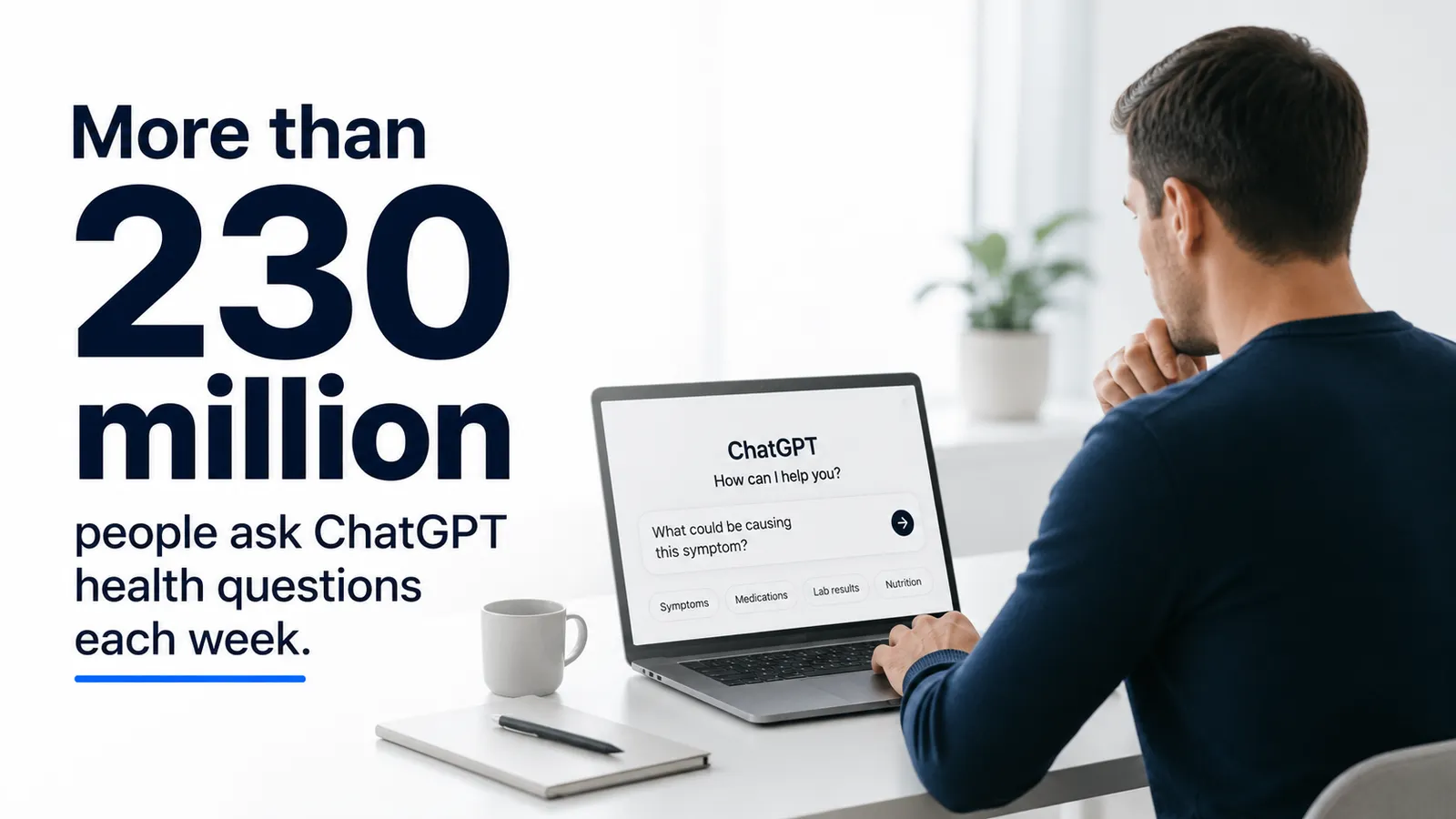

More than 230 million people ask ChatGPT health and wellness questions every week, according to OpenAI's analysis of de-identified conversations.[1] They ask about symptoms, laboratory results, medications, sleep, nutrition, insurance, and what to do next.
OpenAI now offers ChatGPT Health, a dedicated experience that can connect medical records, Apple Health data, and selected wellness apps. It can explain a test result, organize questions for an appointment, and summarize care instructions. OpenAI also states that the product is designed to support medical care and is not intended for diagnosis or treatment.[1]
Receiving an answer and making a safe health decision are different tasks.
A 2026 randomized study in Nature Medicine tested 1,298 people across ten medical scenarios. The large language models identified the relevant condition correctly in 94.9% of cases when tested alone. People using those same models identified the relevant condition in fewer than 34.5% of cases and chose the appropriate level of care in fewer than 44.2%. Their results were no better than those of the control group.[2]
The models had useful medical knowledge, but people did not perform better with them. The study exposed the gap between benchmark accuracy and users' ability to ask questions, interpret answers, and decide what to do.
ChatGPT is becoming a front door to health information. The next step needs a better design: use artificial intelligence (AI) to become more informed, then involve a qualified clinician when the decision depends on examination, diagnosis, treatment, or follow-through.
What ChatGPT Health Actually Does
ChatGPT Health lets eligible users ask questions in a health-focused experience and optionally connect personal data. Depending on availability and permissions, that data can include medical records, visit summaries, laboratory results, prescriptions, Apple Health data, and supported wellness apps.[1][3]
OpenAI launched ChatGPT Health in January 2026 after working with more than 260 physicians across 60 countries. Those clinicians provided more than 600,000 evaluations of model responses, according to the company.[1]
As of July 2026, access is still rolling out. OpenAI says users on Free, Go, Plus, and Pro plans in the United States can join the waitlist. The experience is supported on the web and iOS. Optional medical-record connections are limited to adults in the United States, and Apple Health requires an iPhone.[3]
Practical uses include:
Translate medical language. You can ask it to explain an imaging report or a term such as "mild left ventricular hypertrophy" in plain English.
Organize your history. It can turn a list of symptoms, dates, medications, and prior visits into a concise timeline.
Prepare for a visit. It can generate questions based on a laboratory report or discharge summary.
Summarize instructions. It can convert several pages of clinical text into a medication list, follow-up schedule, and list of unresolved questions.
Compare options. It can help you understand the stated benefits, risks, costs, and open questions surrounding a test or treatment.
Each task works with information already available in text or connected data. ChatGPT can help you inspect and organize that information. It cannot perform a physical examination, listen to your lungs, confirm that you described every relevant symptom, order a test, or accept responsibility for a treatment decision.
A Brief History of ChatGPT
OpenAI released ChatGPT as a public research preview on November 30, 2022.[6] This was the true start of generative AI as we know it today.
ChatGPT Health arrived on January 7, 2026. The product formalized a use case that had already reached hundreds of millions of people. Instead of treating health questions as an incidental part of a general chatbot, OpenAI added medical-record connections, health-specific data controls, and evaluations shaped by physicians.[1]
The Difference Between Information and Care
World Health Organization guidance says large language models can support patient education, clinical work, documentation, and research. It also warns that they can produce false, incomplete, inaccurate, or biased statements. The guidance highlights "automation bias," where people defer to an AI answer and overlook an error they might otherwise catch.[8]
In the 2026 Nature Medicine study, a model could contain the needed fact and still fail to improve the person's decision. The quality of the prompt, the completeness of the history, the user's interpretation, and the follow-up action all affected the result.[2]
Consider a patient reviewing a report that lists an A1C result of 6.1%. ChatGPT can define the test and help the patient prepare questions about trends, medications, diet, sleep, and when to repeat it. A clinician must decide what the result means in the context of that patient's history, other results, current medications, pregnancy status, symptoms, and treatment goals.
Similar limits apply to symptoms. A chatbot can produce a list of possible causes and questions. A doctor can examine the patient, measure vital signs, decide which possibilities deserve attention, order the appropriate workup, document the plan, and remain accountable for what happens next.
Task | ChatGPT can help | A physician adds |
|---|---|---|
Understand a laboratory report | Define terms and organize questions | Interpret the full pattern and decide whether action is needed |
Prepare a symptom history | Build a timeline and identify missing details | Examine the patient and determine which findings matter |
Review treatment options | Summarize stated benefits, risks, and evidence | Recommend a plan based on diagnosis, history, preferences, and examination |
Manage medications | Organize names, doses, and questions | Prescribe, monitor, adjust, and reconcile interactions |
Navigate the health system | Explain types of care and help prepare outreach | Place orders, coordinate referrals, communicate with specialists, and follow results |
AI makes information easier to access. Care begins when someone evaluates that information, makes a decision, carries it out, and stays responsible for the result.
Five Ways to Use ChatGPT Before a Doctor's Appointment
A useful prompt gives the model a narrow job and tells it not to invent missing information. These five uses can make a medical visit more productive.
1. Build a one-page health timeline
List the date each symptom began, what changed, current medications with doses, recent test results, and questions you want answered. Then ask:
Turn these facts into a one-page timeline for my doctor. Preserve every date, medication, dose, and test value. Do not add a diagnosis or facts I did not provide. Put missing information in a separate question list.
Review the output against your source material before sharing it.
2. Translate a report without asking for a diagnosis
Paste the text of the report, remove identifying details if you prefer, and ask:
Explain each term in plain English. Separate what the report directly states from possible interpretations. List five questions I should ask the ordering clinician.
A narrow prompt keeps the task focused on comprehension.
3. Find the gaps in your medication list
Provide the drug name, dose, schedule, and reason you believe you take it. Ask ChatGPT to flag blank fields, duplicate ingredients, and questions for a pharmacist or physician. Do not use the response to start, stop, or change a medication.
4. Turn several concerns into an appointment agenda
A 20-item list can consume the visit before the main issue receives attention. Ask the model to group related concerns and create a short agenda. You still choose the priority, and your doctor can change it based on clinical urgency.
5. Create a follow-up checklist
After the visit, ask ChatGPT to organize the written instructions into appointments, tests, medication questions, and dates. Compare the checklist with the original note. Contact the practice when the summary conflicts with the clinician's instructions.
Our guide to how AI is already handling the first patient interaction examines the same boundary inside doctors' offices. AI can collect and organize information. The physician remains responsible for care.
When the Conversation Needs to Move to a Doctor
Move from AI to a licensed clinician when the answer could change treatment or timing. Examples include:
You have a new, severe, or worsening symptom.
You are deciding whether you need emergency, urgent, or routine care.
You want to start, stop, renew, or change a prescription.
A laboratory or imaging result may require follow-up.
You are pregnant, immunocompromised, recently hospitalized, or managing several conditions or medications.
The answer depends on a physical examination, current vital signs, or a test the model cannot perform.
The model gives conflicting answers or cannot cite the basis for a claim.
Finding a doctor can be difficult when many practices are full. NextMD's guide to getting a primary-care doctor when almost everyone is full explains the available routes. The types of primary care guide compares traditional primary care, urgent care, concierge medicine, and direct primary care (DPC).
Patients who want more continuity may consider a membership practice with a smaller physician panel. For example, NextMD lists Sigma Humans, a physician-led concierge practice in Chicago. Naming a practice here does not mean it endorses ChatGPT or uses the product. It shows the kind of ongoing physician relationship a chatbot cannot create by itself.
Read the Privacy Terms Before Connecting Health Data
Health questions can contain diagnoses, prescriptions, reproductive history, mental-health information, laboratory results, and insurance details. Treat that information as sensitive before you type or connect it.
OpenAI says conversations, files, memories, connected medical records, and Apple Health data within ChatGPT Health are not used to train its foundation models or target ads. Users control which accounts they connect and can disconnect them. OpenAI also says disconnecting medical records and deleting chats are separate actions, so a user may need to do both to remove imported records and references preserved in conversations or memory.[3][9]
Ordinary ChatGPT conversations follow different rules. OpenAI says content from individual services may be used to improve models unless the user opts out. Temporary Chats do not appear in history, create memories, or train the models.[10]
ChatGPT Health is a consumer health product. OpenAI states that the Health Insurance Portability and Accountability Act (HIPAA) does not apply to the consumer experience. The Federal Trade Commission explains that many consumer health apps sit outside HIPAA, although other federal and state privacy laws may still apply.[3][11]
Before connecting medical records or a wellness app:
Read the current product and third-party privacy notices.
Connect only the data sources needed for the task.
Review memory and training controls.
Enable multi-factor authentication on the account.
Learn how to delete chats, memories, and connected data separately.
Privacy controls can change as the product changes. Check the current settings instead of relying on a screenshot or instructions from an older article.
The Better Handoff From AI to a Physician
OpenAI's 230 million figure shows that people want understandable health information at the moment a question occurs. Doctors cannot answer every general question at midnight, and medical portals often spread one person's information across several systems.
ChatGPT can reduce the preparation burden. It can help a patient arrive with an accurate timeline, a readable medication list, and five specific questions. That gives the doctor better starting material.
A physician adds examination, judgment, authority to act, coordination, and continuity. A doctor also knows what happened after the last decision. Longitudinal feedback matters because the quality of healthcare depends on more than producing a plausible answer once.
A five-step sequence keeps the roles clear:
Ask AI to explain and organize.
Check the response against the original record and cited sources.
Take the organized information to a qualified clinician.
Let the clinician make or confirm the medical decision.
Use AI to organize the written follow-up plan, then verify it again.
If you are choosing a physician, our guide to comparing concierge and DPC doctors covers credentials, access, fees, communication, and care coordination.
FAQ
Can ChatGPT diagnose me?
ChatGPT can explain possible causes and help organize information, but OpenAI says ChatGPT Health is not intended for diagnosis or treatment.[1] A diagnosis may require an examination, testing, clinical judgment, and follow-up that a chatbot cannot provide.
Is ChatGPT reliable for medical advice?
Its reliability depends on the task, model, information supplied, and how the user interprets the response. In a 2026 randomized study, people using large language models did no better than a control group at identifying conditions or choosing the appropriate level of care, even though the models performed well when tested alone.[2]
Can ChatGPT Health read my medical records?
Eligible adults in the United States can choose to connect medical records so ChatGPT Health can reference them. Availability is still rolling out, and users control which accounts they connect.[3]
Is ChatGPT Health covered by HIPAA?
OpenAI describes ChatGPT Health as a consumer wellness product and says HIPAA does not apply to it. ChatGPT for Healthcare is a separate product designed for regulated clinical organizations.[3]
What should I ask ChatGPT before a doctor's appointment?
Ask it to organize your symptom timeline, define unfamiliar terms, identify missing details, and turn your concerns into a short question list. Tell it to preserve exact dates, medication doses, and test values without adding facts.
When should I stop asking AI and contact a doctor?
Contact a licensed clinician when you have a severe or worsening symptom, need to decide the appropriate level of care, are considering a medication change, or need interpretation that depends on examination and full medical history. Seek emergency help directly for a possible emergency.
Find a Doctor Who Can Take the Next Step
AI can help you understand the question. A doctor can examine you, order the appropriate test, recommend treatment, and remain responsible for follow-up.
NextMD helps patients compare physician-led concierge and direct primary-care practices across the United States. You can search by city, compare available pricing, and review physician credentials when you need a doctor who has time to take the conversation further.
A Note From the Author
I am not a doctor. This article provides general information and does not offer medical advice, diagnosis, or treatment. Do not use ChatGPT or another AI system as a substitute for emergency services or care from a licensed clinician who knows your medical history.
Sources
OpenAI. (2026). Introducing ChatGPT Health. Read the product announcement
Bean, A. M., Payne, R. E., Parsons, G., et al. (2026). Reliability of LLMs as medical assistants for the general public: a randomized preregistered study. Nature Medicine, 32, 609-615. Read the study in Nature Medicine
OpenAI Help Center. (2026). Health in ChatGPT. Read the current product and data-control guide
Brockman, G., Sutskever, I., and OpenAI. (2015). Introducing OpenAI. Read the founding announcement
OpenAI. (2026). OpenAI and NVIDIA announce strategic partnership to deploy 10 gigawatts of NVIDIA systems. Read the current leadership references
OpenAI. (2022). Introducing ChatGPT. Read the original ChatGPT announcement
OpenAI. (2025). Our structure. Read OpenAI's current structure
World Health Organization. (2024). Ethics and governance of artificial intelligence for health: Guidance on large multi-modal models. Read the WHO guidance summary
OpenAI. (2026). Health Privacy Notice. Read the Health Privacy Notice
OpenAI Help Center. (2026). How your data is used to improve model performance. Read the data-usage guide
Federal Trade Commission. (2026). Complying with the FTC's Health Breach Notification Rule. Read the consumer health-app privacy guidance