
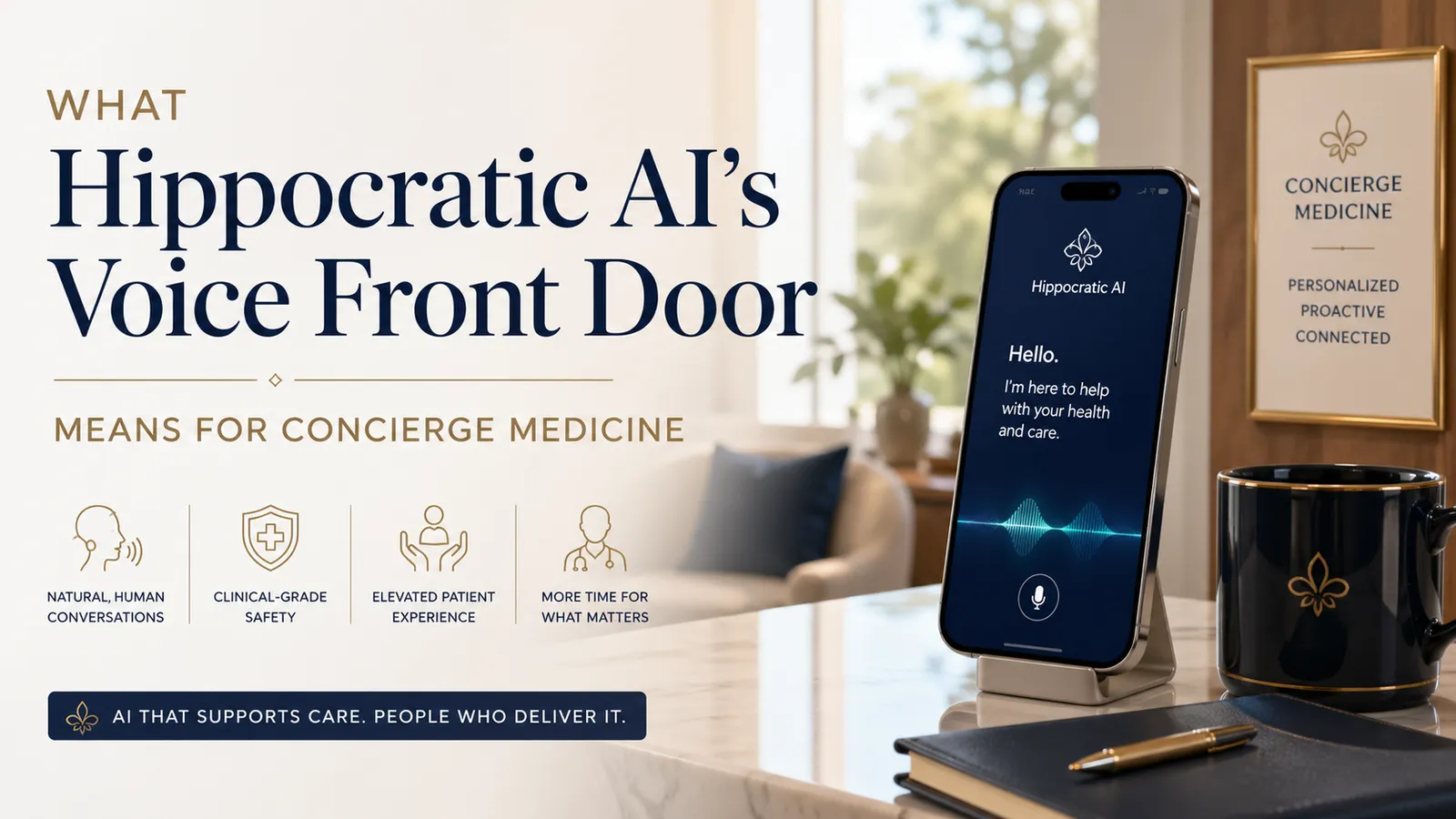

In April 2026, Hippocratic AI launched two products that directly interact with patients.
The first, called AI Front Door, is a voice agent that answers the phone, runs intake, and handles routine patient questions. The second, called Nurse Co-Pilot, is an inpatient assistant for hospital nursing teams. Hippocratic also announced an international expansion partnership with the consulting firm KPMG, which will help large healthcare buyers deploy the technology.[1][2]
Two product launches and a global consulting partnership in the same window is not a small announcement. It is a bet that the first sixty seconds of a healthcare interaction, the part where a person describes what is wrong and someone on the other end starts the response, can be done by a voice AI well enough to scale.
That bet has direct consequences for concierge medicine, because the first sixty seconds is exactly what a concierge doctor has always promised to own.
What Hippocratic AI Actually Built
Hippocratic AI is a healthcare artificial intelligence (AI) company that builds voice agents trained on clinical workflows. The company has raised more than $278 million in venture funding from investors including General Catalyst, Andreessen Horowitz, Premji Invest, and others, with a reported valuation north of $1.6 billion as of its 2025 round.[3]
The two new launches do different jobs.
AI Front Door is patient-facing. It is a voice agent that answers calls or initiates outbound ones, asks symptom and history questions, schedules visits, gives basic education, and routes the patient to the right level of care. The pitch to large clinics and health systems is that AI Front Door handles the high-volume routine work (refill questions, appointment booking, pre-visit history) so human staff can focus on the complex calls.
Nurse Co-Pilot is clinician-facing and inpatient. It assists hospital nursing teams with documentation, monitoring, and routine patient interactions during a hospital stay. It is not designed to replace nurses. It is designed to give one nurse the working capacity of more than one nurse, which matters in an environment where the United States is short an estimated 78,000 to 100,000 registered nurses.[4]
The KPMG partnership wraps both products in enterprise consulting. KPMG will counsel large healthcare clients on how to deploy Hippocratic's voice agents inside their existing operations. That is the kind of distribution deal that turns a startup into infrastructure.
Why This Is a Concierge Medicine Story
Concierge medicine has, for twenty-five years, sold one thing more than any other: when something is wrong, a real doctor who knows you answers. Not a triage line. Not a portal message returned in 48 hours. The doctor.
How concierge medicine actually works behind the scenes comes down to math. Concierge doctors cap their patient panels at under 300 patients. Direct primary care (DPC) doctors typically stay under 800. By comparison, traditional primary care physicians carry panels of 2,000 to 2,500 patients and see 30 to 50 patients a day in visits that average around 13 to 16 minutes.[5]
That difference is why your traditional primary doctor only spends about 7 minutes of meaningful face-to-face time with you, and it is why traditional primary care has a structural opening for AI Front Door. When a patient calls a 2,500-panel practice with a vague concern, the only honest answer the practice can give in real time is: "We will get back to you." A voice agent that triages the call, asks the right ten questions, and books the right slot is a real upgrade to that experience. Not perfect, but a real upgrade.
A concierge or DPC practice does not have that gap. The doctor (or a tightly trained office of three or four people) is the answer. So the question Hippocratic AI raises for concierge medicine is sharper. If voice AI can do the first response acceptably for the mass market, what is the difference worth?
What An AI Front Door Can Do, And What It Cannot
The honest answer is that voice AI in 2026 is good at certain things and limited at others, and a concierge patient should know the line.
What voice AI is genuinely useful for:
Booking, rebooking, and confirming appointments around the clock.
Capturing structured intake (medications, allergies, prior surgeries) before a visit so the doctor walks in with context.
Answering routine questions where the answer does not change much patient to patient (office hours, refill timing, lab pickup, prep instructions for procedures).
Surfacing red flags. A well-tuned voice agent can recognize the words that mean "go to the emergency room now" and escalate the call.
Where voice AI is still limited:
Reading the things a patient does not say. The pause, the wife in the background prompting her husband, the patient who asks twice about chest pressure but says it is "probably nothing." These are the cues a doctor who knows understands
Holding a thread across years. Your concierge doctor remembers that you were stressed about your father's diagnosis last spring, that you started a new SSRI in October, and that you mentioned a weird headache six weeks ago. AI memory across many conversations is improving, but it does not yet do this the way a human relationship does.
Knowing when to break protocol. The reason concierge medicine exists is that the right answer is sometimes "come over right now" or "I will call your specialist directly." A voice agent built on enterprise compliance does not freelance.
That last point is the one to hold onto. The voice agent's value is consistency at scale. The concierge doctor's value is judgment at the moment.
The Real Question For Concierge Patients
The question is not whether your concierge doctor will start using AI. The serious ones already are. Ambient AI scribes are saving documentation hours. Inbox tools draft responses to portal messages. Some practices are piloting voice intake for the after-hours line so patients calling at 2 a.m. with a non-urgent question get a competent first response instead of a delayed callback.
The question is what your concierge doctor uses AI for, and what they keep for themselves.
A good answer in 2026 looks like this: AI handles the routine, repetitive, and overnight load. The doctor handles the relationship, the judgment calls, and anything where you would rather hear a human voice. The relationship is the product. The technology should make more of it possible, not replace it.
A bad answer looks like AI Front Door becoming the default first touch even during business hours, with the human relationship sliding into a once-a-year physical and a portal message every quarter. That is not concierge medicine. That is a glossier version of the system most patients are paying to leave.
Five Questions To Ask Your Concierge Practice About AI
Whether you are evaluating a new practice or checking in with the one you already use, these are the questions worth asking.
When I call during the day, who answers? A person, the doctor, or a voice agent? The answer should be a human, full stop. Voice agents are reasonable for after-hours triage. They are not a replacement for daytime access.
Are you using an AI scribe in my visits? If so, do I need to consent each time? The answer should be yes to both. You should know when you are being recorded and you should be able to opt out.
If I message the practice, is the response written by a person or by AI? Many practices use AI to draft responses that a clinician reviews and edits. That is fine. Pure AI responses with no human review are not.
Where does my data go? Voice transcripts, intake recordings, and AI-generated notes are clinical data. The practice should be able to tell you where it is stored, who can see it, and whether the vendor uses it to train their next model.
What part of my care will never be done by AI? Every concierge or DPC doctor should be able to answer this clearly. If they cannot, ask them to.
The questions look simple. The answers tell you whether the practice is using AI to expand the relationship or to dilute it.
Where The Line Holds
The doctor who walks into your visit with structured intake notes already in front of her, having been freed up by an AI scribe doing the previous patient's charting, is more present in your visit, not less. That is the version of this story that works.
The version that does not work is one where the relationship quietly migrates to the voice agent because it is cheaper and faster. Concierge medicine charges more than traditional primary care precisely because patients are paying for a relationship a 2,500-panel practice cannot provide. A practice that lets AI take over that relationship is selling something different than what its membership fee implies.
Hippocratic AI's launches are an early signal that the voice layer of healthcare is being built right now, and KPMG-led enterprise distribution means it is being built fast. The patients who pay attention to how their concierge practice uses these tools, and which parts it deliberately keeps human, will get the version of concierge medicine they are paying for. The patients who do not ask will get whatever the practice decides to do.
The relationship is still the product. The technology is the leverage. Make sure your concierge doctor knows the difference, and that you do too.
NextMD lists physician-led concierge and DPC practices for patients searching nationwide. Every practice in the directory is led by a Doctor of Medicine (MD) or Doctor of Osteopathic Medicine (DO), the two physician degrees, so your first call is to a real doctor's office regardless of what voice answers it.
Sources
Hippocratic AI. (2026). Hippocratic AI launches AI Front Door for patient intake and Nurse Co-Pilot for inpatient nursing teams. Company announcement. https://www.hippocraticai.com/
KPMG and Hippocratic AI. (2026). KPMG and Hippocratic AI announce international expansion partnership for clinical voice AI deployment. Joint press release. https://kpmg.com/
Bass, D. (2025). Hippocratic AI raises Series B at $1.64 billion valuation to scale generative AI healthcare agents. Bloomberg / Fierce Healthcare coverage. https://www.fiercehealthcare.com/
American Association of Colleges of Nursing. (2024). Nursing Workforce Fact Sheet: Registered Nurse shortage projections through 2030. https://www.aacnnursing.org/news-data/fact-sheets/nursing-workforce-fact-sheet
Milbank Memorial Fund. (2026). The Health of US Primary Care: 2026 Scorecard. https://www.milbank.org/publications/the-health-of-us-primary-care-2026-scorecard/