
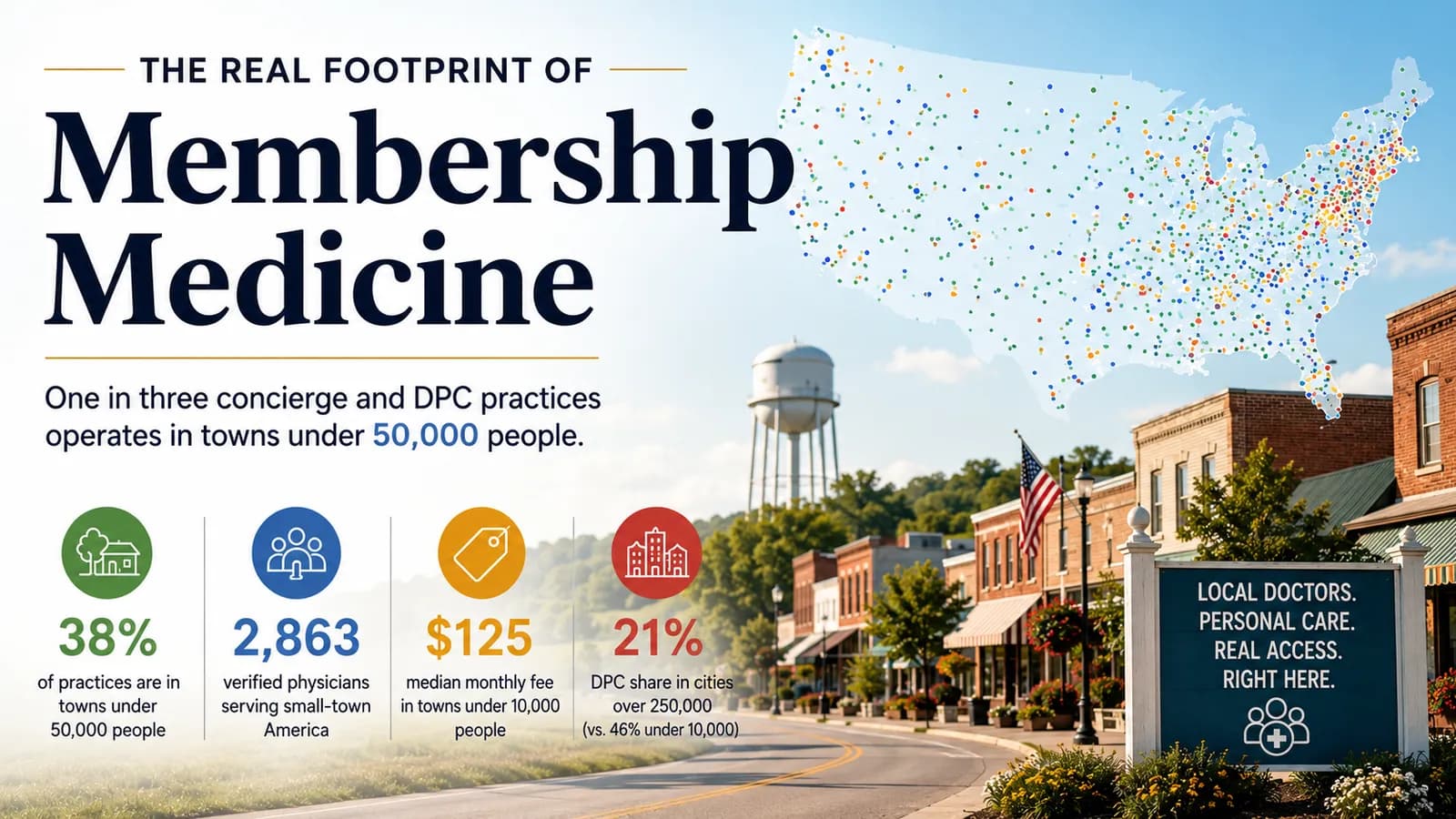

One in three verified concierge and direct primary care (DPC) practices in the United States operates in a town of fewer than 50,000 people. Outlaw Medical, a DPC clinic in Weleetka, Oklahoma, population 806, charges $85 a month for membership-based primary care. Membership medicine has a reputation as a product of Manhattan, Beverly Hills, and Naples. The directory data shows a market that reaches much further.
The numbers in this article come from NextMD's national directory of 8,744 verified physicians at 6,185 concierge, DPC, and hybrid practices, the same dataset behind our 2026 physician census and our ranking of the 25 cities with the most concierge doctors. Those practices sit in 1,954 distinct cities and towns across all 50 states, Washington, DC, and Puerto Rico (NextMD directory data). This article maps the practices by the size of the towns they operate in.
How We Counted
Every practice in the count is verified to include at least one MD (Doctor of Medicine) or DO (Doctor of Osteopathic Medicine). Three methodology notes:
Town populations come from the US Census Bureau. We matched each practice's town to the Census Bureau's Vintage 2024 city and town population estimates[1], supplemented with 2020 Census counts for New York boroughs and a small number of census-designated places the estimates file does not cover.
5,371 of the 6,185 practices (87 percent) matched a Census place. The rest either list no home city in the directory or use a mailing address for an unincorporated community, such as Paoli, Pennsylvania, or Midlothian, Virginia. Unmatched practices are excluded from the size breakdown.
Town labels follow mailing addresses, which can extend past municipal boundaries. A practice with a small-town address may serve patients across a county. Read the smallest-town examples as directional.
Membership Medicine by Town Size
Town size | Towns with a practice | Practices | Share of matched practices | DPC share | Median disclosed fee |
|---|---|---|---|---|---|
Under 10,000 | 371 | 523 | 10% | 46% | $125/mo |
10,000 to 50,000 | 689 | 1,512 | 28% | 35% | $150/mo |
50,000 to 250,000 | 458 | 1,838 | 34% | 31% | $150/mo |
Over 250,000 | 97 | 1,498 | 28% | 21% | $179/mo |
Fee medians cover the practices in each bucket that disclose pricing. Nationally, 53 percent of practices disclose a fee, and the national median is $165 per month (NextMD directory data).
Three findings stand out.
Most membership medicine sits outside the big cities. Cities over 250,000 people hold 28 percent of matched practices. Towns under 50,000 hold 38 percent. That is 2,035 practices employing 2,863 verified physicians (NextMD directory data).
DPC's share doubles as towns get smaller. In cities over 250,000 people, 21 percent of practices are DPC. In towns under 10,000, the DPC share is 46 percent. Concierge medicine follows concentrated wealth, and DPC fills in where wealth is thinner.
Membership gets cheaper as towns get smaller. The median disclosed fee falls from $179 per month in the largest cities to $125 in towns under 10,000. The drop comes almost entirely from the model mix. Median DPC fees run $80 to $100 per month in every bucket, and median concierge fees hold between $192 and $200 per month in every bucket. Small towns are cheaper because small towns have more DPC.
The Long Tail: 1,072 Towns With Exactly One Practice
The 10 cities with the most practices hold just 11 percent of the national total. The top 25 hold 18.5 percent. Everything else, more than 4 in 5 practices, spreads across 1,929 other cities and towns (NextMD directory data).
Of the 1,954 towns with at least one verified practice:
1,072 towns (55 percent) have exactly one practice.
371 towns have fewer than 10,000 residents.
190 towns have fewer than 5,000 residents.
For patients in those towns, the practical question is whether the one practice in town fits their needs, and what sits within driving distance if it does not.
The Smaller the Town, the More DPC
Direct primary care charges a flat monthly fee, typically $50 to $200, and does not bill insurance. That structure, which our beginner's guide to DPC covers in full, works in places concierge medicine never reached. In matched towns under 2,500 people, 54 percent of practices are DPC (NextMD directory data). Three examples:
Birchwood Family Medicine serves Birchwood, Wisconsin, a village of 408 people, for $88 a month.
Annamarie Pond, D.O. runs a DPC practice in Sweden, Maine, population 424, at $55 a month.
Outlaw Medical, the Weleetka, Oklahoma clinic from the opening of this article, serves a town of 806 for $85 a month.
The state-level pattern matches. Among states with at least 30 listed practices, Wisconsin has the highest DPC share at 74 percent, followed by Maine at 72 percent, Minnesota at 69 percent, and Kansas at 68 percent (NextMD directory data). Those are states of small and mid-sized towns, not luxury metros. DPC Frontier, which has mapped self-reported DPC clinics since the model's early years, lists roughly 2,900 nationwide, and its map shows the same spread through the middle of the country[2].
The economics explain the fit. A DPC physician caps the patient panel at up to 800 members, compared with 2,000 to 2,500 patients in a typical insurance-based practice. Because the practice collects fees directly, it skips the billing and coding staff an insurance practice requires. A few hundred paying members can sustain a solo physician in a town too small to support a conventional multi-staff clinic. Evidence suggests members use less downstream care too: in a Society of Actuaries study of one large employer, DPC members visited the emergency room 40.51 percent less often than colleagues on traditional insurance plans[3].
The Other Small-Town Pattern: Wealth Enclaves
Small towns produce a second, different cluster. Where household wealth concentrates, towns of a few thousand people hold concierge practice counts that rival mid-sized cities:
St. Helena, California, a Napa Valley town of 5,257 people, holds 5 concierge practices, including Marie B. Hughes, DO at $217 a month.
Lewes, Delaware, population 3,702 on the Delaware retirement coast, holds 10 practices, half affiliated with the MDVIP network.
Indian Wells, California, population 4,989, hosts an outpost of MD², the ultra-premium network whose fees run $15,000 to $40,000 per year.
Portola Valley, California, a Silicon Valley town of 4,282, holds 4 concierge practices.
These towns behave like the wealthy satellite cities in our top-25 rankings, just at smaller scale. Concierge practices set up where their members live, whether that is a city of 2 million or a wine-country town of 5,000.
That explains a number that surprised us: in towns under 10,000 people, concierge practices roughly match DPC practices, 47 percent to 46 percent (NextMD directory data). Small-town membership medicine runs on two separate engines. DPC serves rural and working communities at $55 to $100 a month. Concierge serves compact wealth enclaves at $200 and up.
What This Means If You Live in a Small Town
Primary care access is thin in many of the same places these practices operate. Nearly 30 percent of US adults have no usual source of primary care, a problem we covered in our piece on the doctor shortage and the membership workaround. A membership model keeps a solo MD or DO independent and reachable in towns the big medical groups pass over, even though it cannot add physicians to a county that has none.
If you live in a town under 50,000, three practical notes:
Check your own town first. 1,060 towns that size have at least one verified practice, and membership fees there run lower than the national median (NextMD directory data).
Expect DPC pricing. In towns under 10,000, the median disclosed fee is $125 per month overall and $80 per month at DPC practices, which many members pay out of pocket alongside a high-deductible insurance plan.
Widen the search radius before settling. More than half of practice towns have exactly one option. Many DPC practices include telehealth, text access, and same-day visits, which stretch how far a membership usefully reaches.
FAQ
Is concierge medicine available in small towns?
Yes. 2,035 verified concierge and DPC practices, one in three nationally, operate in towns under 50,000 people, and 523 of those are in towns under 10,000 (NextMD directory data).
How much does a membership doctor cost in a small town?
The median disclosed fee in towns under 10,000 people is $125 per month, versus $179 in cities over 250,000. DPC memberships in the smallest towns run a median of $80 per month.
Which states have the highest share of direct primary care?
Among states with at least 30 listed practices, Wisconsin leads at 74 percent DPC, followed by Maine at 72 percent, Minnesota at 69 percent, and Kansas at 68 percent (NextMD directory data).
What is the difference between concierge medicine and DPC?
Concierge practices charge $3,000 to over $40,000 per year, usually bill insurance for visits on top of the fee, and cap panels under 300 patients. DPC practices charge a flat $50 to $200 per month, skip insurance billing entirely, and cap panels at up to 800 patients.
NextMD maintains the national directory behind this analysis. You can search all 6,185 verified concierge and DPC practices by city or town, compare pricing, and view doctor credentials at nextmd.ai/search.
Sources
U.S. Census Bureau. (2025). City and Town Population Totals: 2020-2024. Vintage 2024 population estimates for incorporated places and New England towns, released May 2025. Census Bureau City and Town Population Totals
DPC Frontier. (2026). DPC Mapper. Interactive map of self-reported direct primary care practices in the United States. DPC Frontier Mapper
Busch, F., Grzeskowiak, D., & Huth, E. (2020). Direct Primary Care: Evaluating a New Model of Delivery and Financing. Society of Actuaries / Milliman. Direct Primary Care: Evaluating a New Model of Delivery and Financing (PDF)
Source Attribution
Data:
01_raw/Data/practices-master.csv(NextMD directory, July 2026 state), joined to US Census Bureau Vintage 2024 place estimates (SUB-EST2024)Analysis script: session scratchpad
smalltown_analysis2.py(buckets, shares, medians; 2020 Census supplement for boroughs/CDPs)Companion pieces: the-25-us-cities-with-the-most-concierge-doctors-2026-rankings, how-many-concierge-doctors-are-there-in-the-us-2026-census
Canonical pricing/panel numbers: pricing-tiers-and-model-comparison, panel-size-standards