
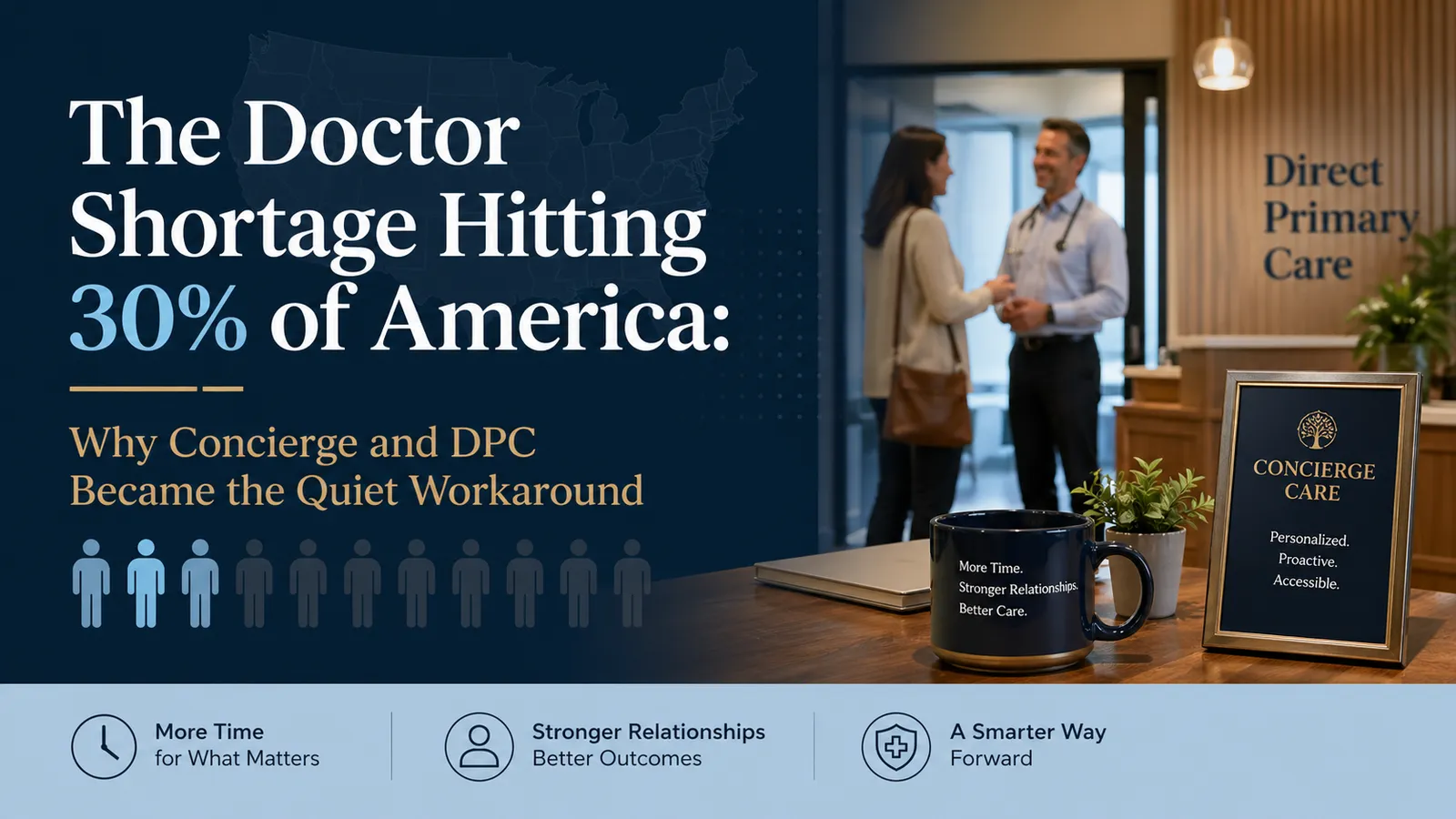

Nearly 30% of US adults do not have a usual source of primary care.[1] That is the highest level recorded in a decade. For children, the number sits at 13.9%, up sharply since 2012.[1]
If you have tried to book a new patient appointment lately and gotten a four-month wait, or no callback at all, the data backs up what you already feel. The traditional primary care system is not just strained. It is contracting.
This is the quiet story behind the rise of concierge medicine and direct primary care. Both models existed before the shortage. But the shortage is what turned them from a niche into a workaround that millions of patients are now actively looking for.
What the Data Actually Shows
Each year, the Milbank Memorial Fund and The Physicians Foundation publish the Health of US Primary Care Scorecard. It is the most authoritative annual diagnosis of the system, and it pulls from federal data sources covering health spending, the physician workforce, and patient access.[1]
The data told a story that has not improved across four straight reports:
Primary care = 4.5% of total US health care spending in 2023, down from 5.4% a decade ago.[1] Comparable countries average closer to 8%.
Primary care physician (PCP) density: 67 per 100,000 people in the US.[1] Canada has roughly 120 family physicians per 100,000.[1]
Only 22% of new physicians entered primary care in 2023.[1] Excluding hospitalists, the number drops to 19.8%, the lowest in a decade.[1]
PCP salaries run about 30% lower than specialist salaries.[6]
A primary care visit reimburses about $259 on average. A gastroenterology visit reimburses $1,092.[1] Procedural specialties earn 4.2 times what office-based primary care earns for the same patient hour.
This is not a soft trend. It is a financing structure that makes primary care the worst-paid, hardest-staffed corner of US healthcare. And it is producing exactly the access collapse you would expect.
Why You Cannot Find a Doctor
A traditional primary care doctor in the United States manages a panel of 2,000 to 2,500 patients.[2] They see 30 to 50 patients a day in visits that average around 13 to 16 minutes.[2] A large share of that time is not spent looking at you. It is spent clicking through electronic health records and dealing with insurance documentation.[2]
When demand exceeds supply at that ratio, three things happen at once:
Wait times stretch. New-patient waits in large metros now run weeks to months.
Existing patients get rationed time. Visits compress further. Phone calls go unreturned.
Doctors leave. A 2018 study found 82% of Wisconsin physicians reported some level of professional burnout.[5] National data shows similar patterns.
The Milbank pipeline numbers explain why no fresh wave of doctors is arriving to fix this. About 37% of medical residents start in primary care. Three to five years out of training, only 21% are still practicing it.[1] More than half move into subspecialties or become hospitalists, doctors who only see patients admitted to a hospital, where the pay is meaningfully better.
The Quiet Workaround
In its 2024 Scorecard, No One Can See You Now, Milbank embedded a verbatim quote from a patient in New York City:
"I liked my primary care doctor but because I had to wait so long to get an appointment with her, when I was sick, I would go to urgent care. During COVID, I got several messages from my doctor that said she was limiting services and adding fees for things like timely prescription refills to keep herself in business. Eventually, I got a letter from her practice saying she was going into concierge medicine. You could get same-day appointments, longer appointments that started on time, and reach her by phone, email, or text. But it was $2,000 a year to join the program, so I opted out and don't currently have a primary care doctor."[3]
That single quote is the workaround in miniature. Her doctor was failing inside the traditional model. Her doctor knew it. Her doctor switched to a model that pays for time. The patient could not afford the membership, so she now has no doctor at all.
This is the story playing out at scale across the country. Concierge medicine and direct primary care (DPC) are not new. What is new is that they are now the only models in which a primary care physician has the financial structure to do the job the way it is supposed to be done.
Where the Displaced Demand Went
Jennifer Dunham's fallback before her doctor switched to concierge is the same fallback most Americans now use. She went to urgent care.
The growth of urgent care is the clearest single signal of how badly traditional primary care is failing to absorb demand. The number of urgent care centers in the United States nearly doubled between 2014 and 2023, growing from roughly 7,220 to 14,382, a 99.2% increase.[7] By mid-2025, the Urgent Care Association counted about 11,877 active centers nationwide, and analysts project the market to grow at roughly 8.6% per year through 2030.[7]
Urgent care is, by design, the middle ground between primary care and the emergency room. Same-day visits, no appointment, $200 to $400 per visit. It exists because primary care does not have the capacity to see you when you are sick, and the emergency room is a poor place to handle a sinus infection or a urinary tract infection.
That growth is not free. Every visit to an urgent care center, and every avoidable visit to an emergency room, is a visit that should have happened in a primary care office with a doctor who knows the patient's history. When primary care spending drops from 5.4% to 4.5% of total US healthcare spending,[1] part of that drop is direct policy disinvestment. The other part is substitution. The dollars patients used to spend on primary care now flow to higher-acuity settings, because primary care cannot see them in time.
This is where the concierge and DPC data starts to read differently. The 2020 SOA/Milliman study found DPC patients visited the emergency room 40.51% less often than traditional insurance patients, with 52.50% lower ER-related costs, even after adjusting for differences in age and health status between the groups.[4] The same study found roughly 35.5% lower preventive care costs for DPC patients, because their doctors integrate prevention into regular visits rather than rationing it into a separate annual physical.[4]
The mechanism is simple. When patients can reach their doctor by text on a Tuesday night, they do not drive to urgent care on Wednesday morning. When the doctor is reachable, the substitution does not happen. The 4.5% spending share for primary care under the traditional model is not the full story of what Americans spend on primary care services. It is the share that flows through primary care offices. The rest flows through urgent care chains and emergency rooms because the primary care doctor cannot pick up the phone.
Membership medicine is not a tax on the system. It is a redirection of the same dollar back to the setting where it works best, which is time with a doctor who can prevent the urgent care or ER trip in the first place.
How Concierge and DPC Solve the Math
The mechanics are not complicated. Both models replace insurance billing, where the practice gets paid per visit by an insurer, with a flat membership fee paid directly by the patient. That single change collapses the patient panel size to something a doctor can actually manage.
Model | Annual Cost | Panel Size | Visit Length |
|---|---|---|---|
Concierge medicine | $3,000 to over $40,000 | Under 300 patients per doctor | 30 to 60+ minutes |
Direct primary care (DPC) | $600 to $2,400 ($50 to $200 per month) | Up to 800 patients per doctor | 30 to 60 minutes |
Traditional primary care | Covered by insurance | 2,000 to 2,500 patients per doctor | 10 to 15 minutes |
Sources for these ranges: NextMD directory data across 4,649 practices, Hint Health 2025 employer report, and SOA/Milliman 2020.[2][4]
When a doctor manages 300 patients instead of 2,500, several things change at once. Same-day appointments become possible. Visits run 30 to 60 minutes. Direct phone, text, or email access to the doctor becomes part of the membership. After-hours calls are answered by the doctor, not a triage line.
The outcomes follow. A 2020 actuarial study by the Society of Actuaries and Milliman found DPC patients visited the emergency room 40.51% less often than traditional insurance patients, with 12.64% lower total healthcare costs, even after adjusting for differences in age, health status, and underlying condition between the two groups.[4] Milbank's own 2026 outcome data found that adults with a stable usual source of care had 20% fewer hospitalizations and 11% fewer emergency department visits when managing chronic disease, with total healthcare costs reduced by 54% compared to adults without one.[1]
The point is not that concierge and DPC are magic. The point is that the basic act of having a doctor who knows you, can see you, and has time to think about your case is what produces these numbers. Traditional primary care is failing to deliver that for a growing share of the country. Membership models still can.
What This Means for You
The doctor shortage is not going to fix itself. The financing problem is structural, not cyclical. New medical school graduates have already voted with their specialty choices, and the salary gap is not closing.
If you can wait six months for a new patient appointment and live with 10-minute visits, the traditional system still works for routine needs. But if you have a chronic condition, a complex family situation, or you simply want a doctor who will pick up the phone, the workaround is no longer exotic.
DPC memberships at the median run roughly $75 to $150 per month, the price of a gym membership. Concierge memberships cost more but deliver more direct physician access. Most members of either model do not pay for these services because traditional primary care failed them in some dramatic way. They pay because they are not willing to let it fail in the first place.
For a deeper look at why traditional visits got so short, see why your primary doctor only spends 7 minutes with you. For the cost math when patients switch, see the DPC vs traditional primary care cost comparison. For the data on what changes when access changes, see why concierge medicine patients visit the ER 40% less often.
NextMD lists more than 4,649 concierge and DPC practices across the United States, including Brentwood MD in Nashville, established practices across the New York metro area, and a growing network in workforce-stressed states like Nevada, where the PCP density is the lowest in the country at 86.9 per 100,000.[1] You can search by city, compare pricing, and view doctor credentials at nextmd.ai/search.
Sources
Jabbarpour, Y., et al. (2026). The Health of US Primary Care: 2026 Scorecard. Continued Underinvestment, Workforce Strain. Milbank Memorial Fund and The Physicians Foundation. milbank.org
Mount Sinai Solutions. (2023). Employer-Sponsored Health Care: Concierge Care Isn't Just a Luxury. Referenced for traditional primary care panel size, daily patient volume, and visit length comparisons.
Jabbarpour, Y., et al. (2024). The Health of US Primary Care: 2024 Scorecard Report. No One Can See You Now. Milbank Memorial Fund and The Physicians Foundation. Patient quote (Jennifer Dunham, New York City) reproduced verbatim from the report.
Busch, F., Grzeskowiak, D., & Huth, E. (2020). Direct Primary Care: Evaluating a New Model of Delivery and Financing. Society of Actuaries / Milliman. soa.org
Carlasare, L.E. (2018). Defining the Place of Direct Primary Care in a Value-Based Care System. Wisconsin Medical Journal, 117(3), 106-110. Referenced for physician burnout data.
Koller, C.F. (2025). Press release on the 2025 Health of US Primary Care Scorecard. Milbank Memorial Fund. Referenced for primary care physician salary differential vs. specialists.
Urgent Care Association. (2025). Center counts. Referenced for active US urgent care center totals (~11,877 active centers as of June 2025) and historical growth from 7,220 centers in 2014 to 14,382 in 2023, sourced from the Trilliant Health 2024 urgent care growth report referenced by the UCA. Forward CAGR figure (~8.6% through 2030) per Grand View Research U.S. Urgent Care Centers Market Report. urgentcareassociation.org/center-counts