

When most people say "primary care," they picture the family doctor's office that takes your insurance and runs 30 minutes behind. In 2026, that office is only one of at least four different ways to get primary care.
The difference matters more than it used to. More than 100 million people in the United States do not have a usual source of primary care.[1] If you are choosing where to get yours, it helps to know exactly what each option is before you commit. This guide breaks down the four main types, what each costs, and how to tell which one fits your situation.
What "Primary Care" Actually Means
Primary care is the everyday medicine that keeps you healthy over time. It covers annual physicals, vaccines, screenings, common illnesses, and the management of long-term conditions like high blood pressure, diabetes, and high cholesterol. The doctor who provides it is usually called a primary care provider, or PCP. A PCP can be a family medicine physician, an internal medicine physician, or a pediatrician for children.
The key word is "over time." Good primary care is a relationship, not a single visit. The doctor who saw your blood pressure creep from 118 to 134 over three years is the one positioned to catch the trend before it becomes a diagnosis. That continuity is the thread that separates real primary care from a one-off appointment, and it is also where the four models start to pull apart.
The Four Main Types of Primary Care
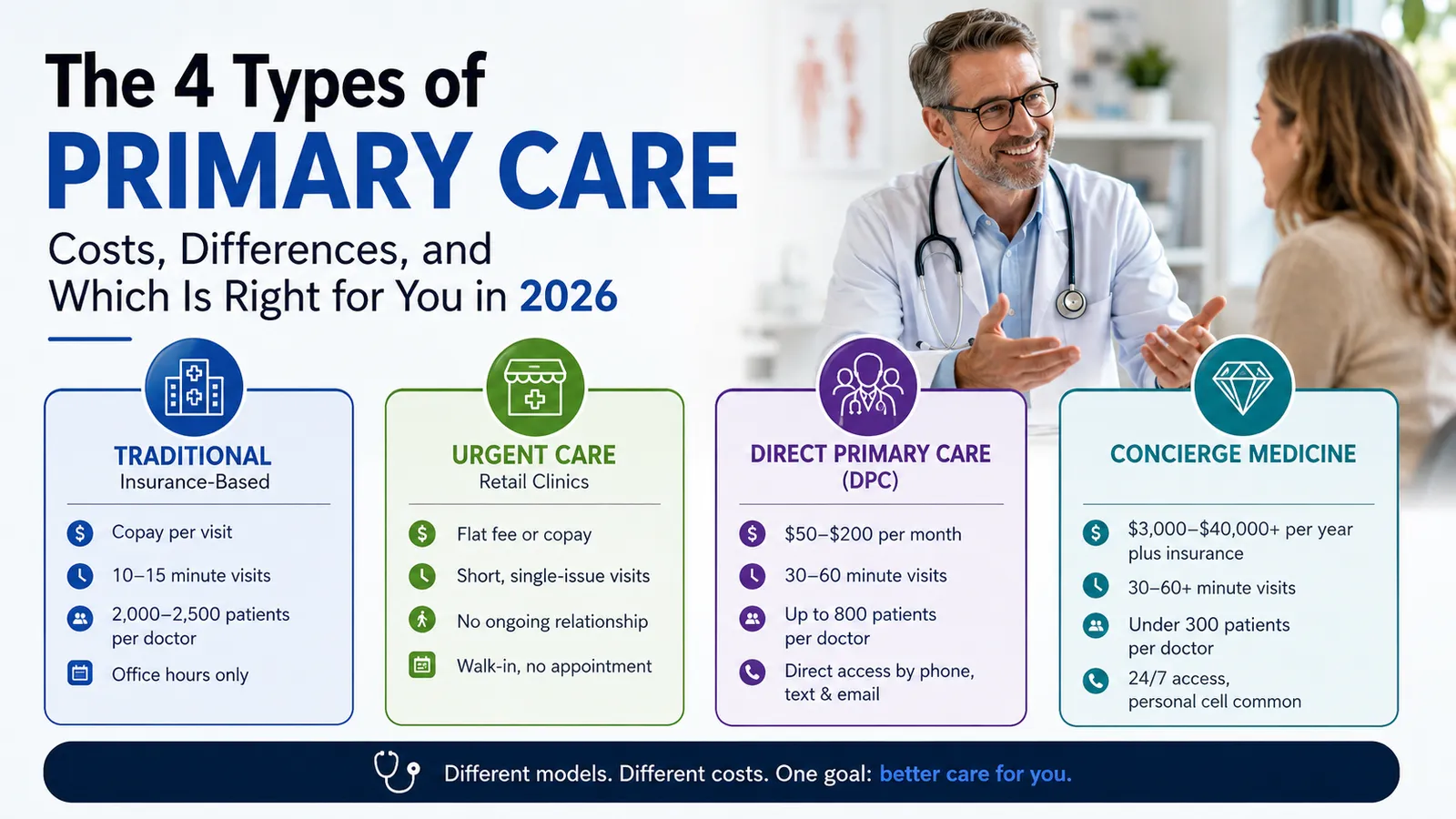
1. Traditional (insurance-based) primary care
This is the model most Americans grew up with. You see a doctor who bills your insurance for each visit, and you pay a copay or coinsurance. It is the default, and for routine, covered care it works for a lot of people.
Strain shows up in the math. A traditional primary care doctor is typically responsible for 2,000 to 2,500 patients. Research on primary care workload found that delivering all the recommended preventive and chronic-disease care to a panel that size would take a single physician roughly 22 hours a day.[2] No one has 22 hours, so visits get compressed. A typical appointment is scheduled for just 10 to 15 minutes, with the face-to-face time often closer to 7, and many offices have stopped taking new patients altogether. The average wait for a new-patient appointment reached 26 days across 15 large metro markets in one national survey.[5] The United States is projected to be short as many as 48,000 primary care physicians by 2034, which makes the squeeze worse every year.[3]
Cost: Covered by insurance (copay or coinsurance per visit)
Appointment length: 10 to 15 minutes
Access: Office hours only
Who it fits: Routine covered care when you already have an established doctor with availability
2. Urgent care and retail clinics
Urgent care centers and pharmacy-based retail clinics handle the in-between problems: a sprained ankle, a fever that will not break, a likely sinus infection on a Saturday. You walk in without an appointment, get seen quickly, and pay a flat fee or a copay.
This tends to be especially common for people who are young, healthy, and have moved away from where they grew up but are under 30 years old.
These are useful, but they are episodic care, not primary care. The clinician who treats your sore throat this week will not be the one tracking your cholesterol next year. There is no continuity and no ongoing relationship. Urgent care is the right call when you need to be seen this week for one specific thing. It is the wrong place to manage a chronic condition or to build the long-term record that catches problems early.
Cost: A flat fee or a copay, typically far less than an emergency room visit
Appointment length: Short, single-issue
Access: Walk-in, no relationship
Who it fits: One-off acute problems when your regular doctor is unavailable
3. Direct primary care (DPC)
Direct primary care (DPC) replaces insurance billing for primary care with a flat monthly membership. You pay the practice directly, usually $50 to $200 per month ($600 to $2,400 a year), and in exchange you get unlimited visits, longer appointments, and direct access to your doctor by phone, text, or email. Most DPC patients keep a basic insurance plan for emergencies, specialists, and hospital care, and use the membership for everyday primary care.
Because the membership funds the practice directly, DPC doctors cap their panels far below the traditional load, often at up to 800 patients. Smaller panels change the experience and, in some cases, the outcomes. A 2020 study commissioned by the Society of Actuaries and conducted by Milliman found that DPC patients visited the emergency room 40.51% less often than traditional insurance patients, even after adjusting for differences in health status.[4] When you can reach your doctor directly, many emergency-room trips simply do not happen.
Cost: $50 to $200 per month ($600 to $2,400 per year)
Appointment length: 30 to 60 minutes
Access: Direct phone, text, and email; same-day or next-day visits common
Who it fits: People who want an ongoing doctor relationship at a predictable monthly cost
4. Concierge medicine
Concierge medicine also uses a membership, but it typically works alongside your insurance rather than replacing the billing for it. You pay an annual retainer for a higher level of access and service, and the practice still bills insurance for covered visits. Annual fees run from $3,000 to over $40,000 per year depending on the tier, with most practices clustered at the lower end.
Concierge doctors cap their panels the tightest of any model, often under 300 patients. That is what funds the signature features: 30 to 60+ minute visits, same-day scheduling, around-the-clock access to the physician, and time for coordination and prevention that a high-volume office cannot offer. If you want the full picture of how the model works and who it suits, see our guide to what concierge medicine is. Sigma Humans in Chicago is one example of the model: a capped panel and a physician who stays reachable instead of booked three months out.
Cost: $3,000 to over $40,000 per year, plus you keep insurance for covered care
Appointment length: 30 to 60+ minutes
Access: 24/7 access, personal cell common
Who it fits: People who want the most physician time and direct, around-the-clock access, and will pay an annual fee for it
Side-by-Side: The Four Types Compared
Traditional | Urgent care | Direct primary care (DPC) | Concierge medicine | |
|---|---|---|---|---|
How you pay | Insurance copay per visit | Flat fee or copay per visit | Flat monthly membership | Annual retainer plus insurance |
Typical cost | Covered by insurance | Flat fee or copay | $50 to $200/month | $3,000 to over $40,000/year |
Appointment length | 10 to 15 minutes | Short, single-issue | 30 to 60 minutes | 30 to 60+ minutes |
Patients per doctor | 2,000 to 2,500 | No panel (episodic) | Up to 800 | Under 300 |
Ongoing relationship | Yes, if you can get in | No | Yes | Yes |
24/7 access to your doctor | No | No | Yes (text/phone) | Yes (personal cell common) |
Who it fits | Routine covered care | One-off acute problems. Often young healthy people in a new city. | Predictable everyday care | Around-the-clock access and time |
The pattern is consistent. The models that cap their panels are the ones that can give you time and access, and they trade a membership fee for it. The models that rely on insurance volume give you coverage but ration the minutes.
Primary Care vs Urgent Care: When to Use Which
People often get this comparison wrong, because the two solve different problems. Primary care is for the long game: prevention, screenings, and managing conditions across years with a doctor who knows your history. Urgent care is for the short game: a specific, acute issue that needs attention today and cannot wait for an appointment.
Use urgent care for a minor injury, a likely infection, or a fever when your regular office is closed. Use primary care, in any of its three relationship-based forms, for everything that benefits from continuity: your annual physical, your blood pressure, your medications, and the subtle changes a doctor only notices when they have seen you before. Urgent care fills a gap. It does not replace a doctor who manages your health over time.
Which Type of Primary Care Is Right for You
Start with two questions: how much continuity do you want, and how do you prefer to pay for it.
If you have a traditional doctor you like and can actually get appointments, there is no reason to switch.
If you cannot find a doctor accepting new patients, membership-based practices are usually open, because their business model depends on keeping panels small. Our guide on how to get a primary care doctor when everyone is full walks through the steps.
If you want unlimited access at a predictable monthly cost and are comfortable keeping a separate insurance plan for emergencies, direct primary care is often the best value.
If you want the most physician time and around-the-clock access and will pay an annual fee for it, concierge medicine is the deeper tier.
DPC and concierge are easy to confuse, since both use memberships and both cap their panels. The short version: DPC replaces insurance billing for primary care and costs less per month, while concierge works alongside insurance and charges an annual retainer for a higher level of access. For the full breakdown, see our concierge vs direct primary care comparison.
How to Find Each Type Near You
Traditional practices and urgent care centers are easy to find through your insurer's directory or a quick search. The membership models are harder to compare, because pricing and panel details are rarely posted clearly.
That is the gap NextMD fills. You can search by city, see which direct primary care and concierge practices are listed near you, compare their monthly or annual pricing side by side, and view each physician's credentials before you call. Every practice listed is physician-led, with at least one MD or DO. Across the NextMD marketplace of more than 6,000 concierge and DPC practices and over 8,700 verified physicians, the average membership runs about $174 per month, with a median of $165 (NextMD directory data, June 2026). It is worth noting that the lower the price of a practice's care the more likely they are to disclose their fees. When we account for non-disclosed prices of concierge medicine the average concierge doctor costs $4,000-$7,000 per year.
FAQ
What are the main types of primary care?
There are four common types: traditional insurance-based primary care, urgent care and retail clinics, direct primary care (DPC), and concierge medicine. Traditional care bills your insurance per visit. Urgent care handles one-off acute problems with no ongoing relationship. DPC and concierge both use memberships and cap their patient panels, which buys longer visits and direct access to your doctor.
What is the difference between primary care and urgent care?
Primary care is ongoing: it covers prevention, screenings, and the management of long-term conditions with a doctor who knows your history. Urgent care is episodic: it treats a specific acute problem, like a sprain or an infection, on a walk-in basis with no continuing relationship. Use urgent care when you need to be seen today for one issue, and primary care for everything that benefits from continuity over time.
Is direct primary care the same as concierge medicine?
No. Both use a membership and cap their panels, but they differ in how they work with insurance and what they cost. Direct primary care replaces insurance billing for primary care with a flat monthly fee, typically $50 to $200, and most patients keep a basic plan for emergencies. Concierge medicine charges an annual retainer, typically $3,000 to over $40,000, and usually works alongside your existing insurance.
Which type of primary care is the cheapest?
For routine covered care, traditional insurance-based primary care has the lowest out-of-pocket cost if you can get appointments. Among the membership models, direct primary care is the lower-cost option, often $50 to $200 per month for unlimited visits, and many people find it competitive with what they already spend on copays and time.
How do I find a DPC or concierge doctor near me?
You can search by city, compare pricing, and view physician credentials for concierge and direct primary care practices at nextmd.ai/search. Every practice listed is physician-led with at least one MD or DO.
NextMD helps you find and compare concierge and direct primary care practices across the United States. Browse by city, compare pricing, and view doctor credentials at nextmd.ai/search.
Sources
National Association of Community Health Centers. (2023). Closing the Primary Care Gap. Report finding more than 100 million people in the United States lack adequate access to primary care. Read the NACHC report
Altschuler, J., Margolius, D., Bodenheimer, T., & Grumbach, K. (2012). Estimating a Reasonable Patient Panel Size for Primary Care Physicians With Team-Based Task Delegation. Annals of Family Medicine, 10(5), 396-400. Finds delivering recommended care to a 2,500-patient panel would require roughly 22 hours per day for one physician. Read on Annals of Family Medicine
Association of American Medical Colleges. (2021). The Complexities of Physician Supply and Demand: Projections From 2019 to 2034. Projects a shortage of up to 48,000 primary care physicians by 2034. Read the AAMC projections
Busch, F., Grzeskowiak, D., & Huth, E. (2020). Direct Primary Care: Evaluating a New Model of Delivery and Financing. Society of Actuaries / Milliman. Found DPC patients visited the emergency room 40.51% less often than traditional insurance patients. Read the SOA/Milliman DPC report
AMN Healthcare / Merritt Hawkins. (2022). Survey of Physician Appointment Wait Times. Average new-patient appointment wait time of 26 days across 15 large metropolitan markets. Read the Merritt Hawkins survey