

In 1997, Garrison Bliss, MD, and Mitch Karton, MD, introduced a lower-cost membership model at Seattle Medical Associates, an early example of modern direct primary care.[1] Their work belongs in a history that also includes concierge medicine, cash-pay practices, and other physicians experimenting with prepaid care.[2][3][4][5]
The idea was affordable access to a doctor through a recurring payment. Turning it into a national movement required other physicians to build their own versions, employers to buy memberships, and lawmakers to clarify the rules. It also involved failures that tested whether a popular care model could sustain a growing business.
Direct primary care (DPC) generally means a recurring fee for an agreed set of primary care services, without billing insurance for those services. Patients still need coverage for care outside the membership.[6]
Memberships typically include routine primary care office and virtual visits, preventive care, and ongoing management of chronic conditions, though the exact services vary by practice.[6] Hospital stays, emergency department care, specialist visits, surgery, and advanced imaging are generally outside the membership, as our guide to what direct primary care covers explains.
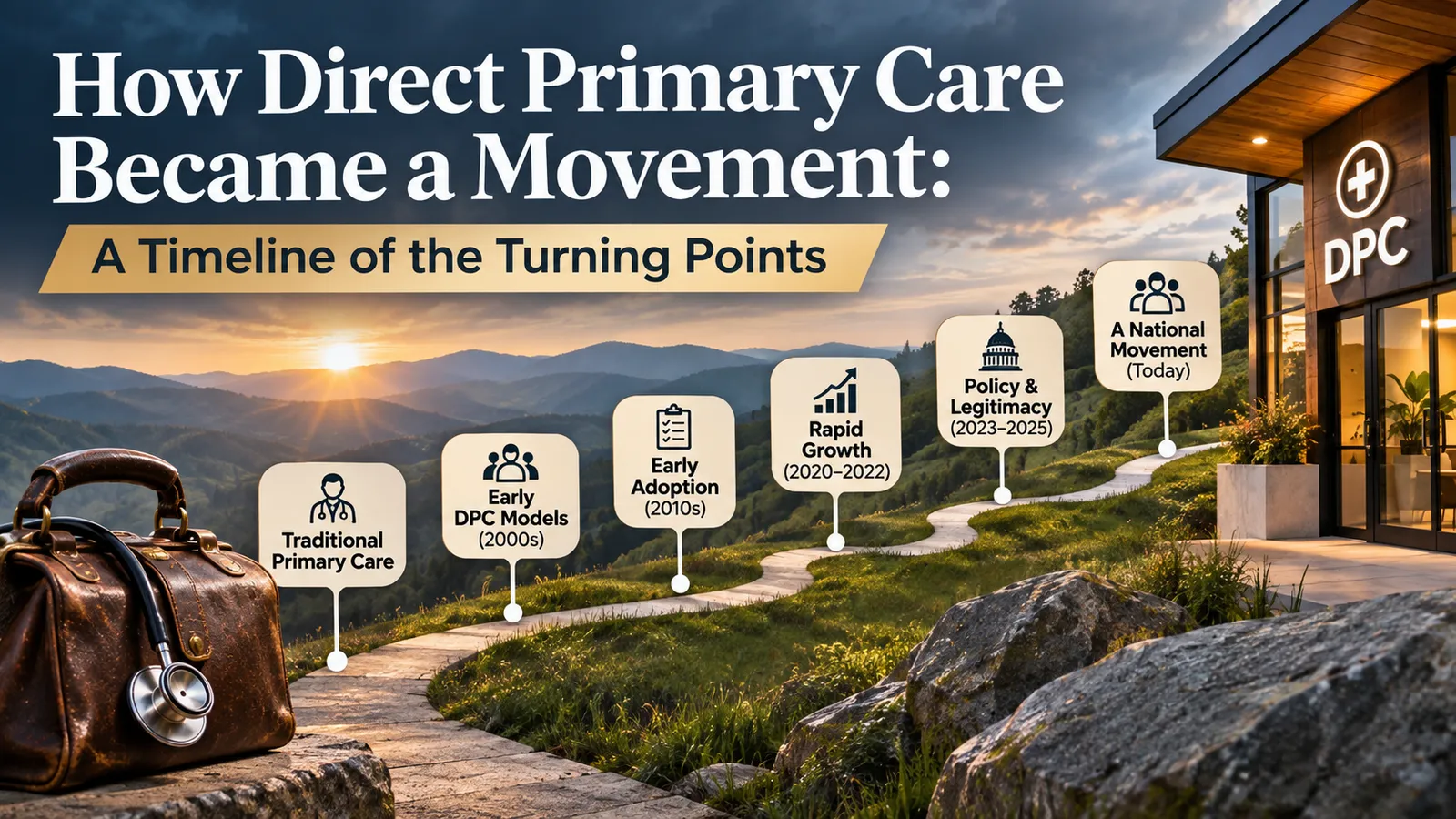
These 22 turning points trace the modern U.S. movement and its immediate predecessors through 2026. They distinguish three related approaches: concierge memberships, payment at each visit, and recurring fees for primary care.
The Direct Primary Care Timeline
Year | Turning point | Why it mattered |
|---|---|---|
1996 | Howard Maron and Scott Hall establish MD² in Seattle.[3] | Concierge membership care provides a predecessor to lower-cost DPC models. |
1997 | Seattle Medical Associates introduces affordable membership care.[1] | Recurring fees offer an alternative way to finance primary care. |
2002 | Brian Forrest opens Access Healthcare in North Carolina.[2] | A low-overhead, cash-pay practice demonstrates another route away from insurance billing. |
2003 | Vic Wood develops Primary Care One in West Virginia.[4][5] | Prepaid primary and urgent care offers another early membership model. |
2007 | Qliance launches and Washington enacts a DPC law.[1][7] | A business seeking to expand gains a clearer state regulatory framework. |
2010 | The Affordable Care Act recognizes qualified DPC medical home plans.[8] | Federal law provides a way to coordinate DPC with comprehensive insurance. |
2013 | Qliance opens a clinic at Expedia's headquarters building.[9] | Employer-sponsored DPC becomes a concrete purchasing model. |
2013 | Turntable Health introduces a team-based membership clinic in Las Vegas.[10][11] | A visible experiment connects membership care with community health and payer partnerships. |
2013–2014 | The first national DPC summits convene; an American Academy of Family Physicians (AAFP) member group follows.[12][13] | Physicians gain organized channels for education and collaboration. |
2015 | DPC Frontier launches; a national study identifies 141 practices.[14][15] | Practical resources and published research help define the field. |
2017 | Turntable Health and Qliance close clinics.[11][16] | Prominent experiments expose the difficulty of sustaining a different payment model. |
2017–2018 | Physicians organize and recruit for the DPC Alliance.[17] | The movement builds a dedicated professional organization. |
2018 | Florida passes its DPC insurance exemption.[18][19] | State recognition spreads well beyond Washington. |
2019–2020 | An executive order leads to proposed Treasury/IRS rules on DPC payments.[20] | Tax recognition advances, but the general health savings account (HSA) contribution barrier remains. |
2020 | The Society of Actuaries publishes Milliman's DPC evaluation.[21] | Employer claims data add evidence about utilization, costs, and financial tradeoffs. |
2020 | DPC membership grows during the pandemic in Hint's data.[22] | Recurring membership care demonstrates resilience in enrollment during a major disruption. |
2021–2022 | DPC networks broaden their reach.[23] | Employers gain more ways to connect geographically dispersed workers with practices. |
2025 | The DPC Coalition reports 34 states with DPC laws or regulations.[24] | Legal recognition is widespread, although tracker definitions differ. |
2025 | The One Big Beautiful Bill Act changes federal HSA law.[25] | Congress creates a statutory route to combine qualifying DPC and HSA contributions beginning in 2026. |
2025 | Health Affairs reports 3,036 concierge and DPC sites in its 2023 sample.[26][27] | Research documents expansion while highlighting the limits of combined-model counts. |
2025 | Employers fund 60% of active memberships in Hint's dataset.[28] | Workplace benefits become a substantial source of enrollment. |
2026 | New federal HSA rules take effect.[25] | Qualifying memberships become easier to combine with tax-advantaged healthcare spending. |
The Future | We believe there is massive growth in store for the DPC market. Our prediction is between 20-50% annual growth over the next 5 years. | This matters because people deeply desire a better relationship with their primary care physicians |
1996: MD² Provides a Concierge Predecessor
Howard Maron, MD, and Scott Hall, MD, established MD² in Seattle in 1996. Its model centered on a small patient panel and highly personalized physician access.[3]
MD² was a concierge practice. It belongs in this timeline because Bliss describes the departure of two partners to establish MD² as an influence on his thinking about monthly fees. He then explored a lower-priced version of membership primary care.[1]
The distinction is important: the development of concierge medicine and the development of affordable DPC are connected histories, but they are not interchangeable models.
1997: Bliss and Karton Develop Affordable Membership Care
Bliss calculated that a practice could operate at $30 to $50 per patient per month, depending on age. He and Karton introduced their membership approach at Seattle Medical Associates in 1997 and filled their practices in just over a year, according to his account.[1]
A monthly payment changes the practice's revenue model: the doctor receives payment to maintain an ongoing relationship and remain available, including during months when a patient has no office visit. The membership must fund the staff, space, and physician time needed to fulfill that promise.
2002: Brian Forrest Demonstrates a Different Route in North Carolina
Brian Forrest, MD, opened Access Healthcare in Apex, North Carolina, in April 2002. In his 2007 account, he described a practice that avoided insurance contracts, collected payment at the visit, and charged $45 for an office visit at that time.[2]
This was an early cash-pay model, with a different payment structure from monthly membership DPC. That distinction matters when tracing the movement's origins.
Forrest reported that about half his patients had traditional insurance, 15% had catastrophic or hospital-only coverage, and 35% were uninsured. His approach addressed the cost of delivering care by reducing overhead and collecting fees directly.[2]
The Seattle and North Carolina examples show physicians experimenting with different business models around a shared question: could they make primary care more accessible by changing how the practice collected payment? The modern movement drew on more than one local experiment.
2003: Vic Wood Introduces Prepaid Care in West Virginia
Vic Wood developed Primary Care One in Wheeling, West Virginia, in 2003.[4] A 2007 Wall Street Journal report described his prepaid plan: $83 per month for an individual or $125 for a family, covering unlimited primary and urgent care along with specified tests and medications.[5]
Those were the prices reported in 2007. The arrangement shows another physician applying recurring payments to ordinary medical needs, including those of uninsured patients. The same report documented the insurance-regulation questions that confronted prepaid practices.[5]
Alongside the Seattle membership model and Forrest's cash-pay approach, Wood's work broadens the early history beyond a single practice or city.
2007: Qliance Launches and Washington Defines the Rules
Garrison Bliss co-founded Qliance with Erika Bliss and Norm Wu in 2007. Their ambition was a scalable, venture-backed DPC business.[1]
That year, Washington enacted a legal framework for direct patient-provider primary care. Practices complying with the law were excluded from specified state insurance categories. The law also established requirements for monthly fees and patient agreements.[7]
This answered a practical question: did taking a recurring payment for future primary care make a practice an insurer?
Washington's law distinguished the arrangement while imposing patient protections. Agreements had to explain that the membership did not provide comprehensive insurance, and disclosures had to encourage insurance for services outside the agreement.[7]
2010: Federal Health Reform Recognizes DPC
The Affordable Care Act, enacted March 23, 2010, included a provision for qualified direct primary care medical home plans. It allowed qualified health plans to provide coverage through these arrangements, subject to federal criteria and coordination with the health plan.[8]
Bliss credits the Direct Primary Care Coalition and its work with Jay Keese in securing DPC's inclusion.[1]
The provision gave DPC explicit recognition in federal health reform. It did not make a standalone membership a complete insurance policy or require every health plan to offer one. The qualified health plan still had to satisfy the law's other requirements.[8]
2013: Expedia Provides an Early Employer Example
Qliance opened a clinic in Expedia's headquarters building in Bellevue in January 2013. It served Expedia employees and the general public, according to contemporary reporting that included an interview with Erika Bliss.[9]
Qliance subsequently reported adding Comcast and the Seattle Firefighters' union among its employer groups in 2014.[29]
Employer participation changed how DPC could reach patients. A practice could enroll people through a workplace benefit, with the purchasing relationship extending beyond individual households.
For the employer, the arrangement offered a way to purchase access to primary care directly. For the practice, it created an opportunity to bring in groups of members, along with dependence on retaining those contracts.
For employees evaluating that benefit today, our guide to employer-provided DPC explains how membership services fit alongside broader coverage.
2013: Turntable Health Tests Team-Based Membership Care
Zubin Damania, MD, known as ZDoggMD, introduced Turntable Health in downtown Las Vegas in 2013. His December announcement promoted the new clinic; his later account described a team-based practice combining individual memberships with employer, union, and insurer partnerships, including work with Iora Health.[10][11]
Turntable broadened the story beyond the small independent membership office. It tested whether relationship-based primary care could operate across several purchasing arrangements within one community. Its subsequent closure would make the financing question just as visible as the care model.
2013–2014: Physicians Begin Meeting as a National Community
The Family Medicine Education Consortium (FMEC) sponsored the first DPC National Summits in 2013 and 2014. It describes learning about the model through its Innovators Network in 2008 and subsequently helping connect physicians interested in its development.[12]
The American Academy of Family Physicians (AAFP) established its DPC Member Interest Group in July 2014.[13]
These organizations helped turn individual practice experiments into a community physicians could find and join. FMEC's educational resources include sessions on working with employers and becoming part of an employee benefit offering. The AAFP group's objectives include mentorship, education, and practical resources for physicians considering DPC.[12][13]
2015: DPC Becomes Easier to Find, Study, and Start
Physician and attorney Philip Eskew founded DPC Frontier in February 2015. Its resources include a practice mapper, state regulatory information, and guidance for physicians starting practices.[14]
That year, Eskew and Kathleen Klink, MD, published a study identifying 141 practices with 273 locations across 39 states. Among 116 practices with available pricing, the estimated median monthly cost was $75, incorporating membership charges and applicable enrollment and visit fees.[15]
Those were findings from the practices the researchers could identify, not a mandatory national census. The paper also distinguished practices operating entirely through direct payment from those combining DPC and insurance-based patient populations.[15]
The work gave the discussion more substance: named practices, locations, definitions, and prices. It also identified an evidence gap. The authors could describe distribution and cost, but called for stronger research on quality and outcomes.[15]
Today's directories differ in their inclusion criteria. NextMD only includes DPC practices led by an MD or DO physician.[30] DPC Frontier's Mapper does not have that same requirement and also includes practices led by nurse practitioners or physician assistants.[31] Their practice totals therefore describe different populations and should not be treated as directly interchangeable.
2017: Turntable Health and Qliance Reveal Financial Vulnerabilities
Turntable Health ended operations at its downtown Las Vegas location on January 31, 2017. Damania attributed the closure to unsustainable local economics and described refusing payer pressure to introduce fee-for-service billing or copays.[11]
Qliance closed its public clinics on June 15, 2017. Contemporary reporting described a decline from 35,000 patients in 2015 to 13,000 in early 2017, alongside the loss of major employer business.[16]
The closure is a necessary part of DPC's history. Patients could value the care while the company delivering it struggled financially. In her interview, Erika Bliss pointed to difficulty obtaining sufficient payment for primary care and resistance from payers.[16]
The lesson for the movement was that membership revenue still had to cover operating costs. Expanding through outside capital and large contracts introduced business risks alongside opportunities to reach more patients.
These closures did not establish that every independent DPC practice was unviable. They did show why patient satisfaction, clinical results, and business sustainability need to be evaluated separately.
2017–2018: The DPC Alliance Builds a Dedicated Organization
Douglas Farrago, MD, describes proposing a DPC-specific organization in 2016, followed by discussions at the 2017 Nuts and Bolts conference and online. The physicians involved contributed their own money to get the organization moving.[17]
By 2018, they were recruiting members at the AAFP's Family Medicine Experience conference. Farrago's account describes wanting practitioners to have an organization focused specifically on DPC and able to represent them.[17]
The movement could therefore continue developing through independent practices and professional collaboration even as a prominent corporate experiment failed. Its future depended on a wider community than any one company.
2018: Florida Marks the Spread of State Recognition
Florida enacted its DPC agreement law in 2018. DPC Frontier identifies it as the 24th state to pass legislation defining qualifying DPC arrangements outside insurance regulation.[19]
The Florida statute expressly covered agreements involving a patient, a legal representative, or an employer. It required written terms addressing covered services, fees, termination, and refunds when a provider stopped offering services.[18]
By this point, the legal question addressed in Washington in 2007 had become a multistate policy effort. Physicians still had to meet the requirements of their own jurisdiction; one state's exemption did not establish a uniform national rule.
State insurance exemptions left federal tax questions unresolved.[25]
2019–2020: Federal Tax Recognition Advances, but the HSA Barrier Remains
On June 24, 2019, President Donald Trump issued Executive Order 13877, directing Treasury to propose rules addressing whether arrangements such as DPC could qualify as medical expenses. Treasury and the IRS followed with proposed regulations in June 2020.[20]
The proposal would recognize qualifying DPC payments as medical expenses under Internal Revenue Code Section 213. But it also maintained that participation in a typical DPC arrangement generally prevented HSA contributions, because the arrangement provided benefits before the required deductible.[20]
An executive order, a proposed rule, and an enacted statute are different milestones. The 2019–2020 effort did not deliver the HSA contribution eligibility that Congress would establish in 2025. This distinction explains why advocates continued seeking legislation after the proposed regulations appeared.
2020: Milliman and the Society of Actuaries Test the Economics
In May 2020, the Society of Actuaries published an evaluation by Milliman researchers combining a physician survey with an employer case study. The claims analysis compared employees and dependents choosing a DPC option with those choosing a traditional plan.[21]
After adjustments for age, sex, and health status, the DPC group had 40.51% lower emergency department utilization and 12.64% lower claims costs. These were associations in one employer's population, not results from a randomized national trial.[21]
The financial conclusion was more nuanced than a simple savings headline. Once membership fees and other benefit-design changes were included, the researchers estimated a 1.3% increase in the employer's total nonadministrative plan costs.[21]
The study gave employers a more concrete way to evaluate DPC. Lower claims and fewer emergency visits could coexist with higher total employer spending, depending on membership prices and how the benefit was structured.
2020: COVID-19 Tests the Membership Model
The pandemic offered a practical test of paying for an ongoing care relationship. Hint's retrospective reporting, citing its 2022 DPC Trends Report, recorded 21% membership growth in 2020.[22]
That is evidence of enrollment resilience in Hint's observed market, not proof that every DPC practice remained profitable or that DPC improved COVID outcomes. Membership counts also measure something different from office visits, so they should not be compared as equivalent measures of utilization.
The business logic became especially relevant: recurring fees could continue supporting a practice when care shifted away from the exam room. Financial resilience still depended on patients or employers retaining those memberships.
2021–2022: Networks Make DPC Easier for Employers to Purchase
Hint's 2022 reporting found that networks operating on its platform expanded from 20 states in 2019 to 40 in 2021.[23] These were networks connecting practices and purchasers, not a count of states where DPC itself was available.
The development mattered for employers with workers in several locations. A network offered a way to arrange access across independent practices rather than build a separate relationship with each one. This helps explain the employer enrollment growth visible later in the decade.
2025: State Recognition Is Widespread
The DPC Coalition reports that 34 states had enacted laws or regulations defining DPC outside insurance regulation as of 2025.[24] That remains its latest published total at this article's November 9, 2026 review.
A narrower check of DPC Frontier's enacted-law list on that date identifies 33 states.[32] The two trackers use different labels and may differ in update timing; neither figure should be presented as 34 identical state statutes. For a particular practice, the state's actual law and applicable requirements remain controlling.
2025: Congress Changes the HSA Rules
The One Big Beautiful Bill Act (OBBBA), enacted July 4, 2025, amended federal HSA law to accommodate qualifying DPC arrangements, with the relevant provisions taking effect January 1, 2026.[25]
This was the legislative step missing from the 2019 executive order and 2020 proposal. It addressed both the ability to contribute to an HSA while enrolled in qualifying DPC and the treatment of qualifying membership payments. The two provisions have different conditions, discussed below.
2025: Health Affairs Measures the Broader Membership-Care Market
A December 2025 study by Jane Zhu and colleagues identified growth from 1,658 concierge and DPC practice sites in 2018 to 3,036 in 2023, an 83.1% increase. The clinician count rose from 3,935 to 7,021.[26][27]
These are combined concierge-and-DPC figures, measured through 2023, not a count of DPC-only practices operating in 2025. The clinician total also includes nonphysician practitioners. The authors linked public and proprietary data; their sample is not interchangeable with the physician-led scope of NextMD or the DPC Mapper's inventory.[26][27]
The study documented expansion while raising questions about workforce distribution and access for patients outside membership practices. A fuller history needs both parts: why clinicians and patients choose these models, and what their growth means for the wider primary care system.[27]
2025: Employers Fund a Majority of Memberships in Hint's Dataset
Hint Health's 2026 report shows the employer-funded share of active memberships on Hint Core rising from 18% in 2017 to 37% in 2020 and 60% in 2025.[28]
Its membership measure also increased from 44 active members per 100,000 U.S. residents in 2017 to 409 in 2025. The report uses Hint's membership database and U.S. Census population figures.[28]
These figures describe Hint's data, not a complete national census. They show a sustained expansion within the platform and the growing role of employers in funding memberships.
2026: A Longstanding HSA Barrier Is Reduced
The OBBBA provisions took effect January 1, 2026, turning the prior year's legislative change into an available financing option.[25]
Qualifying arrangements now preserve contribution eligibility, subject to other requirements. For 2026, the monthly fee thresholds are $150 for one person or $300 for an arrangement covering more than one person, with aggregation rules.[25]
Reimbursement is separate. IRS guidance allows qualifying DPC fees to be reimbursed without that same dollar cap, even when the fee disqualifies a person from making contributions. The arrangement must meet the requirements for services and payment structure.[25]
This addressed a specific obstacle to combining DPC with HSA-based healthcare financing. It did not automatically qualify every membership or resolve the cost of care outside the agreement.
The Future
Looking ahead, we expect direct primary care to keep expanding as more physicians open membership practices, employers add DPC benefits, and patients become familiar with the model. The 2026 HSA changes could support that growth by making qualifying memberships easier to fund, while broader practice networks could help employers offer DPC across multiple locations.
We expect growth rates to be between 20-50% Annually for the next 3-5 years.
What Made DPC a Movement
The history shows several developments reinforcing one another: physicians demonstrating workable practices, colleagues sharing operating knowledge, employers funding enrollment, and lawmakers recognizing the arrangement.
It also shows why growth needs careful measurement. A new law creates permission. An employer contract creates access for a group of workers. A practice opening creates local capacity. Each helps DPC develop, but none alone establishes better outcomes or a sustainable business.
For patients, those developments matter when they result in a local practice with clear fees, available appointments, and continuity of care. The history explains how that option became more widely available. The individual practice still has to deliver it.
FAQ
Is DPC the same as concierge medicine?
Both can involve memberships. DPC generally uses the fee to cover primary care without billing insurance for those services. Concierge practices may charge a membership fee and also bill insurance for covered care.[6]
Does a DPC membership replace health insurance?
No. Membership covers the services in the agreement. Patients need separate protection for hospital care and other expenses outside it.[6]
Sources
Bliss, G. (n.d.). The Origins of Direct Primary Care: Transformation, Simple Ideas, and Trojan Horses. Hint Health. Read Bliss's firsthand account.
Forrest, B. R. (2007). Breaking Even on Four Visits Per Day. Family Practice Management, 14(6), 19–24. Read Forrest's account of Access Healthcare.
MD². (n.d.). Concierge Medicine Origins. Read the practice's founding history.
Doctors Urgent Care. (n.d.). Dr. Vic Wood. Read Wood's biography and the 2003 Primary Care One founding date.
Fuhrmans, V. (2007, October 22). To Cure Insurance Woes, Doctors Try Prepaid Plans. The Wall Street Journal, p. A1; reproduction hosted by Primary Care One, PDF pp. 1–5. Read the contemporary report on Wood's prepaid practice.
American Academy of Family Physicians. (n.d.). Direct Primary Care: What to Know. Read the AAFP model overview.
Washington State Legislature. (2007, as amended). Chapter 48.150 RCW: Direct Patient-Provider Primary Health Care. Sections 48.150.030, .060, and .110. Read Washington's statute.
United States Congress. (2010). 42 U.S.C. § 18021(a)(3): Qualified Direct Primary Care Medical Home Plans. Cornell Legal Information Institute. Read the federal DPC provision.
Cook, J. (2013, January 3). Qliance Raises $8M, Opens New Clinic on Expedia Campus. GeekWire. Read the contemporary report and Erika Bliss interview.
Damania, Z. (2013, December 11). Commercial Break. ZDoggMD. Read the contemporary Turntable Health clinic announcement.
Damania, Z. (2017). The Turntable Health Revolution. ZDoggMD. Read the founder's account of the model and January 2017 closure.
Family Medicine Education Consortium. (n.d.). Direct Primary Care. Read FMEC's summit history and educational resources.
American Academy of Family Physicians. (n.d.). Direct Primary Care Member Interest Group. Read the establishment date and objectives.
DPC Frontier. (n.d.). About Us. Read the February 2015 founding history and mission.
Eskew, P. M., and Klink, K. (2015). Direct Primary Care: Practice Distribution and Cost Across the Nation. Journal of the American Board of Family Medicine, 28(6), 793–801, especially pp. 794–798. Read the practice distribution and pricing study.
Andrews, M. (2017, June 20). A Pioneer in 'Flat-Fee Primary Care' Had to Close Its Clinics. What Went Wrong? KFF Health News, republished by NHPR. Read the Qliance closure report.
Farrago, D. (2024, September 9). How the DPC Alliance Started. DPC News. Read Farrago's firsthand organizational history.
Florida Legislature. (2018). Florida Statutes § 624.27: Direct Primary Care Agreements; Exemption from Code. Read the original 2018 statutory text.
DPC Frontier. (n.d.). Florida. Read the historical state-law entry.
U.S. Treasury and Internal Revenue Service. (2020, June). Certain Medical Care Arrangements, REG-109755-19. Internal Revenue Bulletin 2020-26, Part IV; background on Executive Order 13877 and explanation of HSA treatment. Read the proposed regulations and their limits.
Busch, F., Grzeskowiak, D., and Huth, E. (2020, May). Direct Primary Care: Evaluating a New Model of Delivery and Financing. Society of Actuaries / Milliman, pp. 7, 29–35. Read the claims analysis and employer-cost findings.
Hint Health. (n.d.). Take the Guesswork Out of Your DPC Start-up Journey. Reporting findings from the 2022 DPC Trends Report. Read the reported 2020 membership growth.
Hint Health. (n.d.). Growth of DPC Networks. Reporting findings from Trends in Direct Primary Care 2022. Read the 2019–2021 network expansion data.
Direct Primary Care Coalition. (n.d.). State Legislation, on the Coalition's homepage. Latest published total: 34 states with laws or regulations as of 2025; checked November 9, 2026. Read the Coalition's state-recognition total.
Internal Revenue Service. (2025). Notice 2026-5: Expanded Availability of Health Savings Accounts under the One, Big, Beautiful Bill Act. Pages 1, 4–6, and 11–15, particularly Q&A 20. Read the IRS DPC and HSA guidance.
Zhu, J. M., Marsh, T., Polsky, D., Huntington, A., and Song, Z. (2025, December). Growth in Number of Practices and Clinicians Participating in Concierge and Direct Primary Care, 2018–23. Health Affairs, 44(12), 1473–1481. Read the study abstract and methodology summary.
Ward, M. (2025, December 18). Fee-Based Primary Care Is Rapidly Rising in US, Hastening Doctor Shortages for the Public. Johns Hopkins University, republished by Medical Xpress. Read the research institution's practice and clinician counts.
Hint Health. (2026). Trends in DPC '26. Pages 6 and 9. Read the membership and employer trends report.
Qliance. (2015, January 15). New Primary Care Model Delivers 20 Percent Lower Overall Healthcare Costs, Increases Patient Satisfaction and Delivers Better Care. PR Newswire. Cited for employer relationships. Read Qliance's employer expansion announcement.
NextMD. (n.d.). About NextMD. Read the MD/DO physician leadership requirement.
Louisiana Academy of Family Physicians. (n.d.). Topic 6: Staffing and Building a Team. Section: Resources for Finding a Mentor. Read the distinction between physician-only directories and DPC Frontier's Mapper.
DPC Frontier. (n.d.). State Defining Outside of Insurance Laws. Counted 33 state names marked as enacted laws on November 9, 2026. Read the enacted-law tracker.