
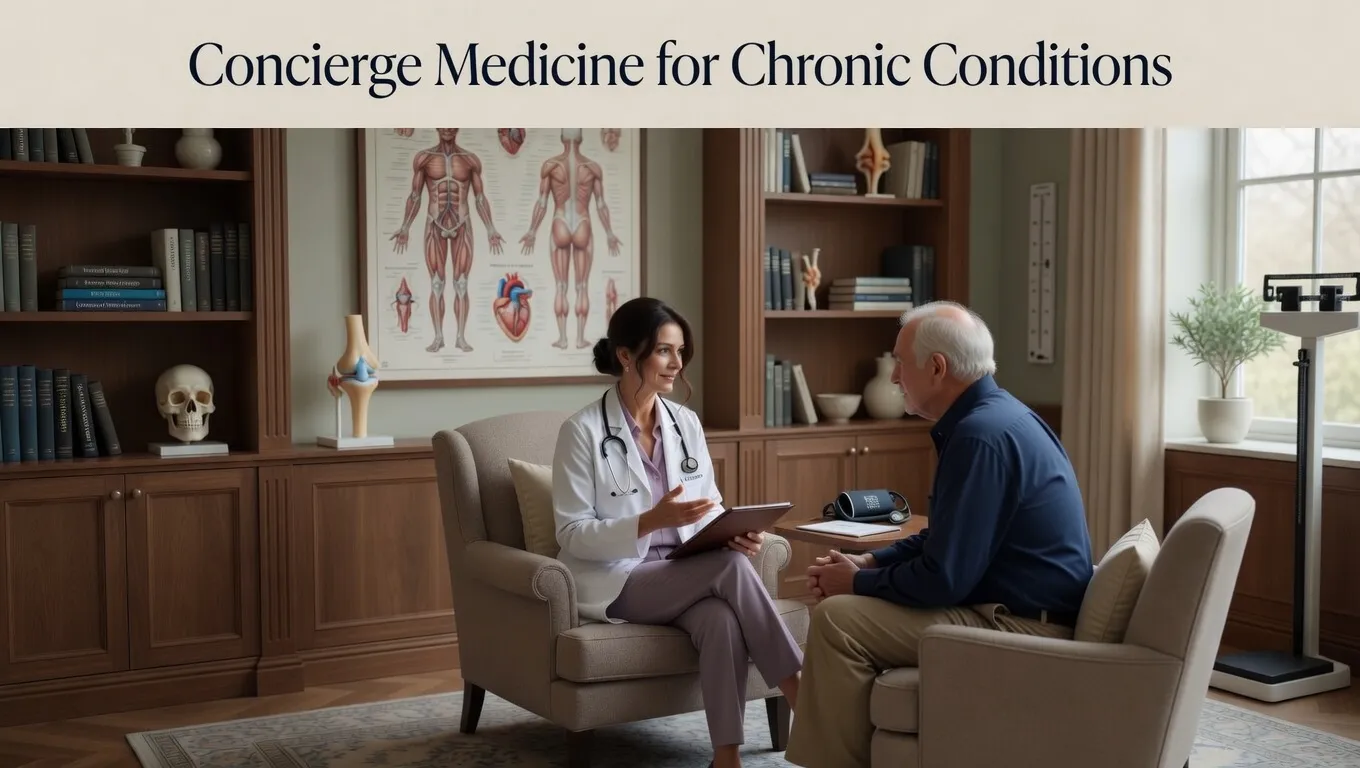

Over half of all American adults live with at least one chronic condition. Four in ten live with two or more.[7] In traditional primary care, those same adults typically get less than 20 minutes of attention from their primary care doctor per visit.
The math does not work for treating and caring for people with chronic illnesses.
The most common chronic illnesses include diabetes, high blood pressure and heart disease. These conditions do not fit into 20 minutes.
They need medication adjustments, lab review, lifestyle coaching, symptom checks, specialist coordination, and the kind of follow-up that can happen before something goes wrong. Concierge medicine and direct primary care (DPC) are structured to deliver exactly that. They are not luxury healthcare. For someone managing a chronic condition, they may be the right setting to actually manage it.
Why 20 Minutes Does Not Work For Chronic Disease
A traditional primary care physician (PCP) carries a panel of 2,000 to 2,500 patients.[1] They see 30 to 50 people a day.[1] Appointments average less than 20 minutes, and a meaningful share of that time is spent clicking through an electronic health record, not talking to you.
That setup is optimized for throughput. It is not optimized for managing a condition that needs monthly attention.
If you have Type 2 diabetes, a good visit should review your A1C trend, walk through your glucose log, adjust medications, check your feet, talk through what you are eating, coordinate with your endocrinologist, and leave room for the new symptom you were not planning to bring up. That does not happen in fifteen minutes. It often gets compressed to "your numbers look okay, see you in three months."
The same compression happens with hypertension and heart disease. Blood pressure logs go unreviewed. Medication side effects go unaddressed. A patient who is doing everything right still ends up in the emergency room (ER) or the cath lab because the small signals were never caught.
The Structural Fix: Smaller Panel, Longer Visit, Real Access
Concierge and DPC practices solve this by changing the structure of primary care itself.
Traditional Primary Care | Direct Primary Care (DPC) | Concierge Medicine | |
|---|---|---|---|
Patient panel per doctor | 2,000 to 2,500 | up to 800 | under 300 |
Appointment length | 10 to 20 minutes | 30 to 60 minutes | 30 to 60+ minutes |
Same-day access | Rare | Mostly of the time | Almost always |
Phone or text to your doctor | Office hours only | Usually Included | Included, often personal cell |
Annual cost | Covered by insurance (premiums, copays, deductibles) | $600 to $2,400 per year | $3,000 to over $40,000+ per year |
Sources: [1][3][5]
The numbers explain the difference in care. A doctor with 2,500 patients has roughly four minutes of margin per patient per year. A doctor with 300 patients has over an hour. That extra time is what makes chronic disease management possible.
What The Evidence Actually Shows For Chronic Disease Patients
The research base on concierge medicine and DPC is strongest on preventive screening, utilization, and ER reduction. It is moderate on direct chronic disease control. And it is thin on long-term mortality. That nuance matters, so here is what is actually known.
Preventive screening is dramatically higher
In a study of 10,186 MDVIP concierge members matched with non-members, the concierge group hit a 96% LDL cholesterol screening rate vs 84 to 89% nationally, and 69% of members were at cholesterol goal compared to 37 to 52% nationally.[2]
In plain English, LDL is the "bad" cholesterol, the kind that clogs arteries and drives heart attacks and strokes. "At goal" means the number is low enough to meaningfully reduce that risk. So the concierge group was both tested more often and actually had their cholesterol under control far more often. For patients at risk of heart disease, that gap is the difference between a statin that gets prescribed on time and a heart attack that did not need to happen.
ER visits drop sharply
A 2020 actuarial study by the Society of Actuaries (SOA) and Milliman found DPC patients had 40.51% fewer ER visits and 12.64% lower total healthcare costs than traditional insurance patients, even after adjusting for health status differences (p<.001).[1] For a chronic disease patient, the ER is often the default on a bad day. Cutting that number nearly in half changes the experience of living with the condition.
This also lowers stress of those with chronic illnesses as they know they have access to a doctor they know when they need them. Rather than a random experience with the local ER.
Patients actually see their doctor
Hint Health's 2025 data (2,400+ clinicians, 1.2 million members) found DPC patients had 3.5x more physician visits per year than the national fee-for-service average, and roughly 6x more total clinician time annually.[3] A single-clinic study in Houston found DPC patients averaged 6.89 appointments per year vs 1.5 in traditional care, and patients who had been enrolled 21 months or longer averaged nearly ten appointments a year, with statistically significant dose-response growth over time (p<.001).[4]
For chronic conditions, frequency is the medicine. A patient seeing their doctor ten times a year with unlimited text access is simply going to catch and correct drift faster than a patient seen once a year.
Honest caveat on outcomes
A 2025 systematic review in the American Journal of Medicine looked at 49 studies published over the last decade.[6] It found consistent evidence on patient satisfaction, preventive screening, and reduced hospital admissions. It did not find large randomized trial evidence on mortality or long-term disease progression. That gap is real. The case for concierge and DPC in chronic disease rests on strong evidence for better access, screening, and ER reduction, and on the reasonable inference that those factors improve control over time. Not on a guarantee of longer life.
What You Actually Get As A Patient With A Chronic Condition
This is the concrete list, drawn from the American Academy of Family Physicians (AAFP) 2024 Direct Primary Care Data Brief, which surveyed 374 physicians (177 DPC, 197 non-DPC).[5] The same service profile applies to most concierge practices.
Same-day or next-day appointments (98% of DPC practices). You can get seen the day a reading looks wrong instead of waiting three weeks.
Phone and text access to your doctor (98%). Medication questions at 9pm get answered in minutes.
Telemedicine included (98%). A medication titration visit does not require taking a morning off work.
In-office EKG (85%). Chest tightness can be evaluated the same hour, not sent to a cardiology referral queue.
Nutritional counseling (82%) and weight management (80%). Two of the most important interventions for diabetes, hypertension, and heart disease are actually included in the membership instead of billed separately.
In-house labs at 50 to 90% off retail. A comprehensive metabolic panel that runs roughly $48 at a commercial lab costs around $3 at a DPC practice with in-house labs.[5] For a diabetic pulling quarterly labs, that adds up fast.
Translate that to real scenarios. A patient with Type 2 diabetes adjusting insulin between endocrinology visits can text their DPC doctor a glucose log and get a titration plan the same day. A patient with hypertension whose home cuff reads 158/98 can get in that morning instead of driving to the ER. A cardiology-adjacent patient who notices new ankle swelling can have an EKG and a specialist call initiated before the afternoon. That is what smaller panels buy.
A practical example of the Entry-tier concierge model is James Wallstrom, MD, an Internal Medicine concierge practice in Glendale, California. Internal Medicine is the specialty that spends the most training time on complex chronic disease, and in a concierge setting with a capped panel, that training has room to actually be used.
Concierge vs DPC For Chronic Disease: Which One Fits
Both models work for chronic conditions. They are structured a little differently.
Direct primary care typically runs $600 to $2,400 per year ($50 to $200 per month). Panels go up to 800 patients. Visits are long, access is direct, and the membership usually covers all primary care touchpoints including labs. DPC is often the best value for someone managing one or two chronic conditions who wants unlimited primary care at a predictable monthly cost.
Concierge medicine runs $3,000 to over $40,000 per year depending on the tier. Panels are capped under 300 patients. The model leans harder into specialist coordination, hospital advocacy, and longer annual wellness visits (60 to 90 minutes). Concierge is often the better fit for a patient with multiple conditions, a complex medication regimen, or active coordination with cardiology, endocrinology, or oncology.
For the full side-by-side, see our concierge vs direct primary care comparison.
The Cost Math Works Faster Than People Expect
An average ER visit in the United States costs approximately $2,200, and out-of-pocket costs after copays and deductibles often run $500 to $1,500 per visit.[1]
Run the math against membership cost.
A DPC membership at $125 per month costs $1,500 a year. One avoided ER visit pays for the year.
A Premium concierge membership at $8,000 a year is paid for by one avoided hospitalization. The average inpatient stay costs well over that figure.
A patient whose hypertension finally gets controlled reduces stroke risk that compounds over decades.
None of this depends on the care being "better" in some abstract sense. It depends on the structural reality that a doctor with time catches problems earlier, and earlier problems are cheaper to fix. For a detailed walk-through, see how much does concierge medicine cost, and is it worth it. See also the related finding that concierge medicine patients visit the ER 40% less often, which is the single most important downstream effect for anyone with a chronic condition.
How To Find A Concierge Or DPC Doctor Who Fits Your Condition
Not every practice handles chronic disease the same way. When you are comparing options, check for:
Specialty fit. For complex chronic disease, board-certified Internal Medicine or Family Medicine physicians are the right starting point. For multi-specialty coordination, look for concierge practices that advertise specialist relationships explicitly.
In-house labs and EKG. These are the tools that make chronic care routine instead of a referral.
Phone and text access, same-day availability, and telemedicine. These are the access features that matter most between scheduled visits.
Panel size disclosure. A practice that caps its panel and publishes the number is signaling that they are serious about access.
For a longer walk-through of how to evaluate a specific practice, see our guide on how to choose the right concierge or DPC doctor. If you want to see what options look like in a major market, the Glendale, California concierge doctor directory is a live example.
And if you would like to take a look at what is available near you, nextmd.ai/search has all of it, by city, with pricing and doctor credentials visible upfront.
NextMD helps you find and compare concierge medicine and direct primary care practices across the United States. Browse by city, compare pricing, and find a doctor who has time for you at nextmd.ai/search.
Sources
Busch, F., Grzeskowiak, D., & Huth, E. (2020). Direct Primary Care: Evaluating a New Model of Delivery and Financing. Society of Actuaries / Milliman. soa.org
Musich, S., Klemes, A., Kubica, M.A., Wang, S., & Hawkins, K. (2016). Personalized Preventive Care Reduces Healthcare Expenditures Among Medicare Advantage Beneficiaries. American Journal of Managed Care. (MDVIP cohort, n=10,186.)
Hint Health. (2025). Employer Trends in Direct Primary Care. Based on data from 2,400+ clinicians and 1.2 million members on the Hint platform. hint.com
Ashaye, A. et al. (2025). Patient Utilization Patterns in a Direct Primary Care Clinic. Single-clinic retrospective cohort study, Houston, n=112.
American Academy of Family Physicians. (2024). Direct Primary Care Data Brief. Survey of 374 physicians (177 DPC, 197 non-DPC). aafp.org
Alhawshani, A., & Khan, Z. (2025). Concierge Medicine: A Systematic Review of 49 Studies on Patient Outcomes, Satisfaction, and Health Equity. American Journal of Medicine, March 2025.
Centers for Disease Control and Prevention. About Chronic Diseases. National Center for Chronic Disease Prevention and Health Promotion. cdc.gov