
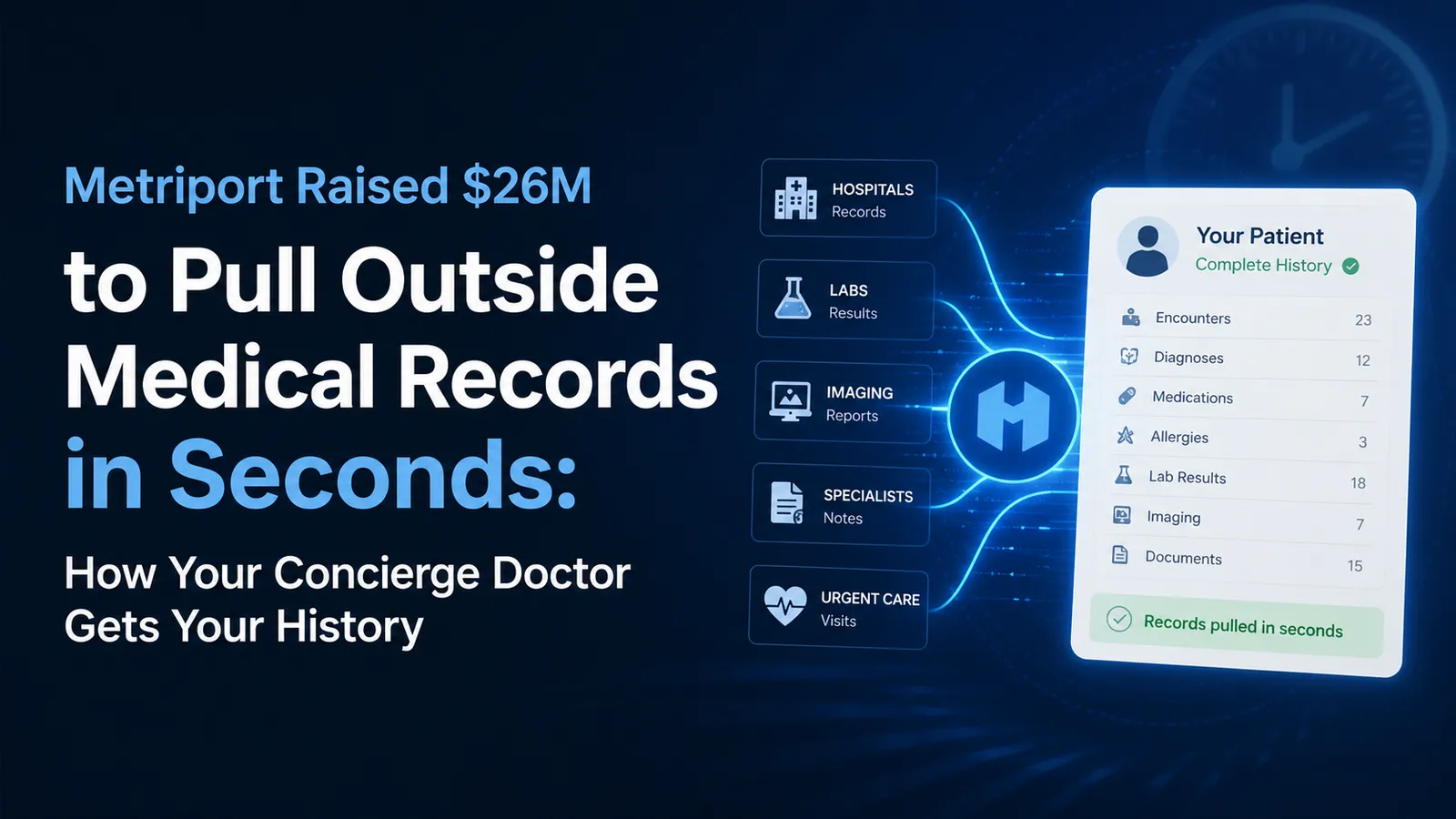

Metriport raised $26 million on August 27, 2026 to pull a patient's outside medical records into a doctor's chart in seconds.[1] TJ Parker, a general partner at Matrix, led the round, with ARTIS Ventures and Y Combinator participating. Total funding now stands at $28.4 million.[1]
Metriport connects to the networks where hospitals, labs, pharmacies, and other practices already share records. It matches the patient, pulls every document it can find, removes duplicates, and converts the result into one standardized record that a doctor sees inside the electronic health record (EHR).[1][2] The company processes 4.2 billion network requests a month and says it returns the first structured record in under 15 seconds.[3][4]
Its named customers include Amazon One Medical, Sollis Health, and Color Health.[1] Sollis Health is a membership-based concierge urgent and emergency care service. That makes this round a useful window into a question most patients never see answered: when you join a new concierge or direct primary care (DPC) practice, how does the doctor actually get your history?
What Metriport Does
Metriport builds software that retrieves a patient's medical records from outside organizations and delivers them to the treating clinician. Its public materials list the sources it queries:[5]
National exchange networks: Carequality, CommonWell, eHealth Exchange, and the federal Trusted Exchange Framework and Common Agreement (TEFCA).
State and regional health information exchanges (HIEs): Manifest MedEx in California, HealthShare Exchange in Pennsylvania, and Contexture in Arizona, among others.
Pharmacies, labs, and EHRs: Surescripts, Quest, Epic, athenahealth, and Canvas.
The company says its network reaches more than 750,000 providers and more than 340 million individuals.[4][5] Once records arrive, Metriport converts them into FHIR R4 (Fast Healthcare Interoperability Resources, the current standard for exchanging clinical data), deduplicates them, and adds an artificial intelligence (AI) summary.[2][5] Practices can also get real-time alerts when a patient is admitted to or discharged from a hospital.[1][2]
The code is open source. Colin Elsinga, Metriport's co-founder and chief operating officer, said: "We created Metriport with open source code because the decisions around how patient information is managed and transformed are too important to trust to a black box."[1]
Production access requires a covered entity with a National Provider Identifier (NPI) and a treatment purpose, and exchange customers contribute their own clinical data back through the same interface.[5] Metriport holds HITRUST r2 certification and SOC 2 Type II.[1][3]
Who Built Metriport
Dima Goncharov and Colin Elsinga founded Metriport in San Francisco in 2022 and went through Y Combinator's Summer 2022 batch.[6] Goncharov is the chief executive officer and worked as a software engineer on aerospace systems and cloud database services before Metriport. Elsinga is a software engineer and designer.[6] The two had built a consumer health app together, and during Y Combinator they concluded that patient record access was the larger problem and that no one was building an open-source solution for it.[7]
Metriport raised a $2.4 million seed round in December 2022 at a $20 million valuation from Y Combinator, Triple Impact Capital, Nueterra Capital, and angel investors.[7] Its first product pulled wearable and remote-monitoring data for digital health companies. The Medical API, which retrieves clinical records, followed in 2023.[7] The August 2026 round brings total funding to $28.4 million and will fund AI summarization and agentic workflow tools.[1][3] Y Combinator lists the team at 29 people.[6]
How Your New Doctor Gets Your Records Today
Every doctor you have seen in the last decade kept a separate chart, in a different system, in a format that does not always match the others. In 2024, 59% of people in the United States had medical records in more than one patient portal. Only 7% used an app that combined those portals into one place.[8] Most of the work of gathering a history still falls on the practice or on you.
A practice has four ways to get your outside history.
Ask you. The intake form and the first visit remain the primary source at many practices. You remember some of it and forget the rest.
Fax a records request. The practice sends a signed release to your prior doctors and waits. Datavant, which runs a large records-retrieval network, said in its own August 27 launch announcement that provider retrieval "continues to rely heavily on fax, phone calls, mail, and manual follow-up."[9]
Query an exchange network. If the practice's EHR is connected to Carequality, CommonWell, or a TEFCA network, it can search participating organizations and pull documents electronically.
Use a records aggregator. Companies like Metriport sit on top of every network at once, run the query, clean the results, and deliver one record.
Sollis Health used the first three methods before it adopted Metriport. Its case study describes staff spending hours on the phone and faxing consent forms, then receiving partial records or nothing at all.[10]
What Changed at Sollis Health
Sollis Health staffs its concierge clinics with emergency-trained physicians and aims to keep members out of the emergency room when treatment in the clinic is safe.[10] Scott Braunstein, MD, the company's chief medical officer, described the problem before Metriport: "That meant repeating tests we couldn't confirm had already been done, or sometimes sending a patient to the hospital simply because we didn't have their history in front of us."[1]
Sollis runs on athenaOne, athenahealth's EHR. Metriport queues outside records for each patient on the day's schedule so the physician can review them before the visit.[10] Three cases from the company's case study show the stakes:[10]
A woman in her 50s with acute back pain recalled an MRI a year or two earlier but did not know where. The team pulled the prior report, confirmed minor disc bulges, and sent her to a spine specialist. She received an epidural injection the next day.
A patient with upper abdominal pain remembered an endoscopy but not the physician or the findings. Metriport surfaced the operative report, and treatment started the same day without a new CT scan.[1][10]
A patient with known coronary artery disease and chest pain showed T-wave changes on an electrocardiogram that could have signaled a heart attack. Amir Tabibnia, MD, Sollis's regional medical director, said pulling the prior electrocardiograms "confirmed those findings were baseline. That prevented us from erroneously sending the patient to the emergency room."[10]
Sollis says it kept more than 1,000 patients out of the emergency room last year.[10] Those figures are company-reported inside Metriport marketing material, but the pattern holds for any practice whose patients have histories elsewhere.
Sollis Health has locations on NextMD, including its Fifth Avenue center in Manhattan. Amazon One Medical, another named Metriport customer, is also listed on NextMD.
The Plumbing Behind the Round
Three developments explain why a records-aggregation company can raise a Series A in 2026.
Information blocking is now enforced. The 21st Century Cures Act of 2016 made sharing electronic health information the expected norm and defined "information blocking" as a practice likely to interfere with access to it. HHS finalized penalties for providers, and ONC posted an enforcement alert in September 2025.[11]
TEFCA created a national network of networks. The Trusted Exchange Framework and Common Agreement, created by the Office of the National Coordinator for Health IT (ONC), designated its first Qualified Health Information Networks (QHINs) in December 2023. Its stated goals include letting patient data follow the patient when switching providers.[12] CommonWell, an alliance founded by EHR companies, is a designated QHIN.[13] Carequality lets networks share records under one legal agreement instead of one-off contracts; its implementers include Epic, athenahealth, CommonWell, and Metriport.[14]
Incumbents are moving too. Datavant launched Provider Exchange on the same day as the Metriport announcement. Datavant describes a network of more than 80,000 provider sites covering more than 40% of United States healthcare organizations.[9]
Parker's stated reason for leading the round points at the customer base: "I see dozens of consumer health companies every year, and the best ones are increasingly working with Metriport."[1] Concierge, DPC, and cash-pay urgent care clinics sit outside a hospital system and have to reach into everyone else's chart.
For Patients: How to Make Sure Your New Doctor Gets Your Records
You have a federal right to your records. Under the HIPAA Privacy Rule, a provider must act on your request within 30 days, with one 30-day extension allowed, and must give you an electronic copy in the format you request when it can. The provider may charge a reasonable, cost-based copying fee but cannot charge you for searching or retrieving the records.[15][16] You can also direct the provider, in writing, to send a copy straight to your new doctor.[16]
Five steps before your first visit at a new concierge or DPC practice:
List every place you were seen in the last five years. The hospital, the urgent care, the cardiologist, the lab, and the imaging center. Your new practice cannot query what it does not know to look for.
Sign the records release at enrollment. Ask whether the practice queries Carequality, CommonWell, or a TEFCA network, and whether your prior organizations participate.
Export your portals. Download visit summaries, lab results, and imaging reports from each portal. On an iPhone, Apple Health can pull records from participating providers into one place. Only 7% of people did this in 2024.[8]
Bring the three documents that change decisions. The most recent electrocardiogram, the last operative or procedure report, and any imaging report from the past two years.[10]
Bring your medication bottles. A portal printout shows what was prescribed. The bottles show what you actually take and at what dose.
If you are in the middle of a switch, our step-by-step guide to moving to a concierge or DPC practice covers the timing. To understand why the same questions come up at every visit, read why you keep answering the same medical questions at every appointment.
For Practices: What to Ask a Records Vendor
A solo concierge internist and a 12-location urgent care network have the same records problem at different volumes. Ask any vendor, including Metriport, these questions before signing.
Question | Why it matters |
|---|---|
Which networks do you query? | Carequality, CommonWell, eHealth Exchange, TEFCA QHINs, and your state HIE cover different organizations. Check whether the hospitals your patients use participate. |
What do I contribute back? | Exchange participation is reciprocal. Metriport's FAQ says exchange customers contribute clinical data through the same interface.[5] Confirm what leaves your chart. |
Does it work inside my EHR? | Metriport lists athenahealth, Epic, and Canvas integrations plus a standalone dashboard.[5] A tool staff must open separately gets used less. |
How long until the first record? | Metriport cites under 15 seconds for the first structured record.[4] Ask for your own numbers during a pilot. |
How are duplicates and AI summaries handled? | The same lab result can arrive from three sources. Ask how the vendor deduplicates and how it shows the original document behind any summary. |
What are the security credentials? | HITRUST r2, SOC 2 Type II, and a signed business associate agreement are the current bar. Ask for the audit report. |
What does it cost at my volume? | Metriport does not publish pricing. Get a written quote and compare it with staff hours spent on faxes. |
A Manhattan concierge physician sees patients who have been to four hospital systems. You can compare concierge and DPC practices across the New York metro on NextMD.
What Comes Next
Metriport plans to spend the new capital on AI summaries and agentic workflows for care teams.[1][3] Datavant is pushing its retrieval network toward providers, and TEFCA keeps adding participants. The value of a concierge or DPC membership depends partly on plumbing you never see. Ask about it. As Dima Goncharov, Metriport's chief executive, said in the announcement: "If a provider is making decisions without your full health history, it should be fair to ask why."[1]
FAQ
What did Metriport raise?
Metriport raised $26 million in a Series A announced August 27, 2026. TJ Parker of Matrix led the round, with ARTIS Ventures and Y Combinator participating. Total funding is $28.4 million.[1]
How does a new doctor get my medical records?
A practice can ask you, fax a signed request to your prior doctors, query exchange networks such as Carequality, CommonWell, or TEFCA through its EHR, or use an aggregator like Metriport that searches every network at once and returns one cleaned record.[1][5][9]
How long does a provider have to give me my records?
Under HIPAA, a provider must act on your request within 30 days and may take one 30-day extension with written notice. Electronic records must be provided electronically in the format you ask for when that is readily possible.[16]
Can my old doctor charge me for my records?
A provider may charge a reasonable, cost-based fee for copying and mailing. It cannot charge for searching or retrieving the records, and it cannot withhold records because of an unpaid bill.[15][16]
Find a Doctor Who Starts With Your Full History
A concierge or DPC physician has the time to read your outside records before you sit down. NextMD lets you compare physician-led practices by location, pricing, services, and doctor credentials. Search for a practice near you.
This article provides general educational information and is not medical or legal advice. Records-access rules vary by state, and some states set shorter deadlines or lower fee caps than the federal rule.
Sources
Metriport. (2026, August 27). Metriport Raises $26 Million to Give Clinicians Insight into Any Patient Question at the Point of Care. PR Newswire. Read the funding announcement
Pennic, F. (2026, August 27). Metriport Raises $26M to Scale Open-Source Point-of-Care Clinical Intelligence. HIT Consultant. Read the HIT Consultant report
Warfield, W. (2026, August 28). Metriport Secures $26M Led by Matrix to Aggregate Clinical Data. citybiz. Read the citybiz report
Metriport. (2026). Healthcare Data Infrastructure for Next Generation Care Delivery. Company homepage with network statistics. View the Metriport homepage
Metriport. (2026). Providers & Startups: The Whole History, and Nothing to Build. Product page with network list, access requirements, and FAQ. View the providers and startups page
Y Combinator. (2026). Metriport: Healthcare Data Infrastructure for Next Generation Care Delivery. Company profile and founder bios. View the Y Combinator company profile
Kamps, H. J. (2022, December 21). Healthcare Data Is a Mess and Metriport Is Here with a Broom. TechCrunch. Read the seed-round report
Richwine, C. (2025). Individuals' Access and Use of Patient Portals and Smartphone Health Apps, 2024. Assistant Secretary for Technology Policy / Office of the National Coordinator for Health IT, Data Brief No. 77. Read Data Brief No. 77
Datavant. (2026, August 27). Datavant Launches Provider Exchange to Streamline Medical Record Retrieval for Providers. Read the Provider Exchange announcement
Metriport. (2026). For Sollis Health, the Full Picture Means Fewer Trips to the ER. Customer story. Read the Sollis Health case study
Assistant Secretary for Technology Policy / Office of the National Coordinator for Health IT. (2026). Information Blocking. Review the information-blocking rules and enforcement resources
Assistant Secretary for Technology Policy / Office of the National Coordinator for Health IT. (2026). Advancing Nationwide Interoperability with TEFCA. Review the TEFCA framework
CommonWell Health Alliance. (2026). Supporting Connected Healthcare Through Trusted Collaboration and Data Exchange. View the CommonWell overview
Carequality. (2026). Carequality Interoperability Framework. Implementer list and framework overview. View the Carequality overview
U.S. Department of Health and Human Services, Office for Civil Rights. (2025). Your Medical Records. Read the HHS guidance on your medical records
Code of Federal Regulations. (2026). 45 CFR 164.524: Access of Individuals to Protected Health Information. Read the right-of-access regulation