
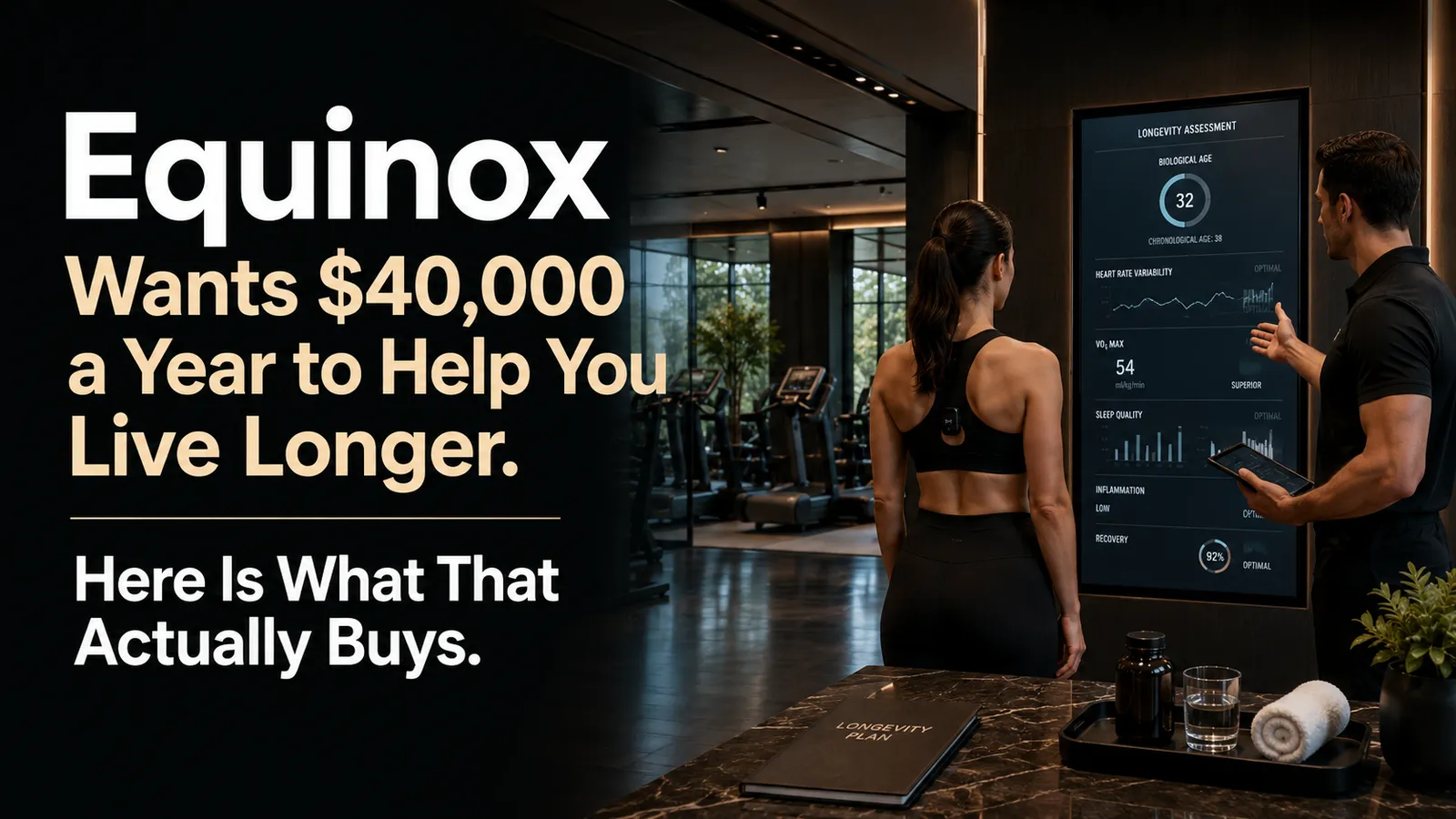

In May 2024, Equinox, the luxury gym chain, launched a longevity membership called EQX Optimize (also branded "Optimize by Equinox"). The headline price is about $40,000 a year, and the program pairs a 100-plus biomarker blood panel from Function Health with three personal-training sessions a week, sleep and nutrition coaching, a monthly massage, and an Oura ring. By February 2026 it had a waitlist of more than 1,000 people, was running in Los Angeles and Dallas, and had a New York launch pending.[4]
What you actually get for $40,000 a year
The Optimize program fee is $3,000 a month with a six-month minimum commitment. That fee does not include a regular Equinox gym membership, which is required and runs about $500 a month (roughly $6,000 a year). The all-in total comes to about $42,000 a year, which is where the rounded "$40,000" figure in most headlines comes from.[1] The membership is only available to people in Equinox's top tier, E by Equinox.
For that money, a member gets a defined bundle. The blood work comes from Function Health, which tests 100-plus biomarkers across heart, thyroid, autoimmunity, metabolic, liver, kidney, cancer markers, nutrients, and heavy metals. Equinox runs its own fitness assessments every six months: VO2 max (the maximum rate at which your body uses oxygen during exercise, a measure of cardiorespiratory fitness), strength, movement range, body composition, postural analysis, and metabolic rate.[2]
The coaching layer is the bulk of the value. Members get three personal-training sessions a week led by a dedicated Tier X coach, plus two 30-minute monthly sessions each with a sleep coach and a nutritionist, one massage a month, and an Equinox-and-Oura co-branded Oura ring recovery kit.[3] It totals about 16 hours a month of individualized professional attention, and the program is reassessed every six months. The 2026 version tests 100 biomarkers twice a year and adds a "health concierge."[4] theSkimm priced the component services at about $23,544 a year, leaving roughly a $16,500 premium for integration and the Equinox brand.[3]
The Function Health engine
The diagnostic core of Optimize is Function Health, an Austin-based company that sells a membership ordering lab tests displayed in an app dashboard with a clinician summary. Function is not itself a lab or a medical provider. Blood draws happen at 2,000-plus Quest Diagnostics locations, which run the tests. Function says it has completed more than 50 million lab tests since 2023.[5]
Function's standalone consumer membership has been reduced to $365 a year (down from $499) and now markets 160-plus lab tests annually.[6] Equinox members get a discounted Function rate of $249 a year for the 160-plus tests.[7]
In 2025 Function acquired the full-body MRI (magnetic resonance imaging) company Ezra and launched "Function Scans," available at about 130 locations and expanding to 200 by year-end.[5] The standalone Optimize program at launch did not include imaging.
Founders & Origin
Equinox was founded in 1991 by three siblings, Lavinia, Daniel, and Vito Errico, with a single upscale fitness club on Manhattan's Upper West Side, bootstrapped without outside investors. In 2000, Harvey Spevak led a management buyout, and in 2006 he partnered with the chairman of Related Companies for controlling interest, ending the Erricos' ownership. L Catterton took a minority stake in 2017, and Silver Lake invested in 2020 at roughly a $7 billion valuation.[8] In March 2024, Equinox secured about $1.8 billion in new capital led by Sixth Street and Silver Lake to refinance maturing loans and fund growth.[9] Spevak is Executive Chairman and Managing Partner of Equinox Group, which runs about 115 clubs with 40 more planned.
Function Health was founded in 2021 by Mark Hyman, M.D., Pranitha Patil, Mike Nemke, Seth Weisfeld, Jonathan Swerdlin, and Daniel Swerdlin; its beta launched in April 2023.[10] Jonathan Swerdlin is CEO, and Mark Hyman, a functional-medicine figure, is Co-Founder and Chief Medical Officer.
Function raised a $3 million seed in 2022, a $53 million Series A led by a16z Bio+Health in June 2024 at about a $191 million valuation, and a $298 million Series B led by Redpoint Ventures in November 2025 at a $2.5 billion valuation.[11] Investors include a16z, Matt Damon, and Zac Efron. Alongside the Series B, Function launched a "Medical Intelligence Lab," a generative-AI chatbot trained to answer questions from a user's lab results, doctor's notes, and scans.[11] By mid-2024 it had nearly 50,000 paying members and a waitlist of over 200,000.[10]
The longevity-clinic market it is entering
Equinox Optimize sits in a crowded field of executive-health and longevity programs that span from $199-a-year testing apps to $250,000-a-year clinics. What sets Optimize apart is that it is fitness-led, not diagnostic-led, and it includes no imaging or genome sequencing.
Several medical clinics out-test Equinox for similar or lower money. Human Longevity (Health Nucleus) charges $8,000 for a whole-body MRI, whole-genome sequencing, and 120-plus biomarkers in a single visit.[12] Fountain Life runs tiered memberships of $10,500 to $85,000 a year, with its APEX tier widely cited at $19,500, adding full-body and brain MRI, coronary CT angiography, DEXA (dual-energy X-ray absorptiometry, a bone-density and body-composition scan), a multi-cancer blood test, and plasma exchange.[13][14] Cenegenics averages $14,000 to $21,000 a year for 270-plus biomarkers and hormone work.[15] Even a traditional clinic or hospital executive physical, the closest non-longevity comparison, generally runs $2,700 to $4,000.[16]
À la carte options undercut all of them. Prenuvo sells a full-body MRI for about $2,500.[17] Superpower offers 100-plus biomarker testing at $199 to $499 a year.[18] Next Health memberships run $99 to $399 a month and center on IV therapy and wellness tech, not full diagnostics.[19] At the top, the Wall Street Journal reports clinics pricing health-plus-status as high as $250,000.[20]
Does the science hold up?
The evidence behind broad biomarker panels and full-body imaging of healthy people is thin, and several physicians have said so directly.
A review of 12 studies found that 95% of asymptomatic patients had at least one abnormal finding on a whole-body MRI, but 91% of those findings were not relevant.[21] A systematic review in the Journal of Magnetic Resonance Imaging pooled a 16.0% false-positive proportion and concluded that providers should not offer whole-body MRI screening to asymptomatic people outside research.[22] University of Michigan radiologist Matthew Davenport notes that 15% to 30% of imaging carries an incidental finding, which drives overtreatment and "makes healthy people think of themselves as patients."[23]
Cardiologist Eric Topol argues that consumer longevity-testing companies, including Function Health, "have not yet provided any evidence for benefit," and that running hundreds of tests on a healthy person "greatly increases the likelihood of false-positive results," a consequence of low pre-test probability.[24]
Not everything is unsupported. VO2 max is a genuinely evidence-backed metric, a strong independent predictor of all-cause mortality.[25] But the anti-aging drugs often associated with longevity marketing, such as rapamycin, metformin, and NAD+, lack human longevity outcome data.[26]
Where is the doctor?
This is the question that matters most for anyone treating Optimize as health care. The program bundles trainers, a sleep coach, and a nutritionist, but a physician reviewing it for Healthcare Huddle, Jared Dashevsky, M.D. (Doctor of Medicine), found that "no physicians are involved (as far as I can tell)," meaning "no one is medically managing customers' cholesterol, blood pressure, or diabetes."[27]
Function Health, the diagnostics partner, states in its own legal terms that it "is a technology company and not a laboratory or medical provider" and is "not a substitute for medical care, medical advice, and/or a detailed discussion with your primary care physician."[28] Function's clinician review is light-touch: results get auto-generated explanations, a written clinician summary arrives one to two weeks after all labs return, and a provider phone call happens only for critical values.[29] Function itself puts it plainly: it "doesn't replace your doctor, it makes you a more powerful patient." Men's Health confirms the gap, reporting that Equinox's program "does not provide face-to-face access to physicians," with blood work interpreted remotely.[30] The MD/DO (Doctor of Medicine or Doctor of Osteopathic Medicine) relationship is not part of what $40,000 buys.
What this means for concierge medicine and DPC
Equinox Optimize is chasing the same affluent, prevention-minded customer that concierge and direct primary care (DPC) doctors serve. (DPC is a model where patients pay a flat membership fee directly to a physician practice.) The Global Wellness Institute analyst Beth McGroarty called the model "gym-as-longevity-clinic," and the wellness market is projected to near $10 trillion by 2030.[31]
The clearest evidence of overlap is that Optimize members keep their own doctors. One profiled member reviewed his Function lab results with both his Equinox nutritionist and a primary care physician he "maintains outside of Equinox."[30] Concierge practitioners frame their work as a complement to insurance, not a replacement.[32]
The price contrast is the part patients should weigh. A real physician relationship costs a fraction of $40,000. MDVIP-style concierge runs $2,100 to $4,500 a year, and many DPC practices cost less still.[33] (Our full guide to what concierge medicine costs breaks down the tiers.) The trade is real: a Penn LDI study found concierge enrollment raised spending 25%-plus with no change in mortality, drawing healthier and wealthier patients.[34] But the structural point holds. A $40,000 gym tier delivers data and coaching without a doctor managing your care, while a concierge or DPC physician delivers the relationship and the medical accountability for a fraction of the cost.
The honest read
Equinox Optimize is a well-built coaching product wrapped around a blood panel, and for a member who already trains hard and wants the data integrated, the convenience may be worth the premium. What it is not is a substitute for a physician. The diagnostics carry real false-positive risk, the longevity interventions are largely unproven, and no MD or DO is managing the member's care. For most people seeking proactive, physician-led prevention, an actual concierge or DPC doctor does more of the medical work for far less money.
Frequently Asked Questions
How much does Equinox Optimize cost?
The Optimize program fee is $3,000 a month ($36,000 a year) on a six-month minimum, and it requires a separate E by Equinox membership of about $6,000 a year. The all-in total is roughly $42,000 a year, which is why most coverage rounds it to "$40,000."[1]
What is included in the Equinox Optimize membership?
A 100-plus biomarker blood panel from Function Health, biannual fitness assessments (VO2 max, strength, body composition, and more), three personal-training sessions a week with a dedicated coach, monthly sleep and nutrition coaching, a monthly massage, and an Oura ring recovery kit.[2][3]
Is Equinox Optimize the same as Function Health?
No. Equinox Optimize is Equinox's program; Function Health is the separate lab-testing partner that supplies the biomarker panel. Function also sells a standalone membership directly to consumers.[2][6]
Does Equinox Optimize include a doctor?
Not in a meaningful clinical sense. The program provides trainers and coaches, and Function Health's lab results get a light-touch clinician summary, but no physician is medically managing your care, and the program does not offer face-to-face physician visits.[27][30]
How much does Function Health cost on its own?
Function Health's standalone membership is $365 a year (reduced from $499) and includes 160-plus lab tests. Equinox members get a discounted rate of about $249 a year.[6][7]
Is the $40,000 longevity membership worth it?
For a committed athlete who wants premium coaching and integrated data, the convenience may justify the price. As medical care it is weaker: the screening carries false-positive risk, several interventions are unproven, and there is no physician managing your health.[21][24][27]
What is the difference between a longevity gym membership and concierge medicine?
A longevity gym membership sells fitness coaching plus testing without a treating physician. Concierge medicine and DPC sell an ongoing relationship with a licensed doctor who diagnoses, prescribes, and manages your care over time, usually for $2,100 to $4,500 a year or less.[33]
Are there cheaper longevity-testing options?
Yes. Superpower offers 100-plus biomarker testing for $199 to $499 a year, Prenuvo sells a full-body MRI for about $2,500, and a traditional executive physical runs $2,700 to $4,000.[16][17][18]
Where is Equinox Optimize available?
As of early 2026 the program operated in markets including Los Angeles and Dallas, with a New York launch pending and a waitlist of more than 1,000 people.[4]
A Note From the Author
I am not a doctor. Nothing in this article should be considered medical advice. This piece is a plain-language explanation of a product and how it fits into the broader concierge and direct primary care landscape. Before making any change to your medical care, talk to a licensed physician who knows your medical history.
NextMD helps you find and compare concierge medicine and direct primary care practices across the United States. Browse practices by city, compare pricing, and find a doctor who has time for you at nextmd.ai/search.
Sources
CBS News. Equinox's $42,000-a-year "Optimize" longevity membership. CBS News. Read on CBS News. Referenced for the $3,000/month fee, required E by Equinox membership, and ~$42,000 all-in total.
Equinox. (2024, May). Set the Bar Higher With EQX Optimize. Equinox. Read on Equinox. Referenced for program inclusions, the Function Health partnership, and the biomarker panel.
theSkimm. Optimize by Equinox membership. theSkimm. Read on theSkimm. Referenced for the coaching breakdown and ~$23,544 component pricing.
CNBC. (2026, February 20). Equinox's longevity membership waiting list. CNBC. Read on CNBC. Referenced for 2026 program details and the waitlist.
TechCrunch. (2025, November 19). Function Health closes $298M Series B at a $2.5B valuation. TechCrunch. Read on TechCrunch. Referenced for Quest draw sites, 50M+ lab tests, and the Ezra acquisition.
Function Health. Function 365. Function Health. Read on Function Health. Referenced for the $365/year price and 160+ tests.
Function Health. Equinox x Function Health. Function Health. Read on Function Health. Referenced for the $249 Equinox member rate.
Public.com. What to know about the 2021 Equinox IPO. Public.com. Read on Public.com. Referenced for Equinox's founding, ownership history, and valuations.
PR Newswire. (2024, March). Equinox Group secures strategic investments. PR Newswire. Read on PR Newswire. Referenced for the $1.8B financing.
Wikipedia. Function Health. Wikipedia. Read on Wikipedia. Referenced for founders, beta launch, and early member/waitlist counts.
PR Newswire. (2025, November 19). With a $2.5B valuation, Function becomes the new standard for health. PR Newswire. Read on PR Newswire. Referenced for the Series B, valuation, and Medical Intelligence Lab.
Human Longevity. Executive Health. Human Longevity. Read on Human Longevity. Referenced for the $8,000 Health Nucleus package.
Aging (PMC). Longevity-clinic editorial. National Library of Medicine. Read on PMC. Referenced for longevity-clinic pricing context.
Worth. How Fountain Life detects diseases. Worth. Read on Worth. Referenced for Fountain Life membership tiers and inclusions.
Cenegenics. FAQ. Cenegenics. Read on Cenegenics. Referenced for the $14,000–$21,000 annual pricing.
PartnerMD. How much does an executive physical cost? PartnerMD. Read on PartnerMD. Referenced for the $2,700–$4,000 executive-physical range.
CNBC. (2025, February 13). Prenuvo adds new health tests to full-body scan. CNBC. Read on CNBC. Referenced for the ~$2,500 full-body MRI.
Fierce Healthcare. Startup Superpower scores $30M. Fierce Healthcare. Read on Fierce Healthcare. Referenced for $199–$499 biomarker testing.
Next Health. Become a member. Next Health. Read on Next Health. Referenced for the $99–$399/month memberships.
Wall Street Journal. Want better health and status? For $250,000, longevity clinics promise both. WSJ. Read on WSJ. Referenced for top-end clinic pricing.
Fred Hutch. (2025, August). Pricey whole-body MRIs don't add up. Fred Hutch. Read on Fred Hutch. Referenced for the 95%/91% whole-body MRI findings.
Journal of Magnetic Resonance Imaging (PMC). Whole-body MRI screening false positives. National Library of Medicine. Read on PMC. Referenced for the 16.0% false-positive proportion.
Michigan Medicine. Whole-body MRIs aren't as beneficial as they seem. University of Michigan. Read on Michigan Medicine. Referenced for incidental-finding rates.
Topol, E. The business of promoting longevity. Ground Truths. Read on Ground Truths. Referenced for Topol's critique of consumer longevity testing.
PubMed. Cardiorespiratory fitness and all-cause mortality. National Library of Medicine. Read on PubMed. Referenced for VO2 max as a mortality predictor.
Aging-US. Rapamycin shows limited evidence for longevity benefits in healthy adults. Aging-US. Read on Aging-US. Referenced for the lack of human longevity outcome data.
Healthcare Huddle. Should you drop $40,000/yr on a gym membership? Healthcare Huddle. Read on Healthcare Huddle. Referenced for the "no physicians involved" finding.
Function Health. App legal terms. Apple App Store. Read on the App Store. Referenced for Function's "not a medical provider" disclaimer.
Function Health. Will my results include explanations? Function Health FAQ. Read on Function Health. Referenced for the clinician-review process.
Men's Health. Longevity gym memberships. Men's Health. Read on Men's Health. Referenced for no face-to-face physician access and the member keeping his own doctor.
Fortune. Equinox's fitness longevity program. Fortune. Read on Fortune. Referenced for "gym-as-longevity-clinic" and the wellness-market size.
Town & Country. Concierge medicine guide. Town & Country. Read on Town & Country. Referenced for the concierge-as-complement framing.
PartnerMD. Concierge medicine costs. PartnerMD. Read on PartnerMD. Referenced for the $2,100–$4,500 concierge pricing.
Penn LDI. Concierge medicine drives higher costs without extending lives. University of Pennsylvania. Read on Penn LDI. Referenced for the spending and mortality finding.