
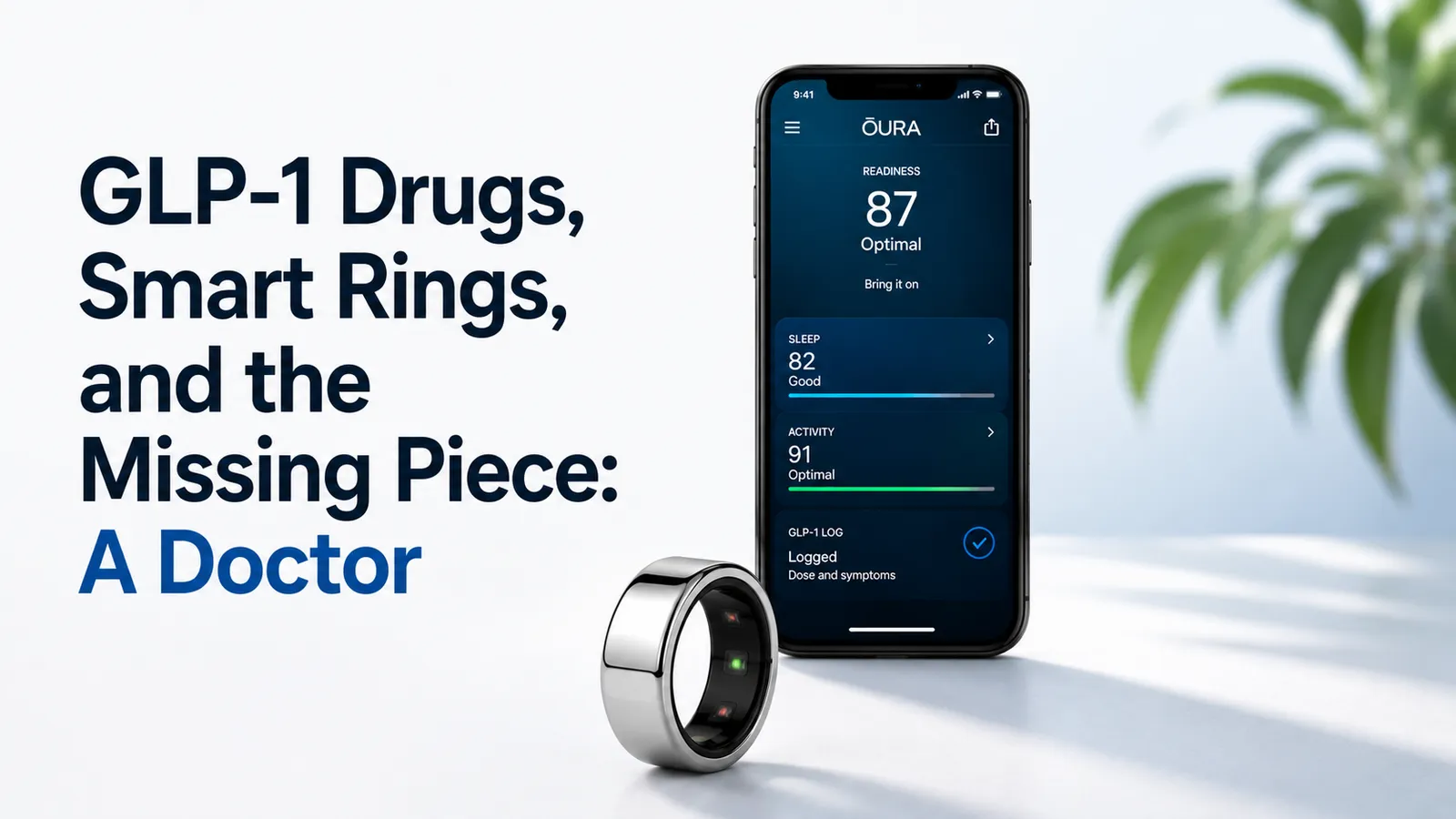

On June 23, 2026, Eli Lilly and Oura announced a deal that pairs Lilly's weight-loss drugs with Oura's smart ring [1]. People who fill a GLP-1 (glucagon-like peptide-1) prescription through LillyDirect, the drugmaker's direct-to-patient pharmacy, become eligible for a free Oura Ring sizing kit and potential savings on the ring itself [1]. The package adds biometric tracking and daily habit support to the prescription. It does not add a doctor who knows your history.
That gap is what this article is about. A GLP-1 is a prescription drug that changes appetite, blood sugar, and digestion, and it needs ongoing medical judgment. A ring and a mail-order pharmacy give you data and a delivery box. They do not give you the person who decides what the data means.
What Lilly and Oura actually announced
The collaboration is narrow, and Oura was careful about its limits. LillyDirect customers get a complimentary Oura Ring sizing kit [1]. The companies say the goal is to connect access to prescribed treatment with behavioral tools that track sleep, activity, readiness, and stress while a person uses GLP-1 medication [1] [2]. Oura's chief medical officer, Ricky Bloomfield, MD, called it an early step toward a more connected care experience [2].
Two details matter. First, Oura states plainly that the collaboration does not involve data sharing between the two companies [1]. Second, Oura's own disclaimer notes the ring is not a medical device and is not intended to diagnose, treat, cure, monitor, or prevent any condition [1]. So this is a marketing and habit-support pairing, not a clinical handoff.
It also fits a pattern. Over the past year, drug access, retail, and wellness companies have built services around GLP-1 supply. Noom partnered with a LillyDirect pharmacy provider to widen access to Zepbound vials. The hybrid metabolic-care company knownwell joined LillyDirect's provider list. Walmart added GLP-1 access to its care platform [2]. As one analysis of these direct-to-consumer models put it, lower-cost drug channels can also create new gaps in coordinated care [3]. The drug is getting easier to obtain. The oversight around it is not keeping pace.
Who builds the ring
Oura Health was founded in 2013 in Oulu, Finland, by Petteri Lahtela, Kari Kivelä, and Markku Koskela [4]. Lahtela, the founding chief executive, wanted to gather wellness data overnight without a screen or a wrist device. The company funded its first ring through a 2015 Kickstarter campaign and grew from there into a major wearable maker [4]. Tom Hale became chief executive in 2022 [4].
Under Hale, Oura's valuation climbed to about 11 billion dollars after a 900-million-dollar funding round in October 2025 [5]. In May 2026, the company confidentially filed for an initial public offering on the strength of fast revenue growth [6]. It has also been moving up the stack toward care, adding clinician access and GLP-1 logging to its newest ring before this Lilly deal. That trajectory is worth understanding on its own, and we covered it in detail when Oura filed to go public. LillyDirect, for its part, is Eli Lilly's platform for connecting patients to disease resources, independent providers, and pharmacy fulfillment, and it is listed as a pharmacy option inside major electronic health record (EHR) systems [1].
What the ring-plus-pharmacy combo does well
Give the pairing its due. GLP-1 medications open a window for behavior change, and a wearable can help a motivated person use it. The Oura Ring tracks sleep stages, heart rate, heart-rate variability, body temperature, and activity. Its GLP-1 tools let a member log doses, side effects, and weight alongside those signals [2]. For someone trying to build steadier sleep and more daily movement, that feedback loop is useful.
Oura says more than half of its members identify as having obesity or being overweight, and tens of thousands already log GLP-1 use in the app [1]. Pairing the ring with the prescription meets those people where they already are. None of that is the problem. The problem is what the pairing quietly implies: that a drug, a tracker, and a delivery box add up to managed care. They do not.
What a GLP-1 actually needs that a ring cannot do
GLP-1 drugs are not a supplement you start and forget. They require a clinician's attention from the first dose to the last.
Dose titration comes first. These medications are started low and increased in steps over months to limit side effects, and that schedule should be guided by a provider who adjusts to how you respond [7]. Side effects need a real person too. Nausea, vomiting, diarrhea, and constipation are common, and some carry warnings that call for prompt evaluation [7]. A ring can show you a rough night. It cannot tell you whether your symptoms are routine or a reason to call.
Body composition is the quieter risk. A meaningful share of the weight lost on these drugs is lean mass, not fat. One body-composition analysis of tirzepatide found that roughly a quarter of the weight lost was lean mass [8]. Protecting muscle takes a plan: enough protein, resistance training, and follow-up. A ring counts your steps. It does not write that plan or check that you are following it.
Then there is the off-ramp. When people stop a GLP-1, the weight tends to return. In the STEP 1 trial extension, participants regained about two-thirds of their lost weight within a year of stopping the drug and lifestyle support [9]. Deciding whether to stay on, taper, or switch is a medical decision that depends on your labs, your goals, and your other conditions. That is a conversation with a doctor, not a notification.
The missing piece is a relationship
Here is what the Lilly and Oura package leaves out, and what a primary care doctor with time supplies. Someone titrates your dose to your tolerance. Someone reads your side effects in the context of your full history. Someone builds the muscle-protection plan and checks your labs. Someone plans the eventual off-ramp instead of leaving you to guess.
That kind of attention is hard to find in a system where the average primary care visit runs short and panels routinely top 2,000 patients per doctor. It is what membership medicine sells. Direct primary care (DPC) practices charge a flat fee, often 50 to 200 dollars a month, and cap panels near 800 patients so visits can run 30 minutes or longer. Concierge practices charge an annual membership, from 3,000 dollars to over 40,000 dollars, and keep panels under 300. Both models exist to give a doctor the time that a GLP-1 prescription actually needs. We made the broader version of this case in why concierge doctors matter as GLP-1s get cheap, and in what personalized medical care actually means in 2026.
Many of these doctors already treat the wearable as a tool inside the relationship, not a replacement for it. A metabolic and functional-medicine practice like Age Better Miami can read your Oura trends, order the labs a ring cannot, and adjust your plan in person. Concierge and metabolic-focused practices cluster in larger metros, so searching by city is a practical way to find one near you. See concierge doctors in Miami, Florida for one active market.
Wear the ring. Use the data. Just put a doctor between you and the drug.
FAQ
Does the Oura and Lilly deal mean my ring can prescribe or order GLP-1 drugs?
No. LillyDirect customers become eligible for a complimentary Oura Ring sizing kit, with Oura positioning the collaboration as behavioral support around prescribed GLP-1 therapy. [1]. The prescription still comes through a provider and LillyDirect's pharmacy. The ring tracks habits and does not prescribe anything.
Is my health data shared between Oura and Eli Lilly?
Oura states the collaboration does not involve data sharing between the two companies [1]. Always review the privacy terms in any app before connecting your records.
Can a smart ring replace a doctor while I take a GLP-1?
No. The Oura Ring is not a medical device and is not meant to diagnose, treat, or monitor conditions [1]. GLP-1 therapy needs dose titration, side-effect monitoring, muscle-protection planning, and a stopping plan, all of which require a clinician [7] [8] [9].
What happens if I stop taking a GLP-1?
Weight tends to return after stopping. In the STEP 1 extension, participants regained about two-thirds of their lost weight within a year [9]. A doctor can help you plan whether and how to taper.
How do I find a doctor who has time to manage a GLP-1?
Direct primary care and concierge practices keep smaller panels and longer visits for exactly this kind of ongoing management. You can browse and compare them by city on nextmd.ai/search.
A Note From the Author
I am not a doctor. Nothing in this article should be considered medical advice.
This piece is a plain-language summary of company announcements, peer-reviewed clinical research, and industry reporting. Before starting, stopping, switching, or adjusting any prescription medication, including any GLP-1 drug, talk to a licensed physician who knows your medical history.
NextMD helps you find and compare concierge medicine and direct primary care practices across the United States. Browse practices by city, compare pricing, and find a doctor who has time for you at nextmd.ai/search.
Sources
Oura Team. (2026, June 23). ŌURA and LillyDirect to Expand Support for People Using GLP-1 Therapies with New Tools and Savings Options. The Pulse Blog, Oura. Read on ouraring.com
Bender, E. (2026, June 23). Oura, LillyDirect team up to support GLP-1 users. MobiHealthNews. Read on MobiHealthNews
American Journal of Managed Care. (2025, November 25). Patients Face New Care Complexities as DTC Options Expand. AJMC. Read on AJMC.com
Oura Health. (2026). Oura Health (company history, founders, and leadership). Wikipedia. Read on Wikipedia
CNBC. (2025, October 14). Oura reaches $11 billion valuation with new $900 million fundraise. CNBC. Read on CNBC.com
Fierce Healthcare. (2026). Smart ring maker Oura files confidentially for IPO as consumer demand propels revenue growth. Fierce Healthcare. Read on FierceHealthcare.com
Cleveland Clinic. (2025). Tirzepatide (Mounjaro) Injection: How It Works and Side Effects. Cleveland Clinic. Read on ClevelandClinic.org
Look, M., et al. (2025). Body composition changes during weight reduction with tirzepatide. Diabetes, Obesity and Metabolism, 27(5). Read on Wiley Online Library. Referenced for the finding that roughly a quarter of weight lost was lean mass.
Wilding, J.P.H., Batterham, R.L., Davies, M.J., et al. (2022). Weight regain and cardiometabolic effects after withdrawal of semaglutide: The STEP 1 trial extension. Diabetes, Obesity and Metabolism, 24(8), 1553–1564. Read on PubMed (PMID 35441470). Referenced for the post-stop two-thirds weight-regain finding.