
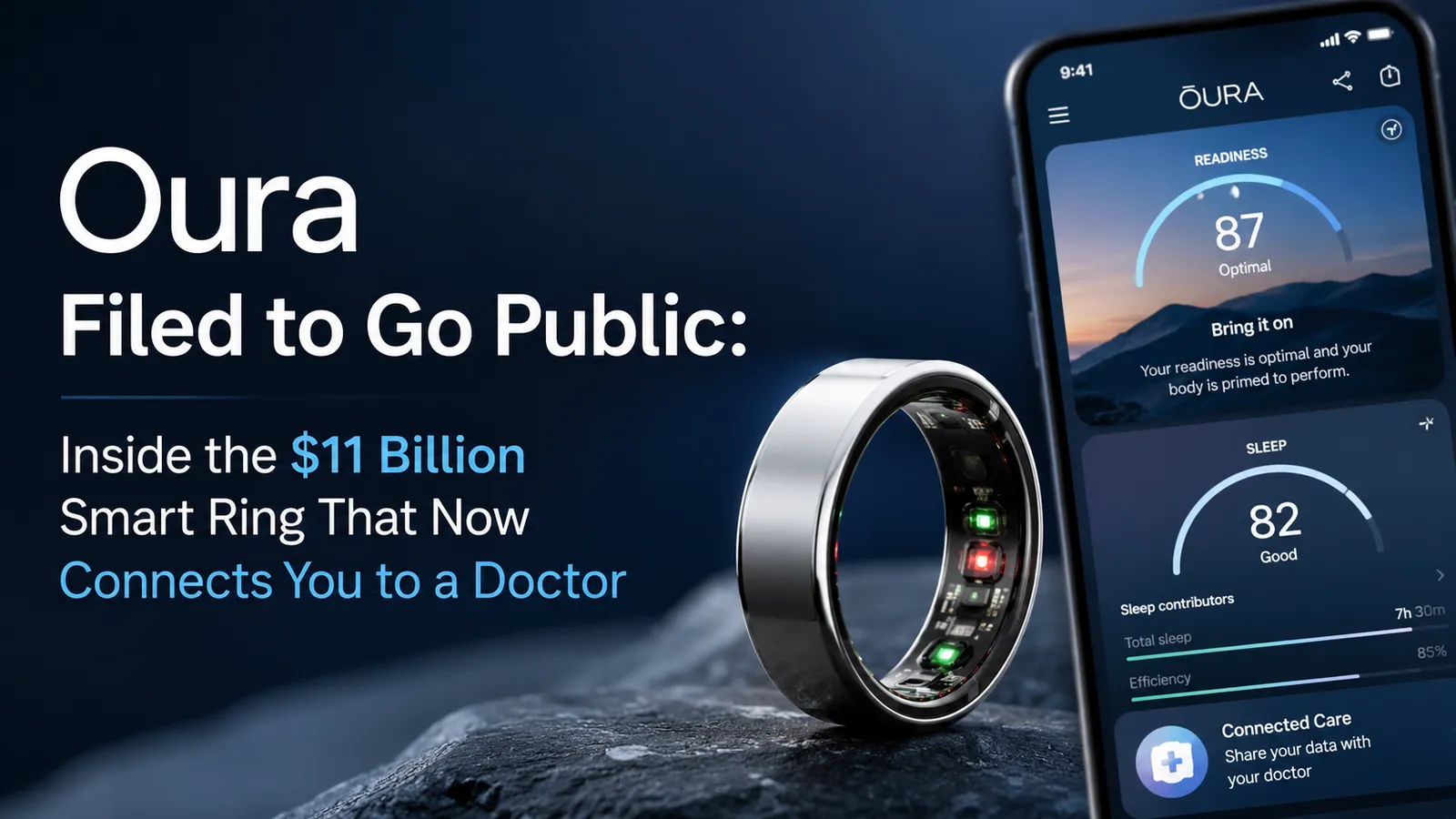

Oura Just Filed to Go Public
In May 2026, Oura confidentially filed for an initial public offering (IPO), the first hard signal that the Finnish smart-ring maker intends to become a public company [1]. The filing caps a fast climb: an $11 billion valuation, a $900 million-plus funding round in October 2025, and roughly 5.5 million rings sold [2] [3]. A confidential filing lets a company begin the regulatory review process without disclosing its financials publicly until closer to the offering, so the exact timing is still open, but the direction is set.
For the millions of people who wear an Oura, or are deciding whether to, the more interesting story is what the company shipped one week after the filing. On May 28, 2026, Oura announced the Ring 5, and for the first time the device does more than measure you. It connects you to a doctor [3]. That is the move worth understanding, because it changes what a smart ring is for, and where it still stops short of an actual physician.
What Oura Actually Does
Oura makes the titanium smart ring that pioneered finger-worn sleep and recovery tracking. Worn overnight, it measures sleep stages, heart rate variability, body temperature, and activity, then turns them into three daily scores: Readiness, Sleep, and Activity [2]. The product wedge has always been sleep, because a ring stays on overnight when a wrist device often comes off, and chronic poor sleep is a real driver of cardiovascular and metabolic problems.
The business is hardware plus membership. You buy the ring once, historically $349 to $549, with the Ring 5 at $399 to $499, then pay $5.99 per month for the scores and trends [2] [3]. That recurring membership, multiplied across 5.5 million rings, is a large part of what an $11 billion valuation is betting on.
Who Built Oura
Oura Health was founded in 2013 in Oulu, Finland, by Petteri Lahtela, Kari Kivelä, and Markku Koskela [4]. Lahtela, the founding chief executive, had spent years in health technology and wanted to gather wellness data unobtrusively, overnight, without a screen or a wrist device. The company raised its first money through a 2015 Kickstarter campaign and grew from that crowdfunded start into a multi-billion-dollar wearable maker [4].
Leadership has turned over twice. Harpreet Singh Rai led the company from 2018 to 2021, and Tom Hale became chief executive in 2022 [4]. Under Hale, Oura's valuation climbed from roughly $800 million in 2022 to $11 billion in 2025, propelled by a $900 million-plus Series E round that October [2] [5]. The May 2026 IPO filing is the next step in that arc, and the Ring 5's new clinician features are part of the pitch a consumer-hardware company makes when it wants public-market investors to see it as a healthcare company.
The Ring 5: A Smart Ring That Now Connects You to a Doctor
The Ring 5 (shipping June 4) keeps the sleep-and-recovery tracking and adds a clinical layer on top [3]:
Counsel Health. A new artificial intelligence (AI) care layer inside the Oura app. You chat with an AI doctor and can escalate to a licensed physician in 43 US states.
ResMed-powered sleep-breathing diagnostics, with routing toward treatment, extending Oura's sleep heritage into a clinical pathway.
GLP-1 dose logging for members on weight-loss medication like semaglutide.
Lab Uploads and personal-health-record import, so your bloodwork can sit alongside your ring data.
"Health Radar," a feature that claims to flag cardiovascular and respiratory issues before symptoms appear.
Counsel Health is the one that matters. For years, the honest answer to "can my Oura replace my doctor" was a flat no, because the ring only measured. Now it offers a path to a human clinician from inside a consumer device. Two caveats belong up front: Counsel Health connects you to a physician, and Health Radar makes a pre-symptom detection claim, but both are access-and-feature promises, not proven outcomes. Treat Health Radar as a product claim until it has independent validation.
What the Ring Can Do, and Where It Stops
For a healthy adult, the Ring 5 is a strong self-tracking tool. Sleep tracking is its best feature, heart rate variability and resting heart rate trends can flag overtraining or an illness coming on, and for someone on a GLP-1 medication, dose logging in the same app is a real convenience. Counsel Health is a useful backstop too: a low-acuity question at 9pm routed to an AI assistant and then a licensed physician beats waiting on a nurse line.
But a concierge or direct primary care (DPC) relationship is not a feature, and that is the line the ring does not cross. The clinician you reach through Counsel Health is a licensed physician, not your physician. There is no continuity, no small patient panel, no doctor who has read your full history, no physical exam, and no one coordinating care across the specialists you may need.
The difference shows up in panel size, the single number that explains why care feels rushed or unrushed. A concierge physician carries a panel of under 300 patients, with ultra-premium tiers far lower. A DPC doctor carries up to 800. A traditional primary care doctor often carries 2,000 to 2,500, which is the underlying reason you wait weeks for an appointment and get 10 to 15 minutes when you arrive. A concierge or DPC visit runs 30 to 60 minutes [6]. The Society of Actuaries' 2020 evaluation of DPC found patients visited the emergency room 40.51% less often than insurance-only patients [6]. The mechanism behind that number is access plus relationship, not a better dashboard. A ring can surface a worrying trend. It cannot examine you, order a confirmatory test, adjust your prescription, or decide whether your borderline thyroid panel needs a re-test in six weeks or a referral to endocrinology this month.
How a Real Doctor Uses Your Ring Data
The most useful way to think about an Oura is as an input, not a replacement. A concierge doctor with a 45-minute appointment has time to scroll through six or twelve months of your sleep, heart rate variability, and resting heart rate, then connect a three-week dip in recovery to the new stressor you mentioned. A 12-minute insurance visit does not. Practices built around prevention already do this. Age Better Miami folds patient-generated wearable data into longevity and functional-medicine programs, and tech-forward practices like Sigma Humans in Chicago treat continuous biometric data as a normal part of the workup alongside lab panels.
The price comparison is not really a comparison, because the two things are not substitutes. Concierge medicine costs $3,000 to over $40,000 per year, broken into Entry ($2,500 to $5,000), Premium ($5,000 to $12,000), and Ultra Premium ($15,000 and up). Direct primary care runs $50 to $200 per month, or $600 to $2,400 per year. A Ring 5 plus a year of membership runs roughly $470 to $570 [2] [3]. One is a device that measures and routes. The other is a physician who takes responsibility for your care.
Why an IPO-Bound Wearable Is Adding Doctors
Oura is not doing this in isolation. It is the second wearable in 17 days to add clinician access to the device. WHOOP added on-demand clinician video visits and electronic health record sync through a partner called HealthEx on May 12, 2026, and Oura followed with Counsel Health on May 28 [3]. Two moves in under three weeks is a category shift: the wearable layer is reaching up toward care, while the direct-to-consumer layer reaches down toward your data, which is exactly what Google's Fitbit Air and Google Health app launch showed in early May. A company heading for public markets has every reason to be valued as a healthcare platform rather than a gadget maker, and adding a clinician layer is how you tell that story. For the wider wearable picture, see what WHOOP's $575M raise means for your concierge doctor.
What none of this changes is the part that was always the hard part. A ring, even one that can hand you a physician in 43 states, does not build a longitudinal relationship with you or own your care over years. That is still the thing concierge and DPC sell.
The Patient Calculation
For most people the answer is not either-or. If you are healthy and want better data on yourself, a Ring 5 is a reasonable buy and Counsel Health is a useful backstop for small questions. If you have a chronic condition, a complex history, or you simply cannot get on your doctor's calendar, the ring will not solve any of that, but a concierge or DPC relationship will. If you have both, the ring becomes a stream of data that an actual physician reads and acts on, instead of one more app you check and forget. The mistake to avoid is treating an AI doctor, or a one-off virtual visit, as a substitute for a doctor who knows you. Compare your options before you decide. Read the full cost guide to concierge medicine for 2026, or browse physician-led practices across Florida.
FAQ
Is Oura going public?
Oura confidentially filed for an initial public offering in May 2026, the first concrete signal it intends to list publicly [1]. A confidential filing lets a company start the regulatory review process before disclosing financials, so the timing is not yet set, but the company has been valued at $11 billion and raised more than $900 million in October 2025 [2] [5].
What does the Oura Ring actually do?
It tracks sleep stages, heart rate variability, body temperature, and activity overnight, then turns them into daily Readiness, Sleep, and Activity scores [2]. The Ring 5 adds Counsel Health, which can connect you to a licensed physician in 43 states, plus GLP-1 dose logging, lab uploads, and sleep-breathing diagnostics [3].
Can the Oura Ring 5 replace my doctor?
No. Through Counsel Health it can connect you to a licensed physician for low-acuity questions, but that is a doctor, not your doctor [3]. It cannot examine you, order confirmatory tests, manage a chronic condition, or coordinate care across specialists. It is a tracking-and-triage tool, not an ongoing physician relationship.
How much does the Oura Ring 5 cost compared to concierge medicine?
The Ring 5 is $399 to $499 plus a $5.99 per month membership, so roughly $470 to $570 in year one [2] [3]. Concierge medicine runs $3,000 to over $40,000 per year, and direct primary care runs $600 to $2,400 per year [6]. They are not substitutes. One measures and routes, the other is a physician relationship.
Is Oura Ring 5's "Health Radar" reliable?
Health Radar claims to flag cardiovascular and respiratory issues before symptoms appear [3]. That is a strong assertion, and as of mid-2026 it is a product claim, not a validated outcome. Treat any pre-symptom alert as a prompt to talk to a real clinician, not a diagnosis.
Find a Concierge Doctor
A ring tells you what is happening in your body. A doctor who knows you tells you what to do about it. Use NextMD to find concierge and direct primary care practices in your city and compare prices.
Search concierge doctors near you on NextMD →
Sources
Fierce Healthcare. (2026). Smart ring maker Oura files confidentially for IPO. Fierce Healthcare. Read on Fierce Healthcare
New York Post. (2026). Oura CEO unveils new AI-powered Oura ring. New York Post. Read on the New York Post
Hagen, J. (2026). Oura unveils AI-enabled Ring 5 with predictive health features. MobiHealthNews. Read on MobiHealthNews
Wikipedia contributors. (2026). Oura Health. Wikipedia. Read on Wikipedia
CNBC. (2025). Oura reaches $11 billion valuation with new $900 million fundraise. CNBC. Read on CNBC
Busch, F., Grzeskowiak, D., & Huth, E. (2020). Direct Primary Care: Evaluating a New Model of Delivery and Financing. Society of Actuaries / Milliman. Read the SOA report (PDF)