
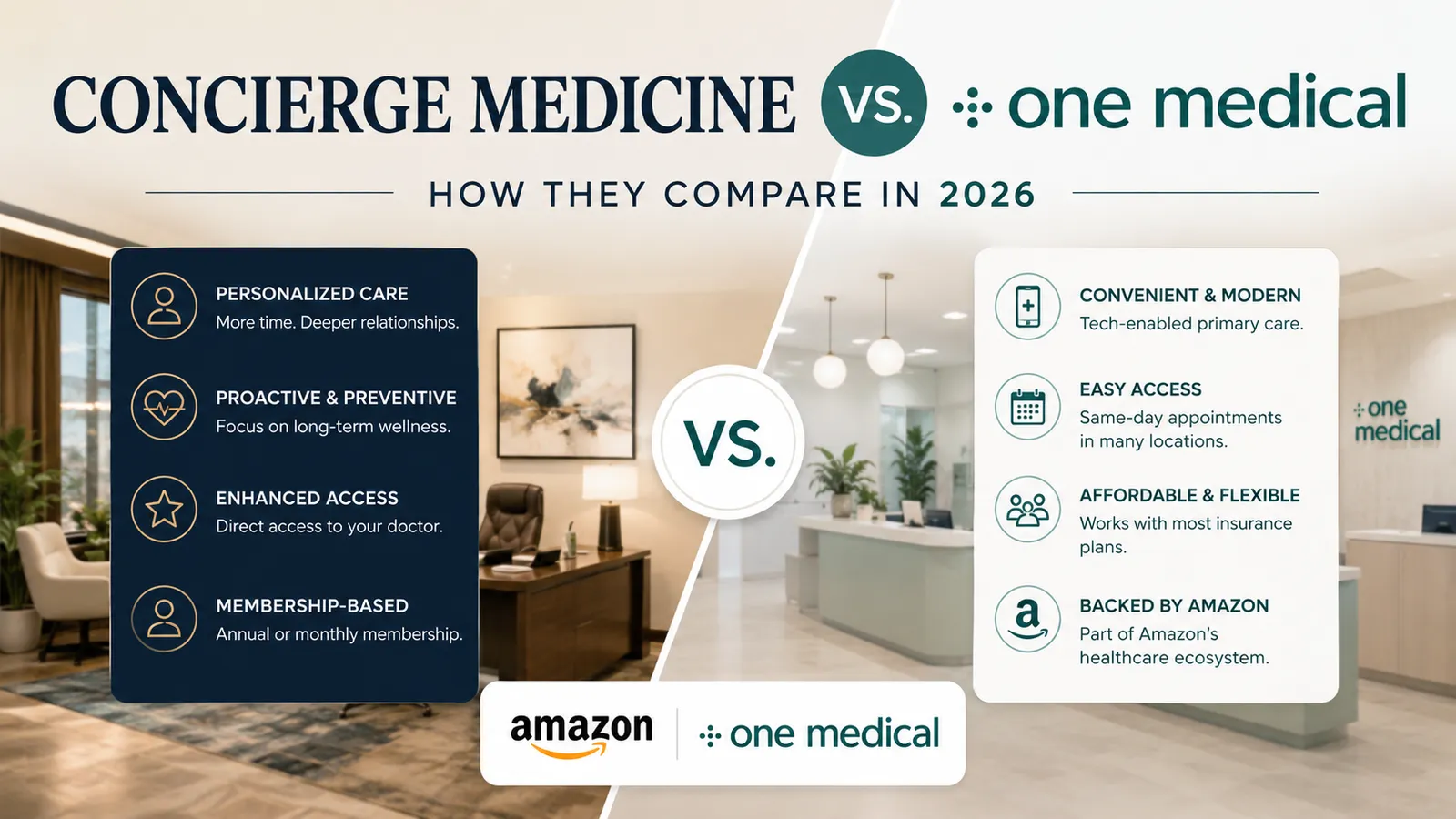

In February 2023, Amazon completed its $3.9 billion acquisition of One Medical [2]. Three years later, the One Medical membership sells for $199 a year, or $99 a year for Amazon Prime members [1]. Concierge practices on NextMD price their care between $3,000 and over $40,000 a year [3].
Both call themselves membership primary care. They are not the same product.
This guide compares the two models side by side. What each costs, how each works, who each is built for, and which fits if you want a doctor who actually picks up the phone.
What Is One Medical?
One Medical is a national primary care brand owned by Amazon the membership covers app booking and 24/7 messaging. Office visits, urgent video chats, and remote visits are scheduled and billed to your insurance, with copays and deductibles applying as they would at any traditional primary care office [1].
One Medical operates in roughly 19 metro markets, including New York, Los Angeles, San Francisco, Chicago, Boston, Washington DC, and Seattle [1]. The company markets itself, in its own page title, as "an alternative to concierge medicine" [1].
What Is Concierge Medicine?
Concierge medicine is a membership model where you pay your physician directly for enhanced access. The annual fee covers same-day appointments, longer visit times of 30 to 60 minutes, and direct phone or text access to your doctor. Concierge practices keep small patient panels of fewer than 300 patients per doctor [4] [5], compared with 2,000 to 2,500 at a traditional primary care practice [4] [5].
NextMD groups concierge practices into three pricing tiers:
Entry Level: $2,500 to $5,000 per year. The Cove Concierge Medicine in Castle Rock, Colorado, lists at $3,700 a year.
Premium: $5,000 to $12,000 per year.
Ultra Premium: $15,000 and up, commonly over $40,000 per year. National brands like MD2 sit at the top of this tier.
Most concierge practices still bill insurance for clinical services like labs, imaging, and procedures. The membership fee is for the access and the small panel.
Side-by-Side Comparison
Aspect | One Medical | Concierge Medicine |
|---|---|---|
Annual Membership | $199 (or $99 with Amazon Prime) | $3,000 to over $40,000 |
Visit Length | Standard appointment slots, similar to traditional primary care | 30 to 60 minutes |
Panel Size | Not publicly disclosed; typical of traditional primary care volumes | Under 300 patients per doctor |
24/7 Access | App messaging and on-demand video chat | Direct phone, text, or cell access to your doctor |
Insurance Billing | Bills insurance for visits; copays and deductibles apply | Bills insurance for clinical services; membership covers access |
Owner | Amazon (acquired 2023) | Independent practices, MD or DO led |
Geographic Footprint | About 19 metro areas | All 50 states |
Best For | Healthy patients in major cities who want a tech-enabled primary care upgrade at near-traditional prices | Patients who want a small panel and a doctor-direct relationship |
Why the Cost Difference Compares Differently Than It Looks
The headline gap between $199 and $3,000 is real, but it does not capture what each membership actually buys.
A One Medical membership pays for the platform. The app, the after-hours messaging, the convenience of booking on a phone. The visits themselves are billed to your insurance like any standard primary care visit [1]. If you have a high-deductible plan, an annual physical at One Medical can still cost you several hundred dollars before insurance starts paying.
A concierge membership pays for the doctor's time directly. The fee buys a smaller panel, longer visits, and direct access to a specific physician. Most concierge practices also bill insurance for clinical services, but the membership is what unlocks the same-day appointment, the 45-minute visit, and the doctor returning your call after hours.
The clinical math matters too. A 2020 peer-reviewed JAMA Network Open study evaluated One Medical's employer-sponsored model at a Southern California aerospace firm with 23,518 employees. The covered cohort had 45% lower total spending and 33% fewer emergency room visits compared with a matched control group [3]. A separate 2020 actuarial study by the Society of Actuaries and Milliman found a 40.51% reduction in emergency room visits among Direct Primary Care (DPC) patients [4]. Both findings point to the same mechanism: more primary care contact means less downstream spending.
What differs between the two models is per-doctor density. The concierge model is built around a doctor who carries fewer than 300 patients [5]. One Medical is built around technology that scales primary care across larger panels.
Who One Medical Is For
One Medical is a strong fit if:
You live in one of the metro markets the company serves [1]
You are healthy and use primary care a few times a year
You value app-based booking and on-demand video over a long-term relationship with one physician
You are price-sensitive and want a primary care upgrade for under $200 a year
You are an Amazon Prime member and want the $99 rate [1]
Who Concierge Medicine Is For
Concierge fits if:
You want to call a specific doctor and have them pick up
You manage a chronic condition and benefit from longer visits
You travel often and need physician coordination across cities or hospitals
You can spend $3,000 to $10,000 a year on direct medical care (Entry to Premium tiers)
You live outside One Medical's metro footprint, which covers most of America
Jeff Toll, MD is a Los Angeles concierge internist serving the same metro where One Medical is heavily concentrated. His memberships start at $400 a month and include house calls. That is roughly 24 times what a One Medical membership costs, and it buys a different product: a single doctor available by phone, longer visits, and care coordination across hospitals and specialists.
For a deeper cost breakdown, see our 2026 guide on how much concierge medicine costs. For the broader membership primary care landscape, our side-by-side comparison of concierge and DPC covers the third option many patients consider.
How to Decide
Two questions get most patients to the right answer.
1. How much access do you actually need?
If you visit a doctor once or twice a year for a physical and the occasional cold, a $199 One Medical membership covers it well. If you want the doctor to know you, return your call within an hour, and spend 45 minutes on each visit, you need the concierge panel size, and that costs more.
2. Where do you live?
One Medical does not exist in most of the country. Concierge practices are listed on NextMD across California and every other state, including markets where One Medical has no presence. Browse practices in the LA metro or use our guide to finding a concierge doctor near you to start.
Last updated: May 2026. One Medical pricing verified live at onemedical.com/membership.
Sources
One Medical. (2026). Membership. One Medical. Read on One Medical
Palmer, A. (2023, February 22). Amazon closes deal to buy primary care provider One Medical. CNBC. Read on CNBC
Basu, S., Phillips, R. S., Phillips, R., Peterson, L. E., & Landon, B. E. (2020). Utilization and Cost of an Employer-Sponsored Comprehensive Primary Care Delivery Model. JAMA Network Open, 3(4):e202666. Read on JAMA Network
Busch, F., Grzeskowiak, D., & Huth, E. (2020). Direct Primary Care: Evaluating a New Model of Delivery and Financing. Society of Actuaries / Milliman. Read on SOA.org
Mount Sinai Solutions. (2023). Concierge Care Isn't Just a Luxury. Mount Sinai Health System. Read on Mount Sinai Solutions