
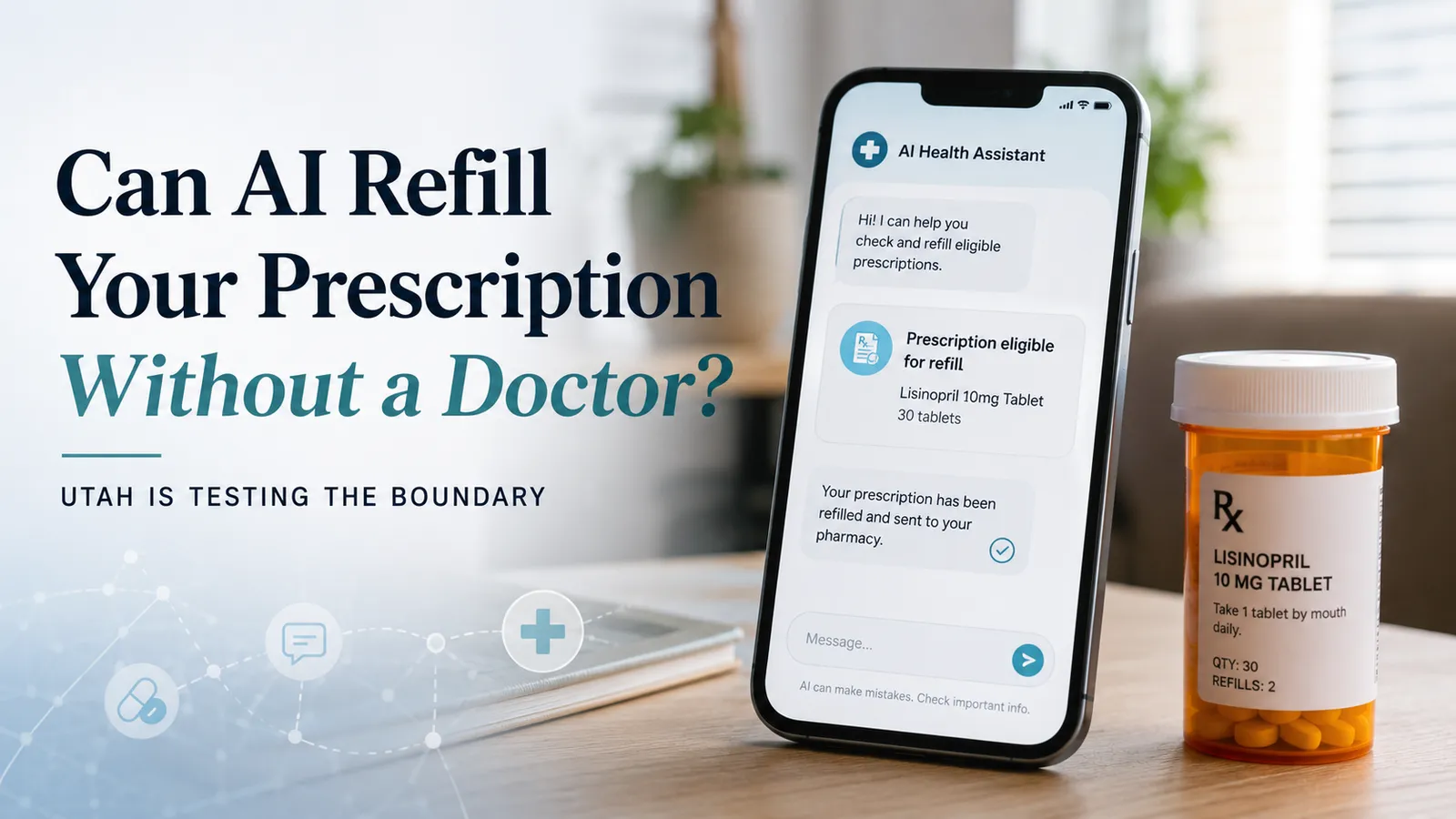

Utah residents can now pay $4 to ask an artificial intelligence (AI) system to renew an existing prescription. The program covers 30, 60, or 90 day supplies of eligible medications, excludes controlled substances, and runs under a temporary state pilot.[1][2]
Today, a Utah physician still authorizes every renewal. The pilot remains in Phase 1, where Doctronic's AI recommends a decision and a licensed medical practitioner reviews it before the prescription reaches a pharmacy.[1] Later phases could let the AI submit renewals directly, with retrospective physician review and continued clinical oversight.[2]
That distinction has been lost in some of the coverage. Utah has created a legal path toward AI-directed prescription renewals. It has not broadly licensed chatbots to practice medicine, and the current pilot does not let AI issue a new drug or change your dose.
The experiment still matters. It tests whether a task that looks administrative can safely move away from the doctor who originally prescribed the medicine.
What Doctronic Does
Doctronic uses an AI chatbot to collect symptoms and medical history, provide health information, and connect patients to licensed telehealth physicians. Its Utah service adds a separate function: renewing an eligible maintenance medication after the original prescription has run out of refills.[3]
The patient workflow has several steps:
Confirm location and identity. The system verifies that the patient is physically in Utah and checks government identification.
Verify the existing prescription. The patient submits the medication details, and Doctronic checks prescription history through Surescripts.
Complete a medication interview. The AI asks about the drug's effectiveness, side effects, allergies, other medications, new health events, and required monitoring.
Run safety checks. The system checks interactions and contraindications and looks for information that conflicts with the existing prescription.
Approve or escalate. A straightforward request moves toward renewal. A case involving conflicting information, new symptoms, or clinical complexity goes to a licensed physician.[2][3]
The AI renewal costs $4. The medication remains a separate pharmacy charge, and Doctronic says the renewal fee is not currently billed to insurance.[3]
Who Built Doctronic
Matt Pavelle and Adam Oskowitz, MD, founded Doctronic in 2023. Pavelle had led engineering teams and describes delayed diagnoses and long waits in his own care as the reason he began exploring AI-based medical triage. Oskowitz brought the clinical side after working as a physician and seeing limited appointment time and physician burnout firsthand.[4][5]
Doctronic started with a free consumer chatbot and added access to human telehealth clinicians in January 2025. A video visit costs $39. By March 2026, the company had raised $65 million across three rounds, including a $40 million Series B led by Abstract and Lightspeed Venture Partners.[4]
The Utah program extends the company beyond health information and telehealth intake. A prescription renewal is a regulated clinical action with a physician's name attached to it.
What the Utah Pilot Allows
Utah created the pilot through its Office of Artificial Intelligence Policy. The office can grant temporary regulatory relief while a company tests an AI service under a written agreement. Doctronic's current agreement runs from October 2025 through October 2026, with an option for another year.[1]
The boundaries are specific:
Allowed in the pilot | Still requires a physician | Excluded |
|---|---|---|
Renew an existing eligible medication for 30, 60, or 90 days | Every renewal during Phase 1 | New medications |
Verify prescription history and interview the patient | Dose or frequency changes in every phase | Controlled or addictive substances |
Screen for interactions, allergies, symptoms, and monitoring gaps | Cases outside the protocol | Unlimited renewals without a medical visit |
Send an eligible renewal directly to a pharmacist in a later phase | Periodic in-person or telehealth reassessment | Changes to the original treatment plan |
Utah says every prescription continues to carry the name of a licensed physician, either through direct review or through the physician-supervised protocol. The company must also provide pharmacists with a way to reach a licensed Doctronic physician.[1]
The rollout has three review levels:[2]
Phase 1: A physician reviews every AI recommendation before the pharmacy receives it.
Phase 2: The AI may submit the renewal first, while physicians retrospectively review every decision.
Phase 3: Physicians review a 5% to 10% monthly sample, plus escalated cases and quarterly performance data.
Utah changed the Phase 1 threshold after launch. Each medication group must now reach 250 completed renewals before that group can become eligible for Phase 2, and the state must approve the transition. Utah also removed butalbital and flecainide from the formulary.[1]
Why Doctors Say a Refill Is a Clinical Decision
The Utah Medical Licensing Board asked the state to suspend the program in April 2026. The board said it learned of the agreement after the service was already operating and argued that a renewal requires reassessing side effects, interactions, effectiveness, laboratory results, and changes in a patient's health.[6]
The concern becomes concrete when you look at the formulary. It has included medications such as apixaban, a blood thinner; empagliflozin, used for diabetes and heart failure; bupropion and citalopram for mental-health conditions; and several blood-pressure drugs.[2] A patient may have taken the same medicine for years, but a new ulcer, kidney problem, pregnancy, supplement, or prescription from another clinician can change the risk.
Some drugs also need a current measurement before renewal. A physician may want blood pressure, kidney function, electrolytes, glucose results, or another condition-specific check before authorizing more medication. The Utah agreement tells Doctronic to ask about required surveillance testing and to decline or escalate a request when protocol criteria are missing.[2][7]
The refill can also create a useful appointment. A doctor may use it to review whether the drug is still working, check overdue screening, or ask why the patient has not been seen recently. A March analysis in JAMA Health Forum warned that moving renewals into a separate AI service could remove those clinical touchpoints.[7]
The Safeguards and the Evidence Gap
Utah's current safeguards address several obvious risks. The pilot verifies identity and prescription history, excludes controlled substances, requires patient disclosure that AI is involved, permits patient and pharmacist escalation, logs decisions, and mandates malpractice coverage for the prescribing company.[1][2]
The state reported that the pilot remained in Phase 1 as of its latest update. It had received no reports of serious safety incidents. Cases where the AI and supervising clinicians disagreed were categorized by the company as presenting no risk, minor risk, or minor-to-moderate risk.[1]
Those early results cannot establish safety yet. Utah says it does not have robust evidence of the program's benefits and needs more data before drawing conclusions.[1]
There is also no published, independent study of this exact prescription-renewal system. Doctronic has promoted a study comparing its broader AI system with physicians across 500 urgent-care telehealth cases. The study was written by people with financial interests in the company, had not completed independent peer review when the pilot launched, and tested a different clinical task.[7][8]
The Food and Drug Administration (FDA) adds another unresolved layer. States license medical professionals, while the FDA regulates many medical products and software tools. The FDA told the Associated Press that it had not authorized any AI chatbots. Experts disagree about whether Doctronic's prescription system should require federal review as a medical device.[8] Our guide to what FDA cleared actually means for a health app explains why state permission and FDA product review answer different questions.
What Happens If the AI Makes a Mistake?
Utah says a licensed physician's name appears on each renewal and expects Doctronic to carry malpractice insurance covering AI-related risk.[1] The agreement also requires monthly performance reporting and gives the state authority to modify or cancel the pilot.[1][2]
Responsibility can still become difficult to trace. A patient could interact with software designed by one company, receive a prescription bearing the name of an employed physician, fill it through an independent pharmacy, and continue treatment originally started by another doctor. The JAMA Health Forum analysis raised questions about how Doctronic's consumer terms allocate liability and how easily a patient could obtain records after an error.[7]
The practical question is who knows the patient's full history and who is accountable for the decision. A renewal protocol can check entered data. A continuous physician relationship adds knowledge of earlier reactions, specialist recommendations, missed tests, and changes the patient may not realize are relevant.
Where AI Helps and Where a Doctor Still Matters
Prescription requests consume time, and delays can interrupt treatment. AI can collect a structured history at any hour, compare the request with pharmacy records, screen for known interactions, and route a complicated case to a clinician. Those are useful functions.
The treatment decision still needs context. A patient requesting another 90 days of lisinopril may also have a new creatinine result, dizziness after losing 20 pounds, and ibuprofen use for a back injury. A protocol works only if it captures each relevant change and applies the right rule.[6][7]
Traditional primary care often struggles to provide that context because doctors manage 2,000 to 2,500 patients. Our article on why a primary-care visit can leave only seven minutes for discussion explains the time pressure. The broader primary-care doctor shortage creates the access problem that services like Doctronic are trying to address.
Concierge medicine and direct primary care (DPC) take a different approach. They reduce the physician's patient panel and charge a membership fee for more time and access. A patient in Utah, for example, can compare AI-assisted services with a relationship-based practice such as Salt Lake Direct Primary Care. The models can also work together. A membership physician can use AI to organize refill information while retaining responsibility for the decision.
What Patients Should Ask Before Using an AI Refill Service
Before requesting a prescription renewal through AI, ask five questions:
Is a physician reviewing this specific renewal before it reaches my pharmacy? The answer can change by pilot phase.
Which clinician's name will appear on the prescription? Ask how you can reach that person if the pharmacist has a question.
What causes automatic escalation? New symptoms, conflicting doses, overdue laboratory tests, and drug interactions should lead to human review.
Will my regular doctor receive the record? A separate refill can fragment the medication history if it never reaches the clinician managing the condition.
What should I do if my health has changed? A new symptom, pregnancy, hospitalization, diagnosis, or medication deserves clinician review even when the refill tool allows you to proceed.
FAQ
Can AI legally prescribe medication in Utah?
Utah has temporarily authorized specific AI-assisted prescription-renewal pilots. The authorization covers renewals of existing eligible prescriptions under a company-specific agreement. It does not allow any chatbot to prescribe freely or issue new medications.[1]
Does a doctor currently approve every Doctronic refill?
Yes. Utah reports that Doctronic remains in Phase 1, where a licensed medical practitioner authorizes every renewal before it is sent to the pharmacy.[1] A later phase could permit direct AI submission with retrospective review.
Can Doctronic change my medication or dose?
No. The pilot permits a 30-, 60-, or 90-day renewal of an eligible medication previously prescribed by a licensed provider. A new drug or a change in dose or frequency requires a physician.[1][2]
Can the AI renew controlled substances?
No. Controlled and addictive substances are excluded from the pilot.[1][2]
Has the FDA approved Doctronic's prescription chatbot?
No FDA authorization for an AI chatbot has been announced. The FDA told the Associated Press that it had not authorized any AI chatbots, while the state and company treat the pilot as a state-regulated medical-practice issue.[8]
Is an AI refill the same as having a primary-care doctor?
No. A refill service addresses one transaction. A primary-care physician manages the condition, monitoring, preventive care, referrals, and changes across your medical history. AI may support that relationship, but the refill alone does not create it.
Find a Physician Who Manages the Whole Treatment Plan
A fast refill solves an access problem. It does not replace a physician who knows why you take the medication, which results need monitoring, and when the plan should change.
NextMD helps patients compare physician-led concierge and direct primary-care practices across the United States. You can search by city, review pricing, and find a doctor with time to manage the whole treatment plan.
A Note From the Author
I am not a doctor or a lawyer. Nothing in this article is medical or legal advice. Do not start, stop, change, or renew a prescription without appropriate guidance from a licensed clinician who knows your medical history. If you have new symptoms or believe you are experiencing a medication reaction, contact a clinician or seek urgent care.
Sources
Utah Department of Commerce, Office of Artificial Intelligence Policy. (2026). Doctronic AI Regulatory Mitigation Agreement and Pilot Status. Read the current Utah pilot page
Utah Department of Commerce and Doctronic. (2026). Doctronic Regulatory Mitigation Agreement. Read the signed agreement and formulary
Doctronic. (2026). Utah AI Prescription Refill Program. Read the patient program description
Aguilar, M. (2026). Doctronic raises $40 million as race to apply AI in clinical care heats up. STAT. Read on STAT
Doctronic. (2026). About Doctronic. Read the founders' profiles
Utah Medical Licensing Board. (2026). Letter to the Utah Office of Artificial Intelligence Policy Regarding the Doctronic Agreement. Read the Medical Board letter
Mello, M. M. (2026). Utah's Experiment With AI-Driven Prescription Renewals. JAMA Health Forum, 7(3), e261001. Read on JAMA Network
Perrone, M. (2026). Is AI ready to take over your prescriptions? Doctors are wary of Utah's automated refill program. Associated Press. Read on AP News
Source Attribution
The current phase, revised transition threshold, formulary changes, reported incidents, and evidence limitations come from Utah's live pilot page as reviewed on 2026-07-14.
The detailed workflow and three-phase review structure come from the signed regulatory mitigation agreement.
Company pricing, product descriptions, and founder narratives are identified as Doctronic's own statements.
The safety and regulatory critique is grounded in the Utah Medical Licensing Board letter, JAMA Health Forum analysis, and Associated Press reporting.