
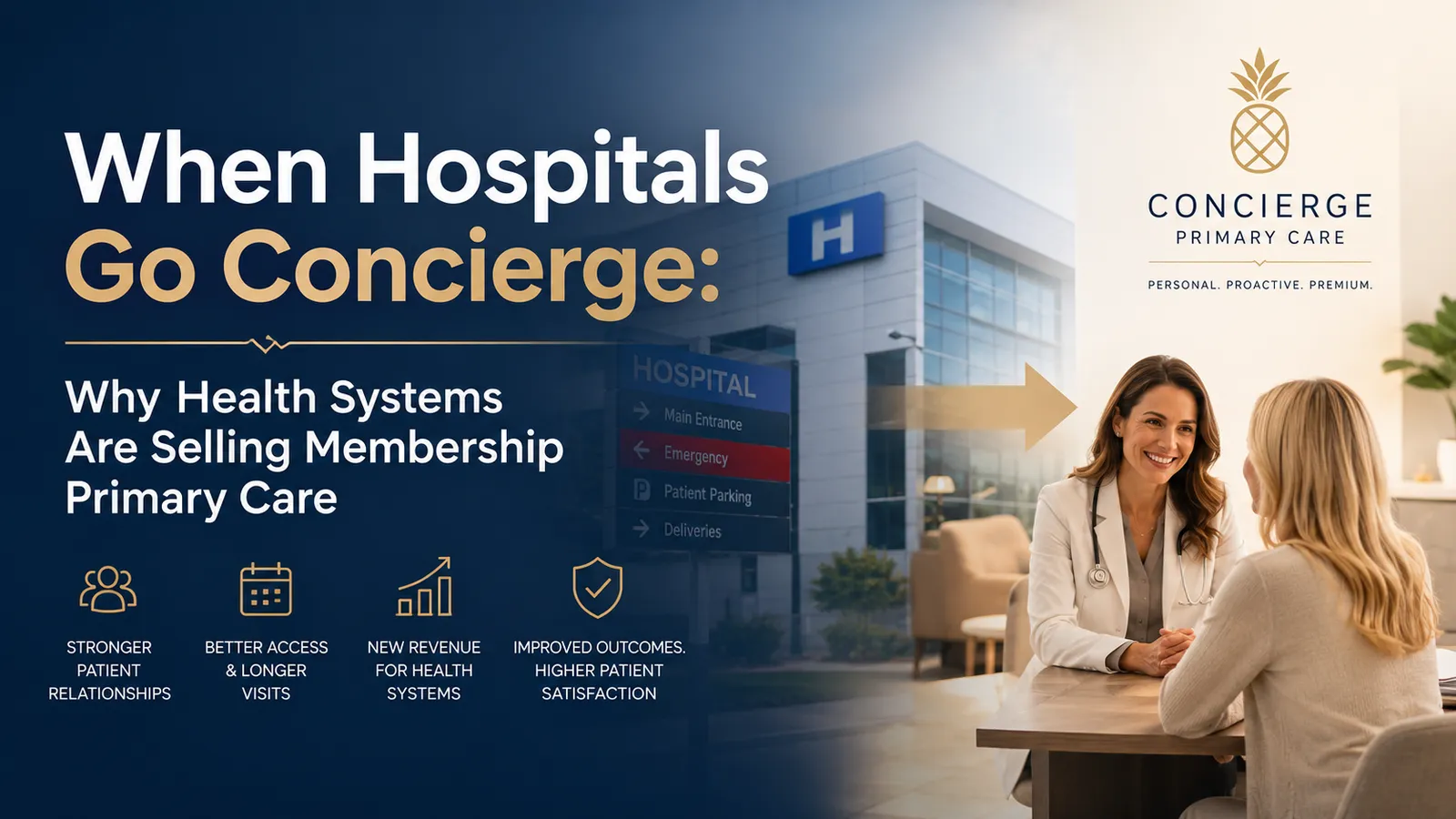

Hospitals are building a concierge model from within the hospital ecosystem. This article breaks down what six hospital/concierge programs actually include, what they cost, how hospital-run concierge care differs from an independent concierge practice.
What Hospital Concierge Medicine Actually Sells
Hospital concierge medicine usually adds an annual fee to an ongoing primary care relationship. The fee commonly pays for access and services that insurance does not cover:
Same-day or next-day appointments
Longer visits and comprehensive annual assessments
Evening or weekend communication with a physician
Help arranging specialist appointments
Preventive health planning, nutrition support, or health coaching
A smaller patient panel that gives the physician more time per member
The medical billing varies by program. Mass General, Inova, Penn, and Beaufort retain an insurance component. Cleveland Clinic uses a full self-pay model for visits with the concierge primary care physician, while care elsewhere in the system may still go through insurance.[4][6][7][8][9]
That distinction matters. A membership fee rarely replaces hospital coverage, specialist coverage, emergency care, surgery, or expensive medications. It buys a different primary care experience and a person who can help coordinate the rest.
Why Health Systems Are Building Membership Programs
1. Membership fees add revenue outside ordinary visit billing
Traditional primary care revenue depends on covered visits and reimbursement rules. A concierge fee creates a second payment for non-covered access, communication, coordination, and convenience.
Mass General illustrates the hybrid structure. Its members pay $10,000 a year and must keep health insurance. The fee covers 24/7 physician access and coordination, while insurance pays for medical services delivered by the concierge doctor.[4]
Industry advisers describe two common hospital structures. A hybrid program may let 5 to 10 percent of a physician's existing panel buy enhanced access. A full conversion moves the physician to a much smaller membership panel. Both can add membership revenue while the organization keeps its payer relationships.[3]
2. Hospitals already employ a growing share of physicians
Hospital ownership gives health systems the doctors, offices, billing operations, and referral networks needed to launch a membership program. In 2024, 34.5 percent of physicians worked in hospital-owned practices, up from 23.4 percent in 2012.[2]
The same employment trend creates a retention problem. Experienced primary care physicians may want fewer daily visits and more time with patients. A concierge track gives a system another practice format to offer without requiring the doctor to leave and open an independent office.
3. The primary care doctor can coordinate care inside one system
Every program in this article emphasizes specialist coordination. Vanderbilt promises quick referrals to its subspecialists. Cleveland Clinic members receive coordinated access across its network. Penn includes medical advocacy. Inova markets navigation across its physicians and facilities.[5][6][7][8]
The business benefit follows from that structure. When a concierge physician refers a member for cardiology, imaging, surgery, or rehabilitation within the same organization, the health system retains more of that patient's care. This is an inference from how the programs describe their coordination benefits, rather than a published result from the systems.
For patients, integration can reduce the work of finding an available specialist and transferring records. It does not guarantee an immediate appointment or require you to use only that system. You should ask how referrals work before joining. Our guide to what happens when a concierge doctor refers you to a specialist explains what good coordination should include.
4. Membership care gives patients an alternative inside a familiar institution
Some patients want more access without leaving the hospital where their specialists already practice. Academic and regional systems can sell continuity with a known medical record, established specialists, and a hospital that already accepts the patient's insurance.
Independent concierge practices can coordinate hospital care too. The institutional program packages that coordination under one brand and one administrative system.
Six Health Systems and Six Versions of Concierge Care
Mass General: a $10,000 hybrid membership
Mass General Concierge Medicine is an ongoing adult primary care practice in Boston. Members pay $10,000 a year, select a physician in the practice as their primary care doctor, and receive 24/7 access by phone or email. The program also includes comprehensive exams, preventive planning, health coaching, nutrition support, and specialist coordination.[4]
Members keep insurance, copays, and deductibles. The annual fee pays for access and service rather than the underlying medical care. That makes Mass General a direct example of a hospital collecting a membership fee while continuing to bill insurers for covered services.[4]
The setting matters in Boston's concierge medicine market, where patients can choose between academic programs and independent practices. Mass General's advantage is integration with its hospital and specialists. Its published fee also places it in NextMD's premium concierge tier.
Vanderbilt: ongoing care, advanced screening, and three locations
Vanderbilt Executive Wellness and Concierge Medicine combines ongoing primary care with the testing menu of executive health. The program offers same-day or next-day weekday visits, extended appointments, communication outside visits, management of acute and chronic conditions, and priority scheduling with Vanderbilt specialists.[5]
Vanderbilt currently lists locations in Green Hills, West End, and Cool Springs. The initial assessment can include cardiovascular testing, pharmacogenomic testing, and tests for cancer or inherited conditions when clinically appropriate. The physician reviews the results and develops short- and long-term recommendations with the patient.[5]
Vanderbilt's public page does not state the membership price. Prospective members should ask which tests the fee includes, which services go through insurance, and whether a recommended test has evidence for someone with their age and risk profile.
Cleveland Clinic: self-pay concierge primary care across several markets
Cleveland Clinic Concierge Medicine operates in Ohio, Nevada, Florida, London, and Toronto. The U.S. program includes 24/7 availability, same-day or next-day appointments on most weekdays, an annual health assessment, chronic disease management, virtual visits, and specialist coordination.[6]
Cleveland Clinic describes its program as full self-pay. The membership covers office and virtual visits with the concierge physician. Care delivered by other Cleveland Clinic providers may run through the member's insurance under the plan's normal terms.[6]
The system also makes a useful distinction between concierge medicine and executive health. Executive Health is a one-day comprehensive physical with a consulting provider. Concierge medicine creates an ongoing relationship with a dedicated primary care physician.[6]
Inova: published pricing and a 400-patient cap
Inova 360 Concierge Medicine is a Northern Virginia network. Inova publishes a $2,400 annual fee for the first family member, $2,200 for additional adults, and $1,200 for children ages 13 to 22 whose parents are members.[7]
Inova says its physicians cap their panels at 400 patients. Members receive same-day or next-day appointments, a two-hour periodic medical review, 24/7 access to an on-call concierge physician, and assistance navigating specialty care. The routine annual physical is submitted to insurance.[7]
The 400-patient cap is higher than NextMD's category standard of under 300 for concierge medicine, but it remains far below the 2,000 to 2,500 patients common in traditional primary care. It also shows why patients should ask for the program's actual panel size instead of relying on a category average.
Penn Medicine: personalized primary care plus broader membership navigation
Penn Medicine operates Penn Personalized Care as a membership-based concierge primary care program. Members receive a dedicated practice phone line, same-day or next-day appointments when available, longer wellness counseling, after-hours access to physicians by personal phone or email, and help coordinating specialty care.[8]
Penn's public pages show that insurance still matters. Members bring insurance cards, may owe copays, and may pay separately for supplemental services or tests that their plan does not cover. The annual fee, which Penn does not publish online, runs for one year and includes member amenities such as parking for visits at specified Penn facilities.[8]
Penn also offers Passport, a separate membership for care coordination, advocacy, and travel support. A Passport physician may serve as the member's primary care doctor, but the product extends beyond a conventional concierge practice. The distinction shows how an academic system can build multiple paid access products around the same clinical network.[8]
Beaufort Memorial: a regional hospital brings an independent practice inside
Beaufort Memorial launched Concierge Care in July 2026 after Dr. James Frost's Signature Health and Wellness joined the hospital's network. The South Carolina system said it plans to add another physician and a Hilton Head Island location in fall 2026.[9]
Members receive same-day or next-day appointments when needed, longer visits, 24/7 communication, specialist coordination, and health navigation. The annual membership covers access. Routine visits, labs, imaging, and specialty care are billed to insurance.[9]
Beaufort illustrates a path available to regional hospitals: bring an established independent physician into the system, preserve the membership experience, and expand it under the hospital's name.
How Hospital and Independent Concierge Practices Differ
Both models charge a recurring fee for more physician time and access. The ownership and referral structure create important differences.
Question | Hospital-system concierge | Independent concierge practice |
|---|---|---|
Who controls the practice? | A hospital or health system | A physician-owner or independent physician group |
Specialist coordination | Usually built around the system's own network | May refer across several competing systems |
Insurance | Often retained for covered services; Cleveland Clinic uses self-pay for concierge primary care visits | Varies, though many concierge practices still bill insurance |
Pricing | Published examples in this article range from $2,400 to $10,000 per year; several systems do not publish fees | Concierge medicine overall runs $3,000 to over $40,000 per year |
Physician availability | May use a shared on-call concierge team | Direct access to the individual physician is common |
Medical records | Usually integrated across the health system | May require record exchange with outside hospitals and specialists |
Referral choice | Convenience may favor specialists employed by the same system | Physician may have more flexibility to compare specialists across systems |
Neither ownership structure automatically produces better care. The practical questions are the physician's panel size, who responds after hours, what the fee covers, and how the doctor handles care outside the practice.
What Patients Should Ask Before Joining
Does the fee cover medical visits, or only access and amenities? Cleveland Clinic includes concierge primary care visits. Mass General and Beaufort separate the membership from insured medical services.[4][6][9]
Do I need to change primary care physicians? Mass General requires members to select a doctor in its concierge practice as their primary care physician.[4]
Who answers at night or on weekends? Direct access to your own doctor differs from access to an on-call physician in the program.
How many patients does my physician carry? Ask for the actual panel cap. Inova publishes 400.[7]
Can the physician refer outside the health system? This matters if the appropriate specialist works elsewhere or your insurance network is narrow.
What happens if I leave? Ask how records transfer, how renewal works, and whether the system can place you with a traditional primary care practice.
FAQ
Do hospitals offer concierge medicine?
Yes. Mass General, Vanderbilt, Cleveland Clinic, Inova, Penn Medicine, and Beaufort Memorial all offer ongoing membership-based primary care or closely related concierge programs. The benefits and billing model differ by system.
Does hospital concierge medicine replace health insurance?
No. Members generally still need insurance for hospital care, specialists, surgery, emergency services, and medications. Some programs also bill insurance for primary care visits, while Cleveland Clinic includes visits with its concierge physician in a self-pay membership.[4][6]
Is executive health the same as concierge medicine?
No. Executive health commonly provides a one-day or annual assessment. Concierge medicine creates an ongoing primary care relationship with continuing access throughout the year. Cleveland Clinic explicitly separates these services.[6]
How much does hospital concierge medicine cost?
Published examples vary. Inova charges $2,400 for the first adult family member, while Mass General charges $10,000 per year.[4][7] Vanderbilt, Cleveland Clinic, Penn, and Beaufort do not publish a standard fee on the program pages reviewed for this article.
Is an independent concierge doctor better than a hospital program?
The ownership model does not answer that question. Compare the individual doctor, patient-panel size, after-hours coverage, price, insurance rules, and referral flexibility. Hospital programs emphasize integration within one system. Independent physicians may coordinate across more than one system.
Hospital systems have turned physician access into a separate membership product. For some patients, the value lies in combining a smaller primary care practice with an academic or regional hospital they already use. Others will prefer an independent physician with more freedom to refer across competing systems.
You can compare physician-led concierge and direct primary care practices, published prices, locations, and doctor credentials at nextmd.ai/search.
Sources
AMN Healthcare. (2025). 2025 Survey of Physician Appointment Wait Times. Read the AMN Healthcare survey overview
American Medical Association. (2025). More Physicians Move to Practices Owned by Hospitals and Private Equity Groups. Read the AMA release
Bauer, T. (2026). Concierge Membership Models: A Strategic Solution for Hospital Systems. Becker's Hospital Review. Read the contributed analysis
NextMD. (2026). Mass General Concierge Medicine. Compiled from the hospital's enrollment, program FAQ, team, and health-coaching pages, all reviewed August 11, 2026. View the Mass General program profile
Vanderbilt Health. (2026). Executive Wellness and Concierge Medicine. Read Vanderbilt's program overview
Cleveland Clinic. (2026). Concierge Medicine. Read Cleveland Clinic's program overview and FAQ
Inova. (2026). Inova 360° Concierge Medicine. Read Inova's program features, pricing, and FAQ
Penn Medicine. (2026). Penn Personalized Care and Passport. Personalized Care overview; Personalized Care FAQ; Passport FAQ
Beaufort Memorial Hospital. (2026, July 1). New Concierge Care Option at Beaufort Memorial Expands Primary Care Services. Read the announcement