
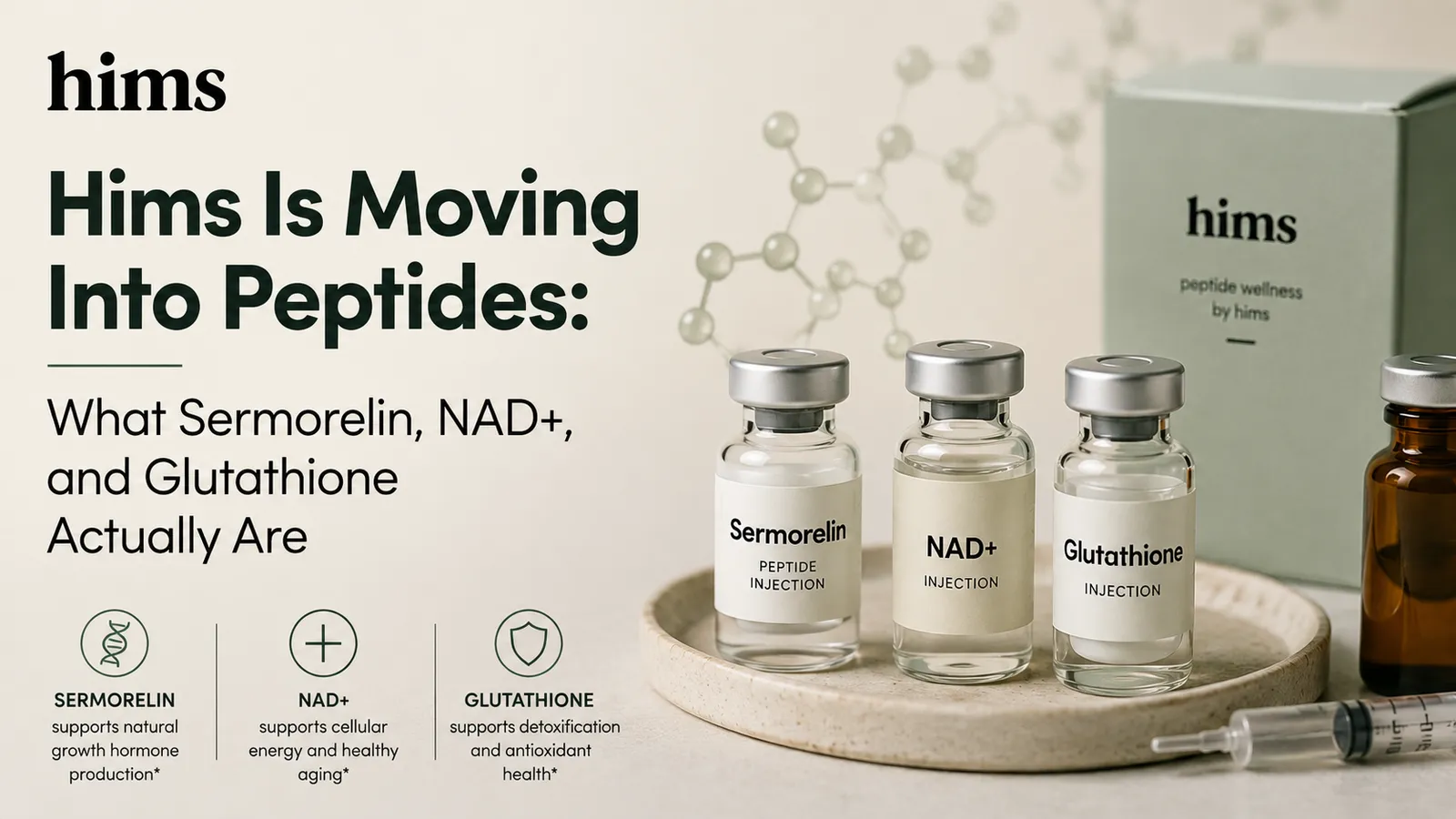

Hims & Hers sells prescription and nonprescription treatments directly to consumers. Customers answer health questions online, meet with a licensed clinician when required, and can receive medication from a pharmacy through the same platform. Hims owns pharmacies that fill most of those prescriptions.[1]
Today the main page features a full lineup of glucagon-like peptide-1 (GLP-1) medicines, including Wegovy, Zepbound, and Ozempic products. Eligible customers can join, complete a provider evaluation, receive a prescription, and have medication delivered.[2]
Today, the next big category appears to be 'Peptides.'
According to its August 2026 investor roadmap, the company marked that category 'coming soon' and said the launch depends on a decision from the FDA.[3]
What People Use These Treatments For
Here is the plain-language version:
Treatment | Why someone might seek it | What the evidence says |
|---|---|---|
Sermorelin | To raise growth hormone, with the hope of improving sleep, recovery, muscle, or body fat | It can raise growth hormone-related laboratory values. Good evidence for broader anti-aging benefits in healthy adults is lacking.[5] |
NAD+ | To improve energy, mental clarity, recovery, or longevity | Oral NAD+ precursors can change laboratory markers. A 2026 review found no qualifying trials showing that NAD+ injections or infusions improve anti-aging or wellness outcomes.[6] |
Glutathione | For antioxidant support, “detox,” skin brightening, or recovery | Oral studies have produced mixed results, and changes in antioxidant levels do not prove that a person will feel better or live longer.[7][8] |
Sermorelin and glutathione are sold as peptide treatments. NAD+ is different, although longevity services often place it in the same category. The three have different purposes and different levels of evidence.
Hims Already Sells GLP-1 Peptide Drugs
Hims currently offers multiple GLP-1 weight-loss products. Its website includes active prices, eligibility language, provider review, membership details, and “Get started” buttons.[2] This is an established peptide-drug business.
GLP-1 medicines copy the effects of a hormone released after eating. Depending on the drug and approved use, they can help regulate appetite, blood sugar, and weight.[2]
The separate “Peptides” roadmap item points to an additional category. Hims has taken several steps toward that expansion:
It bought a manufacturing facility. Hims acquired a California peptide facility in February 2025.[9]
It publicly supported a regulatory path. In April 2026, Hims said it was exploring additional peptide therapies under FDA guidance.[10]
It added a broader peptide category to its roadmap. Its August 2026 investor deck lists that category as coming soon, subject to an FDA decision.[3]
Hims has not published the individual drugs, doses, prices, or launch date. It has also not said whether its products would be FDA-approved drugs, compounded drugs, or both.
Patients should evaluate the actual product when Hims releases those details. A company announcement cannot tell you whether a specific treatment is safe or useful for your health problem.
Who Built Hims & Hers
Andrew Dudum, Hilary Coles, Jack Abraham, and Joe Spector launched Hims at the Atomic venture studio in November 2017. The company first sold access to treatments for hair loss and erectile dysfunction. Hers followed in 2018 with products for women.[11]
Hims & Hers became publicly traded in January 2021 through a merger with Oaktree Acquisition Corp. The transaction valued the company at approximately $1.6 billion.[12] Hims later added its own pharmacies, laboratory testing, international businesses, and the California peptide facility.[1][9]
That scale is relevant to patients. Hims can turn treatments previously sold by specialized longevity clinics into national consumer products.
Sermorelin: A Drug That Raises Growth Hormone Signals
Sermorelin tells the pituitary gland to release more growth hormone. Clinics commonly sell it to adults who want better sleep, faster exercise recovery, more muscle, less body fat, or protection against aging.
The evidence supports a narrower conclusion. In one small study, 10 healthy older men injected growth hormone-releasing hormone twice a day for 14 days. The higher dose raised growth hormone and insulin-like growth factor 1, usually called IGF-1.[5]
The study showed a change in hormone levels. It did not test whether the men lived longer, slept better, gained useful strength, avoided fractures, or maintained lower body fat.
Is sermorelin FDA-approved?
The FDA previously approved sermorelin under the brand name Geref for children with growth hormone deficiency and for diagnostic testing. The manufacturer stopped selling it, and the approvals were withdrawn in 2009 at the manufacturer’s request. FDA later confirmed that safety or effectiveness concerns did not cause the withdrawal.[13]
There is no currently marketed FDA-approved sermorelin product in the United States. Sermorelin offered to adults for wellness or anti-aging is generally prepared by a compounding pharmacy. FDA does not review each compounded drug for safety, effectiveness, or manufacturing quality before a patient receives it.[14]
The Endocrine Society recommends growth hormone treatment for adults with proven growth hormone deficiency. It recommends against giving growth hormone to older adults solely because they have a low age-adjusted IGF-1 level without pituitary or hypothalamic disease.[15] That guideline covers growth hormone rather than sermorelin, but it shows why a diagnosis matters before changing this hormone pathway.
If a clinician recommends sermorelin, ask what problem they diagnosed, what result they expect, and how they will monitor IGF-1 and blood sugar. You should also know when the clinician would lower the dose or stop treatment.
NAD+: An Energy-Related Molecule With Unproven Infusion Benefits
NAD+ helps cells carry out processes involved in energy production and repair. Clinics sell NAD+ injections and intravenous infusions for fatigue, concentration, recovery, and anti-aging.
The marketing often mixes direct NAD+ infusions with oral supplements such as nicotinamide riboside and nicotinamide mononucleotide. These products enter the body differently and should not be assumed to have the same effects.
A 2026 systematic review examined 33 human studies and 80 animal studies of NAD-related products. Oral precursors often changed NAD-related laboratory markers, but health benefits were mixed or absent. The reviewers found no qualifying clinical-outcome trials of intravenous or intramuscular NAD+ for anti-aging or wellness.[6]
In practical terms, no good clinical trial has shown that an NAD+ infusion makes a healthy person more energetic, improves mental clarity, or slows aging.
FDA has also received reports of severe chills, shaking, vomiting, and fatigue after injectable NAD+ products. Some patients needed medical treatment. FDA said the reactions were consistent with excessive bacterial toxins and warned pharmacies against using food-grade NAD+ ingredients to make sterile injections.[16]
This warning does not mean every NAD+ infusion is contaminated. It shows why the source and manufacturing quality matter when a product goes directly into the bloodstream.
Glutathione: An Antioxidant With Mixed Supplement Evidence
Your body makes glutathione to help cells manage oxidative stress. Clinics sell oral or injectable glutathione for “detox,” skin appearance, energy, and recovery.
Two oral studies reached different results. A six-month trial involving 54 healthy adults found that oral glutathione increased glutathione levels in several parts of the body.[7] An earlier four-week trial found no meaningful change in glutathione status or measures of oxidative stress.[8]
Both studies measured laboratory markers. Neither established that glutathione gives healthy people more energy, prevents disease, or extends life. They also studied pills, so they do not prove that injections provide a benefit.
FDA investigated adverse reactions linked to compounded intravenous glutathione in 2018 and 2019. Patients developed nausea, vomiting, chills, low blood pressure, and difficulty breathing. Testing found excessive bacterial toxins in an ingredient intended for dietary supplements rather than sterile injections.[17]
NAD and glutathione currently appear in an FDA category for substances still being evaluated for pharmacy compounding. That category is not FDA approval of a finished treatment or an endorsement of any wellness claim.[18]
Why “Compounded” Matters
A compounded drug is prepared by a pharmacy for a patient or clinical need. Compounding can be useful when an FDA-approved product cannot meet a patient’s needs, such as when a person requires a different dose or cannot use a particular ingredient.[14]
The finished compounded drug is not FDA-approved. FDA does not review it in advance the way it reviews an approved prescription product. Poor compounding can lead to contamination, an incorrect dose, or a product that contains too much or too little of an ingredient.[14]
Before accepting a compounded injection, ask:
Why do I need a compounded product?
Which pharmacy will make it?
What exact ingredient, dose, and route will I receive?
What evidence supports this use and delivery method?
Who should I contact if I have a reaction?
Severe chills, shaking, vomiting, breathing difficulty, faintness, or low blood pressure during or after an injection require prompt medical attention. FDA documented these symptoms in reactions involving contaminated compounded NAD+ and glutathione products.[16][17]
A Prescription Is Only One Part of Medical Care
Ordering a treatment is a transaction. Medical care continues after the order.
A clinician should understand your diagnoses, medications, and goals before prescribing. The clinician should explain what improvement to expect, check for side effects, review results, and stop a treatment that is ineffective or harmful.
Telehealth can support that relationship when follow-up is built into the service. NextMD’s guide to telehealth versus in-person primary care explains when a video visit may be enough and when an examination matters.
Hims has expanded laboratory testing and ongoing digital health tools, including its Labs AI product. NextMD previously examined what the Hims & Hers Labs AI launch means for concierge medicine. Those tools can support follow-up, but patients still need to know which clinician is responsible for reviewing the complete treatment plan.
The same issue appears across the longevity market. NextMD’s review of Bryan Johnson’s prescription platform explains why easier access to a drug does not automatically provide coordinated medical care.
Patients who want a doctor to manage preventive or longevity treatments alongside the rest of their health can compare practices through California’s concierge and direct primary care directory. Private Medical in Santa Monica is one example of a physician-led practice. Its inclusion here does not imply that it prescribes these products.
What to Ask Before Buying
Before paying for sermorelin, NAD+, glutathione, or another treatment marketed as a peptide, ask the prescriber seven questions:
What health problem are you treating? “Optimization” is not a measurable diagnosis.
What exact result should I expect? Ask about symptoms or health outcomes, not only a laboratory number.
Does research support this exact product and delivery method? A study of a pill does not prove an infusion works.
Is the product FDA-approved or compounded? Ask for the name of the pharmacy.
What needs to be checked before I start? The answer should reflect your health history and other medications.
When will we decide whether it is working? Ask for a follow-up date and stopping rule.
Who manages side effects and coordinates with my regular doctor? You should know who owns the treatment plan.
The Bottom Line
Hims is already a major seller of GLP-1 peptide drugs. Its next move is a broader peptide category aimed at longevity and wellness, but the company has not announced which additional treatments it will sell. Patients cannot evaluate that new offering until Hims publishes the drugs, doses, pharmacy sources, prices, and follow-up process.
Sermorelin can raise growth hormone signals, but evidence does not establish the broad anti-aging benefits commonly advertised to healthy adults. NAD+ infusions lack clinical-outcome trials for wellness or anti-aging. Glutathione is important inside the body, but supplement studies do not prove broad “detox,” energy, or longevity benefits.
Focus on what problem the product treats, whether evidence supports that exact treatment, who made it, and who will monitor you after the purchase.
FAQ
What are peptide treatments used for?
Approved peptide drugs treat many conditions, including diabetes, obesity, osteoporosis, and certain eye diseases.[4] Longevity clinics also market peptide-related products for sleep, energy, recovery, body composition, and anti-aging, but each claim needs to be evaluated separately.
Is sermorelin FDA-approved?
No currently marketed sermorelin product has FDA approval in the United States. The previously approved Geref products were withdrawn at the manufacturer’s request for reasons unrelated to safety or effectiveness.[13] Adult wellness products are generally compounded.[14]
Is NAD+ a peptide?
No. NAD+ is involved in cellular energy processes, but it is not a peptide. Clinics often sell it beside peptide products as part of a broader longevity category.
Do NAD+ infusions improve energy or slow aging?
No qualifying clinical-outcome trial has shown that intravenous or intramuscular NAD+ improves wellness or slows aging.[6]
Is glutathione a detox treatment?
Your body uses glutathione as an antioxidant. Studies do not establish that glutathione pills or injections broadly “detox” healthy people, improve energy, or extend life.[7][8]
Does Hims already sell peptide drugs?
Yes. Hims actively sells access to GLP-1 peptide medicines for weight loss, including Wegovy and Zepbound products.[2][4] Its separate “Peptides” roadmap item refers to a planned expansion beyond the current GLP-1 lineup. Hims had not published the additional product list or launch date as of August 15, 2026.[3]
This article is for education and is not medical advice. Do not start, stop, or change a prescription or injected product without discussing your health history and goals with a licensed clinician.
If you want a physician who can assess a longevity treatment in the context of your complete medical history, you can compare concierge and direct primary care practices at nextmd.ai/search.
Sources
Hims & Hers Health, Inc. (2026). Annual Report on Form 10-K for the year ended December 31, 2025. Read the SEC filing
Hims & Hers Health, Inc. (2026). Wegovy Pill. View the active Hims product page
Hims & Hers Health, Inc. (2026, August). Investor Presentation, August 2026, pp. 13, 16. Read the official investor presentation
U.S. Food and Drug Administration. (2026, July 28). FDA Publishes Revised Draft Product-Specific Guidances for Certain Generic Peptide Products. Read the FDA announcement
Corpas, E., Harman, S.M., Pineyro, M.A., Roberson, R., Blackman, M.R. (1992). Growth hormone-releasing hormone-(1-29) twice daily reverses the decreased GH and insulin-like growth factor-I levels in old men. Journal of Clinical Endocrinology & Metabolism, 75(2), 530-535. Find on PubMed
Gallagher, C., Emmanuel, O.O. (2026). NAD+ supplementation for anti-aging and wellness: A PRISMA-guided systematic review of preclinical and clinical evidence. Ageing Research Reviews, 116, 103057. Find on PubMed
Richie, J.P. Jr., Nichenametla, S., Neidig, W., et al. (2015). Randomized controlled trial of oral glutathione supplementation on body stores of glutathione. European Journal of Nutrition, 54(2), 251-263. Find on PubMed
Allen, J., Bradley, R.D. (2011). Effects of oral glutathione supplementation on systemic oxidative stress biomarkers in human volunteers. Journal of Alternative and Complementary Medicine, 17(9), 827-833. Find on PubMed
Hims & Hers Health, Inc. (2025, February 21). Hims & Hers acquires US-based peptide facility. Read the company announcement
Carroll, P. (2026, April 15). Applauding FDA's Move Towards Regulatory Clarity on Peptide Therapy. Hims & Hers. Read the company statement
Hims & Hers Health, Inc. (2026). About Hims: Modern Men's Healthcare. Read the company history
Hims & Hers Health, Inc. (2021). Hims & Hers Appoints Two New Board Members. Read the investor announcement
U.S. Food and Drug Administration. (2013, March 4). Determination That Geref (Sermorelin Acetate) Injection Was Not Withdrawn From Sale for Reasons of Safety or Effectiveness. Federal Register, 78(42), 14095-14096. Read the Federal Register notice
U.S. Food and Drug Administration. (2026). Compounding and the FDA: Questions and Answers. Read the FDA compounding guidance
Fleseriu, M., Hashim, I.A., Karavitaki, N., et al. (2016). Hormonal Replacement in Hypopituitarism in Adults: An Endocrine Society Clinical Practice Guideline. Journal of Clinical Endocrinology & Metabolism, 101(11), 3888-3921. Read the Endocrine Society guideline
U.S. Food and Drug Administration. (2024). FDA reminds compounders to use ingredients suitable for sterile compounding. Read the FDA compounding alert
U.S. Food and Drug Administration. (2019, June 7). FDA highlights concerns with using dietary ingredient glutathione to compound sterile injectables. Read the FDA compounding alert
U.S. Food and Drug Administration. (2026, May 14). Bulk Drug Substances Nominated for Use in Compounding Under Section 503A of the Federal Food, Drug, and Cosmetic Act. Read the current FDA category list