
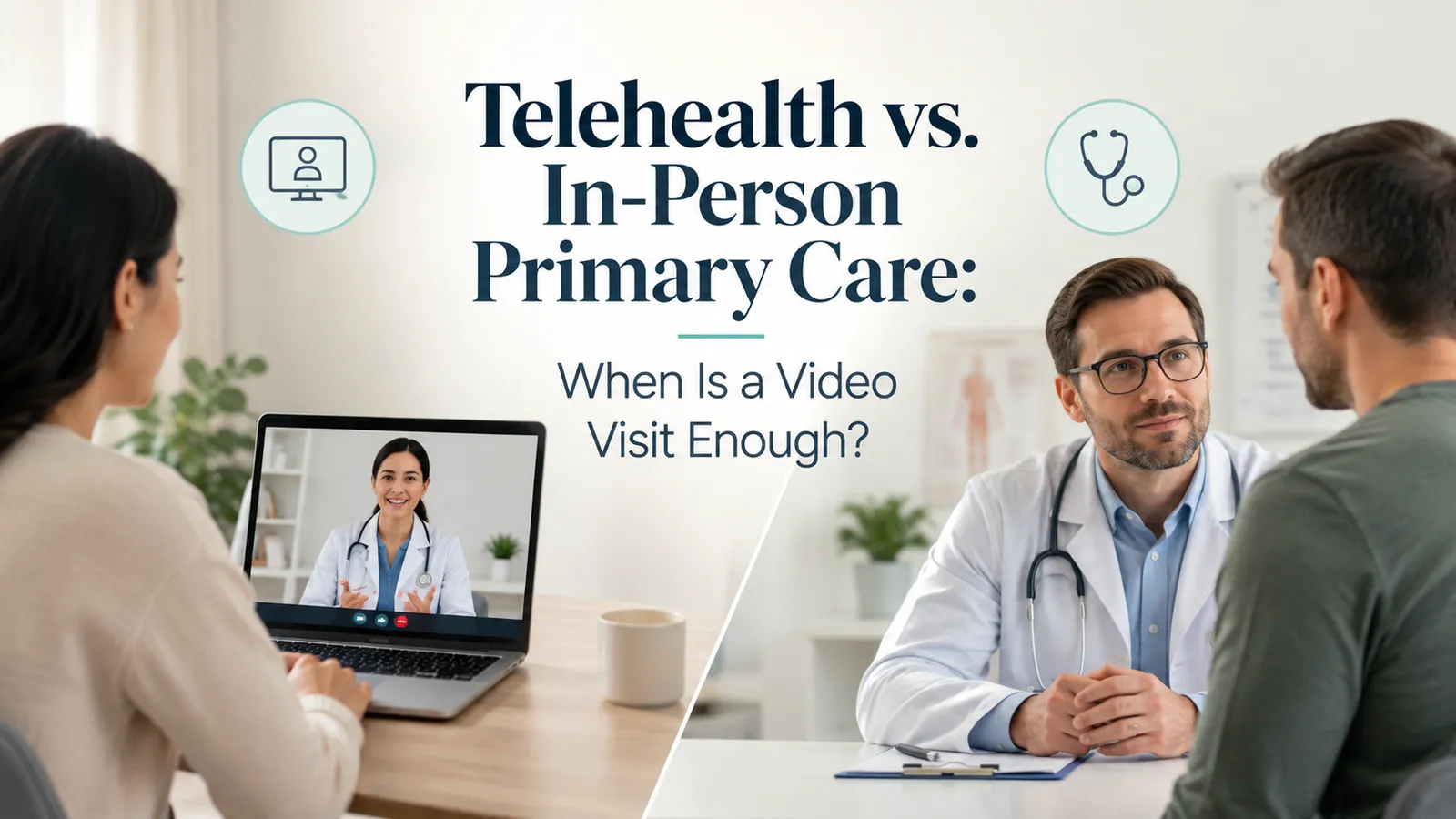

A Mayo Clinic study compared in person medical exams with video medical exams.
The study compared video-visit diagnoses with diagnoses made during later in-person visits for 2,393 patients. The two diagnoses agreed in 86.9% of cases. Agreement reached 96.0% in psychiatry and psychology, but fell to 64.7% for diseases of the ear and mastoid process.[1]
Diagnostic agreement fell when the final diagnosis required a physical examination, neurological testing, or pathology.[1]
Those results describe the practical boundary between telehealth and an office visit. A video appointment can work well when your doctor needs a detailed history, a visual check, home measurements, or a conversation about an existing treatment plan. An in-person visit becomes more useful when the answer depends on touch, instruments, a specimen, imaging, or a procedure.
This article provides general educational information. It cannot determine the right setting for your symptoms. Contact your clinician for individual guidance. Call 911 or your local emergency number for a possible medical emergency.
The Short Answer
A video visit may be enough when:
You are following up on a known condition.
Your doctor already has the relevant records and test results.
You can provide useful home measurements, such as blood pressure, temperature, blood glucose, or weight.
The concern can be evaluated through conversation or a clear visual examination.
You have no emergency warning signs.
Start with an in-person visit when:
The doctor may need to press on a painful area.
The doctor needs to listen to your heart or lungs, inspect your eardrum, test reflexes, or perform another hands-on examination.
You probably need a swab, urine test, blood draw, electrocardiogram, X-ray, ultrasound, or other test during the visit.
You have a new injury, significant swelling, weakness, numbness, or loss of function.
You may need a procedure.
Federal guidance lists medication management, test-result review, common illnesses, skin problems, post-surgical follow-up, behavioral healthcare, therapy, and chronic-condition monitoring among the services telehealth can support.[2] It also advises patients and clinicians to decide when an in-person appointment is necessary.[2][3]
A Practical Decision Framework
Use this table as a starting framework rather than a diagnostic protocol. Your age, pregnancy status, medical history, medications, symptom severity, and access to home equipment can change the appropriate setting.
Situation | Video may be a reasonable starting point | In-person care becomes more useful when |
|---|---|---|
Known chronic condition | You have recent home readings and want to review a stable plan | Readings changed substantially, symptoms are new, or the clinician needs laboratory work or an examination |
Medication question or refill | The medication and diagnosis are established, and required monitoring is current | You have a new side effect, need monitoring, or the prescription is subject to additional examination or prescribing rules |
Laboratory or imaging results | The test is complete and the purpose is explanation or planning | The result creates a need for a new examination, repeat specimen, procedure, or urgent treatment |
Rash or visible skin concern | You can provide clear photographs and show the area on camera | The area is difficult to see, rapidly changing, painful, associated with systemic symptoms, or may need sampling |
Cough, cold, or upper-respiratory symptoms | Symptoms appear mild and the visit will focus on history, self-care, and triage | Breathing, oxygenation, lung sounds, throat testing, or a chest examination may change the decision |
Ear pain or hearing change | A clinician is triaging the problem or you have access to a remote otoscope | The eardrum needs direct inspection or symptoms are severe, persistent, or associated with neurologic findings |
Abdominal or pelvic pain | A clinician is gathering history and directing the next step | Palpation, a pelvic examination, urine testing, blood work, or imaging may change the diagnosis |
Joint or muscle concern | The clinician can observe range of motion, gait, and a guided movement test | Trauma, deformity, marked swelling, weakness, numbness, or possible imaging makes an office evaluation more appropriate |
Mental health follow-up | Privacy is available and you can communicate safely | There is an immediate safety concern, severe confusion, intoxication, or a need for emergency intervention |
New or unclear symptoms | Your regular clinician can triage the concern and arrange the next step | The symptom remains unexplained, is worsening, or requires physical findings to narrow the diagnosis |
When Video Visits Work Well
Follow-up for a known condition
Telehealth works better when the doctor already knows the diagnosis and can review new information against an established baseline. Examples include discussing a blood-pressure log, reviewing blood glucose readings, checking how a stable medication is working, or talking through a completed laboratory panel.[2]
Imagine that your usual home blood-pressure readings run near 125/78, and a two-week log now averages 142/90 after a medication change. A video visit gives your doctor the readings, timing, medication list, and symptoms. The doctor can decide whether the next step is another home-monitoring period, a prescription change, laboratory work, or an office examination.
Usable data gains value when a clinician knows what the numbers looked like before.
Test-result and medication discussions
A screen adds little when the main work is explanation. A doctor can review an X-ray report, discuss a cholesterol panel, reconcile medications after a hospital stay, or explain why a follow-up test was ordered through video.[2]
A video visit can still produce an in-person next step. Telehealth can handle the interpretation and planning even when a laboratory, imaging center, or clinic must perform the next test.
Behavioral healthcare
Behavioral health depends heavily on conversation, observation, privacy, and continuity. In the Mayo Clinic study, psychiatry and psychology had 96.0% diagnostic agreement between the initial video visit and the subsequent in-person reference diagnosis.[1]
Researchers studied selected patients who completed both types of visits, so the result does not prove that video fits every mental-health concern. It does help explain why therapy and medication follow-up remain common telehealth uses.[2]
Visible problems and guided movement
A camera lets a clinician observe a rash, facial movement, gait, breathing effort, swelling, or range of motion. Federal guidance also describes patient-assisted abdominal, cardiopulmonary, neurological, musculoskeletal, skin, and ear, nose, and throat examinations.[3]
Image quality and positioning matter. A blurred camera cannot show whether a skin lesion has an irregular border. A seated view cannot fully show a limp. Your clinician may ask you to change the lighting, move the camera, walk across the room, or take still photographs before deciding whether the virtual examination is sufficient.
First-pass triage with your regular doctor
A video visit can answer a narrower question: Where should you go next? Your doctor may determine that home care and observation are reasonable, send you to a laboratory, arrange a same-day office examination, or direct you to urgent or emergency care.
A federal patient-safety review identifies limited examinations, communication gaps, and reliance on patient-measured vital signs as telehealth safety concerns. It also notes that integrating telehealth into the patient's regular medical home can reduce risk because the clinician can access records and arrange testing, referrals, and follow-up.[4]
Concierge and direct primary care (DPC) can use video particularly well here. The remote visit sits inside an ongoing physician relationship instead of ending with a one-time recommendation. NextMD's guide to the main types of primary care explains how continuing care differs from a transactional urgent-care visit.
When an In-Person Examination Adds Information
The doctor needs to touch the painful area
Palpation means examining an area by touch. A clinician may press on the abdomen, compare temperature between two joints, check whether swelling leaves an indentation, or locate the point of greatest tenderness.
A patient can sometimes perform a guided self-examination on video. The clinician cannot feel the resistance, temperature, texture, or guarding through the screen. New abdominal or pelvic pain, a lump, or a painful swollen joint may therefore require an office evaluation.
The doctor needs instruments you do not have
A standard video visit cannot provide heart or lung sounds, a close view of the eardrum, an eye examination through an ophthalmoscope, or an electrocardiogram. The clinician may also need reliable measurements of oxygen saturation, heart rate, temperature, or blood pressure.[3][4]
Remote examination devices can move part of this work into the home. A study of 690 pediatric patients compared a mobile device with conventional in-person examination. It found useful agreement for several skin, heart, lung, ear, and throat findings in children older than two, while documenting limitations for infants and abdominal sounds.[7]
Our guide to home medical-exam devices and their limits explains how a digital stethoscope or otoscope changes a virtual visit. Even with that equipment, the clinician may still need an in-person examination.
A specimen, image, or procedure will decide the next step
Video cannot collect blood, urine, or a throat swab. It cannot produce an X-ray, ultrasound, computed tomography scan, or magnetic resonance imaging scan. It also cannot close a wound, drain an abscess, remove a foreign body, or perform a biopsy.
Your doctor can order these services during telehealth. You still have to complete them at an appropriate facility.
A study at two Boston primary-care sites reviewed 4,133 colonoscopy, dermatology, and cardiac stress-test orders. Patients completed 42.6% of orders placed during telehealth within the study's designated time frames, compared with 58.4% of orders placed during in-person visits. The observational study covered 2020 and 2021 and cannot establish that telehealth caused the difference.[6]
Before ending a video visit, ask where the test will happen, who will schedule it, how quickly you should complete it, and who will contact you with the result.
A neurological or musculoskeletal finding changes the decision
Video can show speech, facial symmetry, walking, some eye movements, and selected strength or range-of-motion tasks.[3] It cannot fully reproduce reflex testing, sensation testing, a detailed eye examination, or the clinician's hands-on assessment of strength and joint stability.
Mayo Clinic researchers found that diagnoses were less likely to agree when the in-person reference diagnosis depended on neurological testing or a physical examination.[1] New weakness, numbness, balance problems, severe headache, or a significant injury deserves a low threshold for direct clinical assessment.
A Second Visit Does Not Mean the Video Visit Failed
Telehealth can save a trip when the clinician can complete the work remotely. It can also become the first step of a two-step process.
A Kaiser Permanente study examined 2,357,598 primary-care visits. Within seven days, 6.2% of video visits led to an in-person primary-care visit, compared with 1.3% of initial office visits. Differences varied by condition and were smallest for mental-health visits. The researchers cautioned that the observational data could not fully account for differences in symptom severity or why patients selected each visit type.[5]
An appropriate video visit may end with a same-day examination because the clinician identified a need for lung sounds, palpation, testing, or imaging. That escalation shows the triage process working.
Safety breaks down when nobody closes the loop. You should leave the visit knowing what to do next, when to do it, and which change in symptoms should prompt faster care.
When to Skip Telehealth and Seek Emergency Help
Do not wait for a routine video appointment when you may be having a medical emergency.
MedlinePlus lists breathing difficulty, chest pain or discomfort, uncontrolled bleeding, loss of consciousness, severe abdominal pain or pressure, sudden weakness or vision change, inability to speak, coughing or vomiting blood, poisoning, and swelling of the face or tongue among adult emergency warning signs.[8]
Call 911 or your local emergency number for symptoms that may threaten life or limb. If you are already on a telehealth call, tell the clinician your exact location. Federal telehealth guidance advises clinicians to confirm the patient's location and establish how local emergency services and a nearby support person can respond if a crisis develops.[9]
Telehealth can help with emergency triage. It should not delay emergency medical services.
How to Make a Video Visit More Useful
Before the visit
Choose a private, well-lit space with enough room to stand and walk if asked.
Test the camera, microphone, and internet connection.
Write down when the symptom started and how it changed.
Have your medication list, allergies, and relevant records available.
Gather home readings that relate to the concern, if your clinician requested them.
Take clear photographs of a visible problem in good lighting.
Know the address where you are physically located during the visit.
During the visit
Describe the exact location and timing of the symptom.
Tell the clinician what makes it better or worse.
Report any new medication, injury, travel, exposure, or procedure that preceded it.
Say when you cannot perform a requested movement or measurement safely.
Ask whether the working diagnosis remains uncertain without an in-person examination.
Before disconnecting
Confirm whether you need a laboratory test, imaging, office visit, specialist, or prescription.
Ask who will schedule each next step.
Ask how and when you will receive results.
Write down the symptoms that should trigger urgent or emergency care.
Confirm how to reach the practice if the problem worsens.
Federal guidance recommends documenting what the patient could and could not perform during a virtual examination and sending clear follow-up instructions after the visit.[3]
How Concierge and DPC Practices Can Combine Both Formats
Physicians can use video, messaging, office visits, home monitoring, and local testing as connected parts of the same care relationship.
Holy City Med Urgent and Primary Care in South Carolina is one example in NextMD directory data. It offers both virtual-only and combined in-office and virtual membership options. Patients can compare it with other concierge and DPC practices in South Carolina.
When you evaluate a practice, ask how it moves patients between formats. A useful policy explains which concerns can start by video, how quickly the office can provide an examination, where laboratory and imaging orders go, and who follows the result.
FAQ
Is telehealth as accurate as an in-person visit?
It depends on the problem. One Mayo Clinic study found 86.9% agreement overall between selected video and later in-person diagnoses, with lower agreement when physical examination, neurological testing, or pathology established the final diagnosis.[1]
Can a telehealth doctor order laboratory tests or imaging?
Yes. A clinician can order laboratory work, X-rays, and other diagnostic services during a video visit. You must complete the test at a laboratory, imaging center, clinic, or hospital, and the practice should explain who will review the result.[2][6]
Should an annual physical be in person?
An in-person visit provides vital signs and a direct physical examination and allows the office to collect specimens or perform tests. Some parts of preventive care, including history review, medication reconciliation, counseling, and result follow-up, can happen through telehealth.[2][3]
Can a video visit evaluate a rash?
Often, yes as a starting point. Clear photographs and good video can help a clinician assess visible skin findings, but an office visit may be needed when the image is inadequate, the diagnosis remains uncertain, or the area requires palpation, dermoscopy, culture, or biopsy.[2][4]
What if the telehealth doctor says I need an office visit?
Schedule the recommended visit within the stated time frame. Ask whether you need the practice office, urgent care, an emergency department, a laboratory, or an imaging center, because those settings provide different services.
Find Primary Care That Offers Both Access and Follow-Through
NextMD is a free directory of physician-led concierge and direct primary care practices. You can search by city, compare practice models, and review listed services to find a doctor who can use video when it fits and arrange direct examination when it does not.