
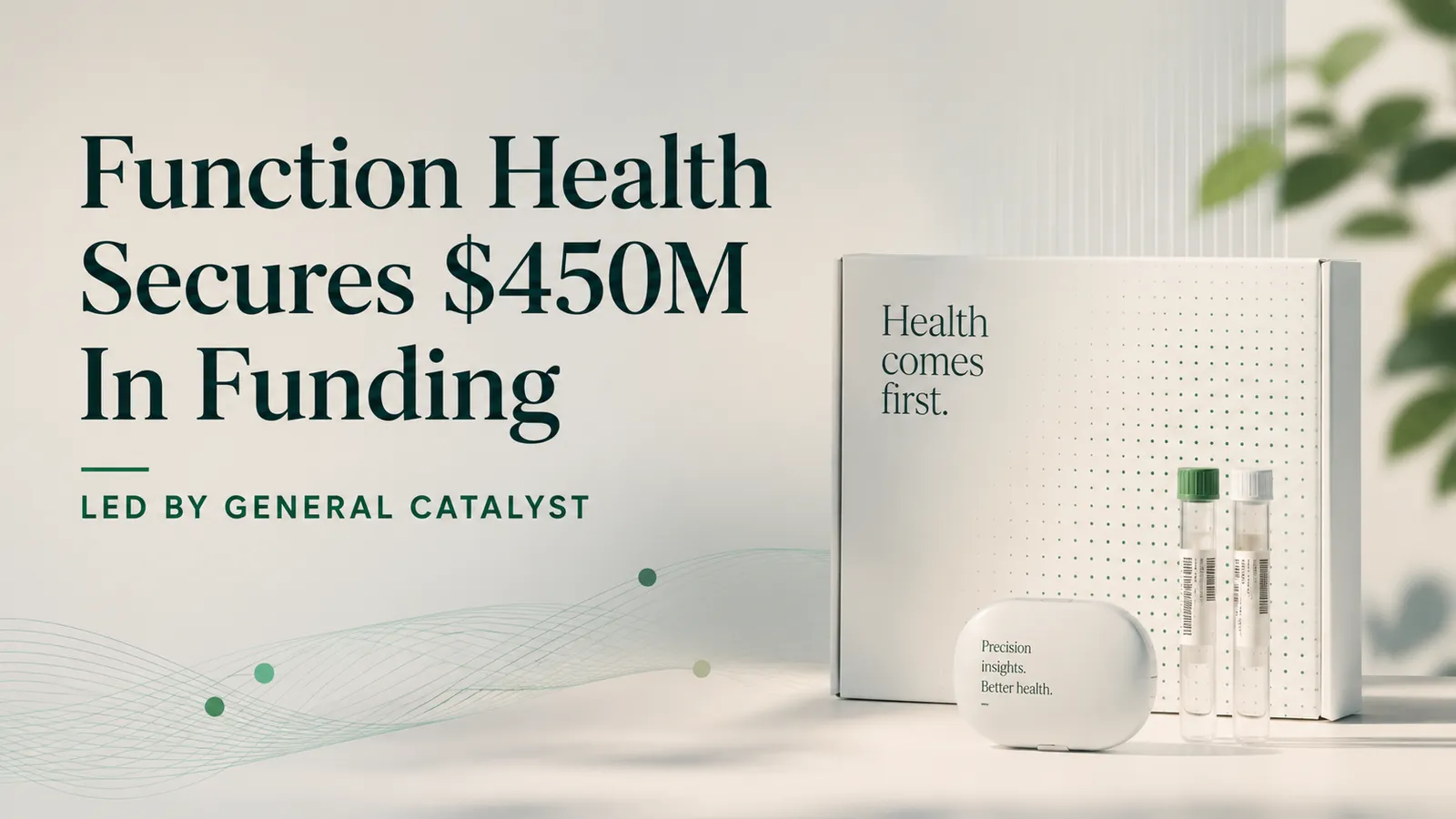

Function Health is a consumer health platform that gives members access to more than 160 laboratory tests a year. Its $365 membership includes repeat testing, a dashboard for tracking results, written explanations, and clinician review.[1][2]
On July 30, 2026, the company secured $450 million in growth financing led by General Catalyst. The capital is intended to help Function acquire more members and bring the platform to millions more people.[3]
The timing gives Function several new ways to reach them. One week before the financing announcement, OpenAI named Function as a launch connection for Health in ChatGPT.[4] The day before that, Robinhood made a Function membership a complimentary benefit of its new $695-a-year Platinum Card.[5]
General Catalyst is betting that Function can take this product from the early preventive-health and longevity market to a much larger consumer audience.
What Function Health Does
Function gives consumers direct access to a large testing program without requiring each test to originate in a traditional primary-care visit. The standard membership now costs $365 per year, down from $499.[1]
For members, the product has three main parts:
Test broadly. The initial blood draw includes more than 100 tests across heart health, blood sugar, thyroid, hormones, liver, kidneys, inflammation, nutrients, heavy metals, autoimmunity, and other categories. Members can use more than 2,000 Quest Diagnostics locations.[2]
Review everything in one place. Function organizes the results in a dashboard and provides explanations, action items, and a clinician summary. A healthcare provider calls when a result reaches a critical level.[2]
Measure again. Members return three to six months later for more than 60 follow-up tests, bringing the annual total above 160.[2]
Members can download the report and share it with their physician. Additional tests and imaging are available outside the standard membership.
Function's core product is the organized testing cycle: a broad baseline, explanations in one account, and another measurement later in the year. The company is now adding imaging, mobile blood draws, supplement tracking, and AI connections around that starting point.
How the $450 Million Financing Works
General Catalyst supplied the money through its Customer Value strategy. This was growth financing for customer acquisition, sales, and marketing, not a conventional $450 million equity round.[6]
Under General Catalyst's model, the firm provides the acquisition budget and receives a capped share of the value generated by the customers that spending brings in. If the spending underperforms, General Catalyst says the company does not make a standard fixed repayment from its own cash.[6]
For Function, the structure provides a large pool of capital for expansion without issuing $450 million of new equity. For General Catalyst, the return depends on Function's ability to acquire members at a reasonable cost and retain them long enough to produce value.
Function and General Catalyst have not disclosed the agreement's cap, term, customer-acquisition targets, or other company-specific economics. They also did not announce a new valuation. The $450 million should therefore be understood as dedicated growth financing, separate from Function's previous venture rounds.
How Function Reached This Point
Function's new financing follows several years of rapid company building.
The company's LinkedIn profile lists 2022 as its founding year, and Function launched its beta in April 2023.[7][8] Its leadership page identifies Jonathan Swerdlin, Pranitha Patil, Mark Hyman, M.D., Seth Weisfeld, and Dan Swerdlin as co-founders. Andreessen Horowitz's 2024 investment announcement also identified former chief technology officer Mike Nemke as a member of the founding team.[9][10]
Jonathan Swerdlin serves as chief executive officer. Function describes him as a repeat healthcare entrepreneur and investor. Patil, the company's chief business officer, previously worked in health strategy at Accenture. Hyman, Function's chief medical officer, previously practiced at Cleveland Clinic and helped establish its Center for Functional Medicine. Weisfeld came from product design, including work involving artificial intelligence at Meta. Dan Swerdlin serves as general counsel.[9][10]
By June 2024, Function reported nearly 50,000 paying members and a waitlist of more than 200,000 people. The company had raised $53 million at that point.[8]
In November 2025, Function raised a $298 million Series B led by Redpoint Ventures at a $2.5 billion valuation. That round brought its conventional capital raised to about $350 million at the time.[11]
The new General Catalyst financing provides a different pool of money. Instead of proving that Function can launch a membership and attract early demand, the company now needs to show that it can distribute the product at mainstream scale.
OpenAI and Robinhood Give Function New Distribution
Function's expansion is no longer dependent only on people finding its website or hearing about the company through health and longevity communities.
OpenAI says more than 300 million people ask health-related questions in ChatGPT each week. Health in ChatGPT can connect to Function Health accounts with the user's permission, allowing people to ask questions about changes in their own test results and prepare for medical appointments.[4]
Robinhood offers another path. Its $695 annual Platinum Card includes a complimentary Function membership as a cardholder benefit.[5] That places Function alongside the travel, rewards, and lifestyle benefits consumers already associate with premium credit cards.
These partnerships can lower Function's cost of finding customers. They also make the membership feel less like a niche longevity product and more like a mainstream consumer subscription.
The General Catalyst capital gives Function room to pursue more arrangements like these, support promotions, and advertise to much larger audiences. Function has not published a detailed budget, so this is an inference from the financing model rather than a disclosed spending plan.
Function Is Expanding Beyond Blood Tests
Function's longer-term strategy appears broader than selling a fixed laboratory panel.
The company acquired Ezra, a full-body magnetic resonance imaging business, in May 2025.[12] It acquired Getlabs, a mobile blood-draw company, in April 2026.[13] One month later, it bought supplement-tracking company SuppCo.[14]
Those acquisitions add three capabilities around the core membership:
Imaging through Ezra
At-home collection through Getlabs
Supplement tracking through SuppCo
Function can use the same consumer account to organize more types of health information over time. Laboratory results remain the entry product, but the company is building toward a broader preventive-health platform.
That matters to the financing thesis. A member who uses only one set of blood tests has a limited relationship with the company. A member who returns for testing, adds imaging, schedules home collection, tracks supplements, and connects the account to ChatGPT may be more likely to renew and purchase additional services.
What the Membership Includes, and Where It Stops
Function provides more clinical involvement than a simple laboratory-results portal. Members receive written explanations and a clinician summary, and a provider calls about critical findings.[2]
Function also draws a clear boundary around the service. Its current legal language describes the company as a healthcare technology company rather than a laboratory or medical provider. Function says it does not provide medical advice, diagnosis, treatment, or a medical opinion. It recommends discussing results with a primary-care physician or another licensed provider.[1]
Function membership feature | Included? |
|---|---|
160+ annual laboratory tests | Yes |
Dashboard and trend tracking | Yes |
Written explanations and clinician summary | Yes |
Provider call for a critical result | Yes |
Diagnosis | No |
Prescriptions or medication changes | No |
Ongoing treating physician | No |
Referral and workup management | No |
Routine or urgent primary care | No |
Add-on imaging and extra tests | Additional cost |
This boundary becomes important as Function reaches a much larger audience. Broad panels can find overlooked problems, but they also produce borderline values, temporary abnormalities, and results whose usefulness depends on the patient's age, symptoms, history, and risk factors.
A 2026 narrative review of predictive biomarkers in asymptomatic adults found limited evidence of improved care for many biomarkers marketed to healthy consumers. The authors highlighted false positives, anxiety, overdiagnosis, and follow-up testing as potential risks. They also emphasized the primary-care physician's role in interpreting results inside the patient's actual risk profile.[15]
Even familiar measurements can change quickly. In a study of 1,864 adults, more than 30% of initially elevated bilirubin, aspartate aminotransferase, or alanine aminotransferase results returned to normal when repeated an average of 17.5 days later.[16]
The American Academy of Family Physicians recommends screening based on evidence and individual risk. It recommends against mass or direct-to-consumer screening that lacks evidence.[17]
Function can deliver the data and flag a concern. A treating clinician still decides whether a result needs repetition, medication changes, imaging, a specialist referral, urgent care, or simple observation.
Where Function Fits With DPC and Concierge Medicine
Function, direct primary care, and concierge medicine all charge membership fees, but the memberships buy different services.
Model | Typical annual price | Main product | Diagnoses and treats? |
|---|---|---|---|
Function Health | $365 | Broad testing, tracking, explanations, and clinician review | No |
Direct primary care | $600 to $2,400 | Ongoing primary care with a physician | Yes |
Concierge medicine | $3,000 to over $40,000 | Ongoing physician care with smaller panels and expanded access | Yes |
NextMD's concierge medicine versus direct primary care comparison explains the differences in access, insurance, and price.[18] Our concierge medicine cost guide covers the range within physician-led memberships.
Function can complement either model. It can order and organize the tests while the physician determines which findings matter, documents the plan, prescribes when appropriate, and follows the outcome.
The pairing may become more common as Function grows. Millions of new members would also mean millions of reports that eventually need to enter regular medical care.
What to Watch Next
The $450 million commitment makes Function one of the best-capitalized consumer preventive-health companies in the market. Several measures will show whether the expansion is working:
Membership growth and renewal. Customer acquisition works only if enough members stay.
More distribution partnerships. OpenAI and Robinhood may be the beginning of a larger partner strategy.
Use of acquired products. Ezra, Getlabs, and SuppCo need to become meaningful parts of the member experience.
Changes to price or packaging. Function may use promotions, partner subsidies, or product bundles to accelerate adoption.
The clinical handoff. Growth will test how effectively members move abnormal findings into physician-led care.
Function has already shown that people want easier access to broad health data. The next phase is about proving that this demand can support a large, durable consumer-health platform.
The Bottom Line
Function Health secured $450 million because General Catalyst believes the company can turn customer-acquisition spending into long-term member value.
The product at the center of that bet is a $365 annual membership with more than 160 laboratory tests, repeat testing, a health dashboard, written explanations, and clinician review. OpenAI and Robinhood give Function access to audiences far beyond the early longevity market. Ezra, Getlabs, and SuppCo give it products beyond the original blood panel.
The financing does not turn Function into a medical practice. Its opportunity is to become the consumer account where people collect and understand more of their health data. The physician remains responsible for diagnosis and treatment.
If Function can acquire members efficiently, keep them engaged, and manage that handoff, the company has a credible path from a popular testing membership to a mainstream preventive-health platform.
Frequently Asked Questions
How much did Function Health raise?
Function Health secured $450 million in growth financing from General Catalyst in July 2026. The money came through General Catalyst's Customer Value strategy and is intended to finance customer acquisition, sales, and marketing.[3][6]
Was the $450 million a venture-capital round?
No. It was structured growth financing rather than a conventional equity round. Function did not announce a new valuation with the deal.
What does Function Health do?
Function Health sells a $365 annual membership that includes access to more than 160 laboratory tests, repeat testing, result tracking, written explanations, and clinician review.[1][2]
Who founded Function Health?
Function's current leadership page names Jonathan Swerdlin, Pranitha Patil, Mark Hyman, M.D., Seth Weisfeld, and Dan Swerdlin as co-founders. Andreessen Horowitz also identified former chief technology officer Mike Nemke as part of the founding team.[9][10]
Does Function Health diagnose or treat medical conditions?
No. Function says it is a healthcare technology company and does not provide medical advice, diagnosis, or treatment. Members need an outside physician to make clinical decisions based on the results.[1]
Can Function Health connect to ChatGPT?
Yes. OpenAI named Function Health as a supported connection for Health in ChatGPT. Users can choose to connect their accounts and ask questions based on their health information.[4]
Find a Doctor Who Can Act on the Results
Function can organize a large amount of health data. A physician still needs to decide what the findings mean for you and what should happen next.
NextMD helps patients search by city, compare available pricing, and review physician credentials across concierge and direct primary care practices in the United States.
A Note From the Author
I am not a doctor. This article provides general information and does not offer medical advice, diagnosis, or treatment. Discuss laboratory results and screening decisions with a licensed clinician who knows your medical history.
Sources
Function Health. (2025, November 20). Function membership is now $365/year. Read the pricing announcement and current service disclaimer
Function Health. (2026). Frequently Asked Questions. Review the tests, result process, and membership details
Dorbian, I. (2026, July 30). Health testing platform Function inks $450m from General Catalyst. PE Hub. Read on PE Hub
OpenAI. (2026, July 23). Launching Health in ChatGPT. Read the OpenAI announcement
Robinhood. (2026). Robinhood Platinum Card. Review the current card benefits
Singhvi, P., & Mohan, K. V. (2023). The Unbundling of Growth Equity. General Catalyst. Read how the Customer Value strategy works
Function Health. (2026). Function Health company profile. LinkedIn. Review the company profile
Function Health. (2024, June 25). Function Emerges as the Fastest-Growing Health Platform in the US with Unique Approach that Starts with 100+ Lab Tests. PR Newswire. Read the Series A and beta-launch announcement
Function Health. (2026). About Function Health. Review the founders and current leadership
Pande, V., Wolf, D., Cohen, Z., Collins, A., & Kim, B. (2024, June 25). Investing in Function Health. Andreessen Horowitz. Read the founding-team background
Park, K. (2025, November 19). Function Health raises $298M Series B at $2.5B valuation. TechCrunch. Read the Series B report
Function Health. (2025, May 5). Function Health Acquires Ezra, Introduces $499 Full-Body MRI Scan. PR Newswire. Read the acquisition announcement
Function Health. (2026, April 8). Function Acquires Getlabs, Bringing Healthcare Directly to You. PR Newswire. Read the acquisition announcement
Function Health. (2026, May 12). Function Acquires SuppCo to Bring Trust and Clarity to Supplements. Read the acquisition announcement
Wiedermann, C. J., Piccoliori, G., Engl, A., & Hager von Strobele-Prainsack, D. (2026). Predictive Biomarkers for Asymptomatic Adults: Opportunities, Risks, and Guidance for General Practice. Diagnostics, 16(2), 196. Find on PubMed
Lazo, M., Selvin, E., & Clark, J. M. (2008). Clinical implications of short-term variability in liver function test results. Annals of Internal Medicine, 148(5), 348-352. Find on PubMed
American Academy of Family Physicians. (2019, updated 2023). Screening. Read the AAFP policy
NextMD. (2026). Concierge Medicine vs DPC in 2026: Complete Comparison. Read the model and pricing comparison