
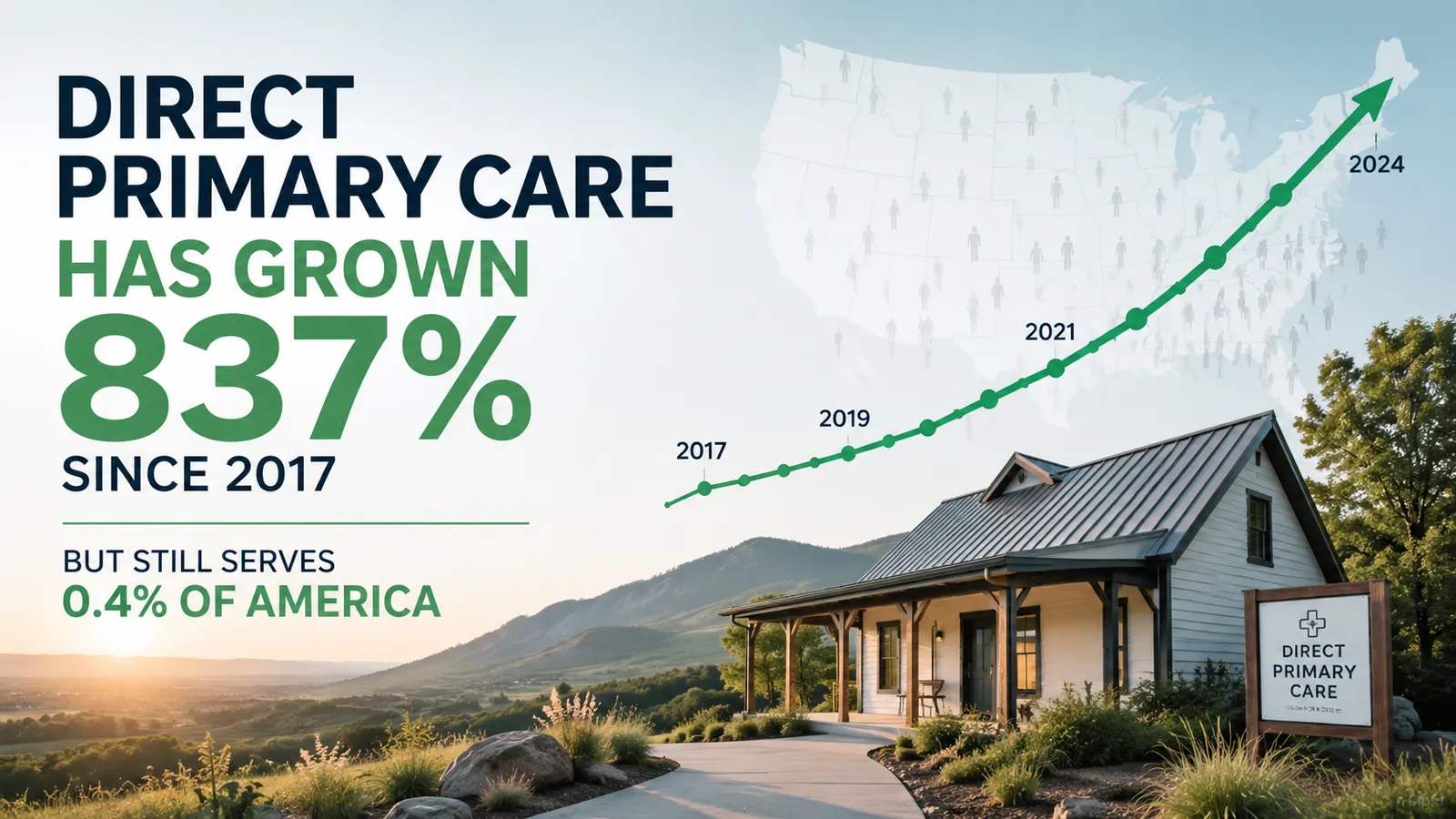

Direct primary care membership has grown over 800% since 2017 yet it still reaches less than 1% of Americans
NextMD's database provides the practice-side view. As of September 1, 2026, we track 2,023 physician-led DPC practices, or 30.6% of our 6,603 membership practice listings. They span all 50 states plus Washington, DC, and Puerto Rico. Of those DPC practices, 1,462 publish a price, with a median of $99 per month. Our directory excludes practices led only by nurse practitioners or physician assistants. The NextMD national market report explains the methodology.[4]
Hint Health counted 409 active direct primary care members per 100,000 US residents in 2025, up from 44 per 100,000 in 2017. Its 2026 report covers 1.4 million members and more than 2,700 clinicians.[1]
Hint's database provides a broad view of the category. The report is an industry dataset rather than a government census. The exact national total may differ, but the reported penetration equals about one DPC member for every 244 Americans.[1]
Direct primary care (DPC) combines fast growth with limited national reach. Patients, physicians, and employers have shown demand for the model. Wider adoption now depends on four practical issues: local availability, consumer understanding, employer distribution, and physician supply.
What Direct Primary Care Covers
Direct primary care practices charge a recurring membership fee instead of billing insurance for routine primary care. The canonical DPC price range is $50 to $200 per month, or $600 to $2,400 per year.[4] Hint reported a $99 median retail membership in 2025.[1]
Membership commonly covers longer appointments, same-day scheduling, phone or text communication, telemedicine, chronic-condition management, and care coordination. In the American Academy of Family Physicians (AAFP) 2024 survey, 98% of responding DPC practices included same-day appointments, phone or text consultations, and telemedicine in the fee.[2]
DPC does not replace health insurance. You still need coverage for hospital care, surgery, specialty care, and expensive medications. The model separates routine primary care from insurance coverage for larger and less predictable expenses.
The Growth Reflects Demand From Three Groups
Three groups are supporting DPC growth.
Patients are enrolling. Hint measured an average annual membership growth rate of approximately 33% from 2017 through 2025. The average member age stayed between 41 and 43 during that period, suggesting growth across a stable adult customer base rather than a one-year demographic shift.[1]
Physicians report higher satisfaction. In the AAFP survey, 94% of responding DPC physicians said they were satisfied with their practice, compared with 57% of physicians outside DPC. Twelve percent of DPC physicians reported burnout once a week or more, compared with 46% outside the model.[2]
Employers are paying for memberships. Employer-funded memberships increased from 18% of active Hint memberships in 2017 to 60% in 2025.[1]
Federal tax policy removed another barrier in 2026. People enrolled in qualifying DPC arrangements can remain eligible to contribute to a Health Savings Account (HSA) and may use HSA funds for qualifying membership fees. The monthly limit for the HSA eligibility rule is $150 for an individual or $300 for an arrangement covering more than one person.[3] NextMD's guide to the $150 DPC and HSA rule explains which memberships qualify.
These changes support continued growth. Four barriers determine how many patients can access the model.
Barrier 1: DPC Availability Varies by Location
Hint reported DPC network coverage in 49 states in 2025, up from 21 states in 2019.[1] A state-level presence does not guarantee that a patient can find an open practice within driving distance.
The concentration data shows the difference. Minnesota had 2,077 DPC members per 100,000 residents in 2025. Colorado had 1,287.5 per 100,000. The national figure was 409.[1] A Minnesota resident was therefore about five times as likely as the average American to appear in Hint's DPC membership data.
Local examples make the gap easier to see. A patient searching Kansas membership practices can find DPC options across Wichita, Overland Park, Lawrence, and other cities. Atlas MD in Wichita lists four physicians and a $50 monthly fee in NextMD directory data. Many smaller communities still have one physician-led option or none.
Patients need enough local choices to compare physician credentials, prices, services, and availability. One practice on a statewide map provides access for one community. Several practices in the same market create dependable consumer choice.
Barrier 2: Patients Still Confuse DPC With Insurance and Concierge Care
DPC asks patients to pay a doctor directly while continuing to carry insurance. That structure creates predictable questions:
Does the membership replace my insurance premium?
Can I still use insurance for specialists and hospital care?
Are office visits included in the monthly fee?
Is DPC the same as concierge medicine?
Can I pay with an HSA?
Each question affects whether a patient searches for the model. Someone who assumes every medical membership costs $20,000 per year may overlook a local practice charging $99 per month. Someone who expects the membership to cover hospitalization may buy the wrong combination of services.
Physicians face a related education task. Among the AAFP members surveyed in 2024 who were outside DPC, 27% knew about the model but were still learning about it.[2] Patient recruitment was one of the two concerns physicians cited most often when considering a transition to DPC.[5]
Clear descriptions help both groups. A DPC practice should state the monthly price, included services, insurance requirements, physician credentials, and enrollment status on one page. Directories and employer materials should use the same definitions.
Barrier 3: Employer Adoption Requires Benefits Infrastructure
Employers fund 60% of active memberships in Hint's dataset.[1] The AAFP also found that 63% of responding DPC practices had a signed or formal employer contract.[2]
Employer funding changes how DPC reaches patients. One agreement can enroll dozens or hundreds of workers. The practice gains predictable revenue, and the employee can try the model without adding another monthly household expense.
The agreement creates administrative work. A practice or DPC network must:
negotiate with the employer or benefits adviser;
define which employees and dependents qualify;
coordinate the membership with the health plan;
enroll and remove members as employment changes;
explain the benefit to workers; and
report utilization or other agreed measures without compromising patient privacy.
A small independent practice may not have staff for those functions. A national DPC network can offer one contract across several cities, while a local practice can serve only employees who live nearby. This gives networks a distribution advantage and can place them between the physician and the employer.
Employer adoption can expand DPC while preserving independent care if local practices can participate without building a separate benefits company. Patients who already have the benefit can use NextMD's guide to understand what employer-sponsored DPC includes.
Barrier 4: Each DPC Clinician Has Limited Capacity
DPC practices protect appointment time by maintaining smaller patient panels. The AAFP survey found an average panel of 402 patients.[2] NextMD uses a canonical ceiling of up to 800 patients per DPC physician, compared with 2,000 to 2,500 patients in traditional primary care.[4]
Larger panels would increase membership totals, but they would also reduce the time and availability included in the membership. DPC growth therefore requires more clinicians, not only more patients for existing clinicians.
The supply calculation shows the scale required:
One percent of the US population is approximately 3.4 million people. At the AAFP average of 402 patients per clinician, DPC would need about 8,500 clinicians to serve them.[1][2]
Ten percent of the US population is approximately 34 million people. At the same average panel, DPC would need about 84,600 clinicians.[1][2]
These calculations illustrate capacity rather than predict future enrollment. They also show why software alone cannot expand DPC to tens of millions of patients.
Physician interest is increasing. The share of responding AAFP family physicians who said they operated a DPC practice rose from 3% in 2022 to 9% in 2023.[5] Physicians considering the transition cited capital or cash flow (54%) and patient recruitment (50%) as their two most common concerns.[5]
The two concerns connect physician supply to patient distribution. A physician needs confidence that enough local patients or employers will enroll. Patients need an available physician before they can choose the model.
What Would Move DPC Beyond 0.4%?
DPC can grow several times over while remaining a small part of American primary care. Moving from 0.4% to 1% would add roughly two million members and still leave 99% of Americans outside the model.
Here are four requirements for that next stage:
More local practices. Patients need nearby physicians with open panels.
Consistent consumer explanations. Patients need to understand what the fee includes and why insurance remains necessary.
Simpler employer purchasing. Independent practices need a manageable way to join employer benefits without adding a large administrative staff.
A credible physician transition path. Doctors need working capital, patient-recruitment support, and realistic timelines for filling a panel.
The 837% growth figure shows that DPC can attract patients. The 0.4% penetration figure shows how much distribution and clinical capacity the category still needs.
FAQ
How many Americans use direct primary care?
Hint Health's 2026 report covers 1.4 million members and estimates 409 active DPC members per 100,000 Americans, or about 0.4% of the population.[1] Hint's database is an industry dataset rather than a complete government census.
How fast is direct primary care growing?
DPC membership per 100,000 Americans increased 837% from 2017 through 2025, according to Hint Health. That equals an average annual growth rate of approximately 33%.[1]
Do employers pay for direct primary care?
Yes. Employers funded 60% of active memberships in Hint's 2025 data, and 63% of DPC practices responding to the AAFP survey reported at least one formal employer contract.[1][2]
Does direct primary care replace health insurance?
No. DPC memberships cover routine primary care services defined by the practice. Patients still need insurance for hospital stays, surgery, specialty care, and other large medical expenses.
Can you pay for DPC with an HSA?
Yes, qualifying DPC fees became eligible for HSA reimbursement in 2026. The separate rule that preserves HSA contribution eligibility applies to arrangements costing no more than $150 per month for one person or $300 for more than one person.[3]
Find a Direct Primary Care Doctor Near You
NextMD lists physician-led DPC and concierge practices across the United States. You can compare locations, membership prices, physician credentials, and practice models before contacting a practice. Search for a direct primary care doctor near you.
This article provides general educational information and is not medical, legal, tax, or financial advice. Confirm insurance and HSA eligibility with your health plan, tax adviser, and the practice before enrolling.
Sources
Hint Health. (2026). Trends in DPC '26. Hint Health Data Analytics. Read the 2026 Direct Primary Care Trends Report (PDF).
American Academy of Family Physicians. (2024). 2024 Direct Primary Care Data Brief. AAFP. Read the AAFP DPC Data Brief (PDF).
Internal Revenue Service. (2026). Notice 2026-05: Health Savings Account Guidance Under the One, Big, Beautiful Bill Act. Internal Revenue Bulletin 2026-02. Read the IRS guidance on direct primary care arrangements.
NextMD. (2026). Concierge Medicine and Direct Primary Care: The 2026 US Market Report. NextMD. Read the NextMD membership-medicine market report.
Marso, A. (2024, April 26). Surveys Show More Family Physicians Practicing Direct Primary Care and Enjoying It. American Academy of Family Physicians, FPM. Read the AAFP survey summary.