
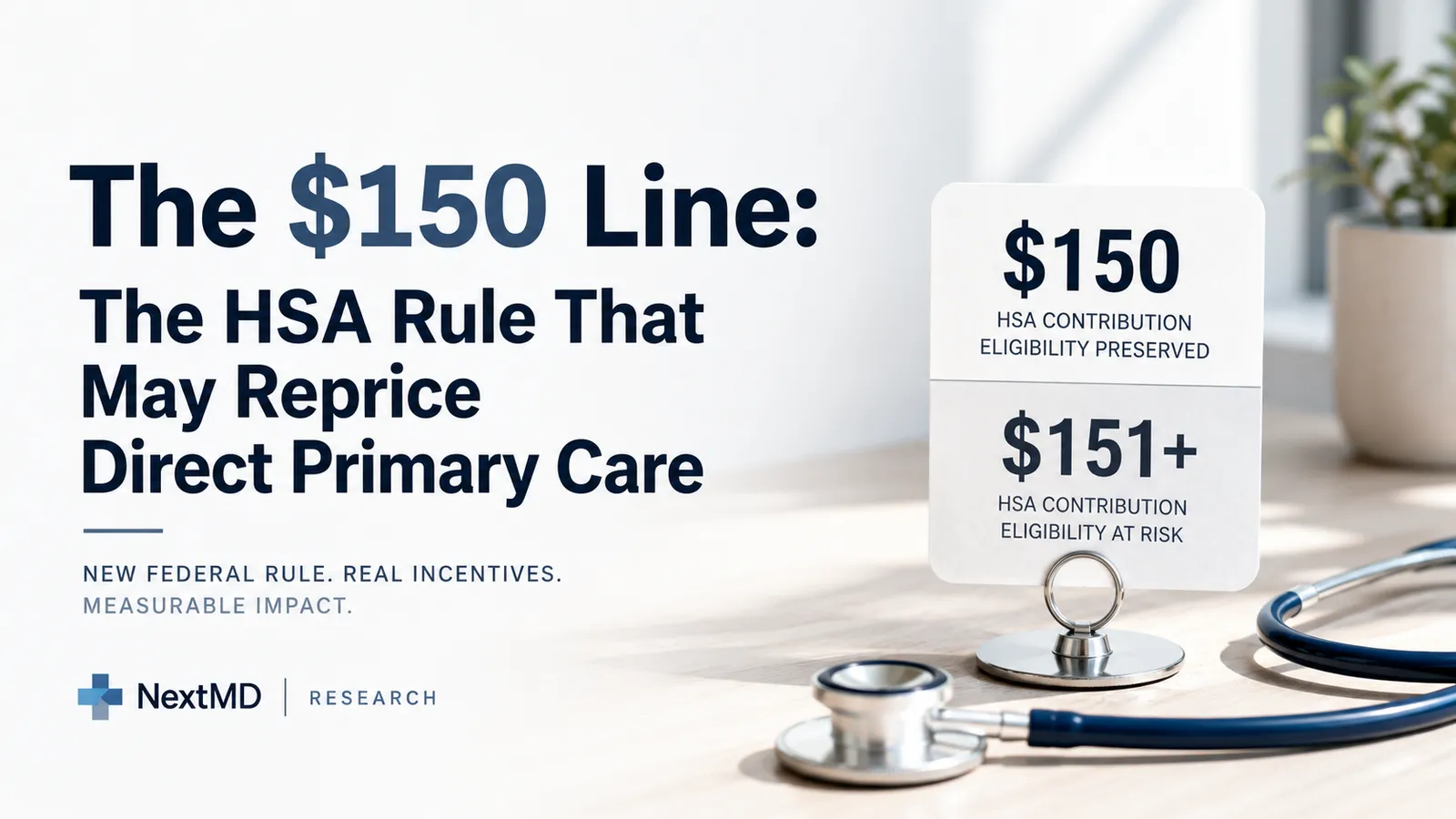

The $150 Line: The HSA Rule That May Reprice Direct Primary Care
There is now a federal line running directly through direct primary care pricing: $150 per month.
As of January 1, 2026, a qualifying direct primary care (DPC) membership at or below $150 preserves a patient's ability to contribute to a Health Savings Account (HSA). At $151, that protection can disappear. The membership may still be reimbursable from existing HSA funds, but the patient can lose the ability to put new money into the account.[1]
One dollar now changes the answer.
Here is the number I keep coming back to: 104 DPC practices in the NextMD directory charge exactly $150 per month. Another 27 charge $149. Only 40 sit anywhere between $150 and $175.
The broader membership-medicine market is close too. Across 3,469 priced concierge, DPC, hybrid, specialty, and performance-medicine practices, the median listed fee is $162.50. The DPC subset is cheaper, with a $99 median, but 171 priced DPC practices still sit above the federal line.
I believe $150 will become a defining price for DPC. Patients now have a reason to choose the practice at $150 over the one at $159. Employers and benefits advisers have a simpler benefit to explain. Practices have to decide whether preserving HSA contribution eligibility is worth more than the revenue they give up to reach the line.
Rules create incentives. Incentives change prices. This one is measurable.
This article provides general educational information, not tax or legal advice. The membership agreement, services, billing structure, total fees, and member's health coverage determine the federal tax treatment.
The $150 Rule Has Two Different Effects
The Internal Revenue Service (IRS) guidance answers two questions that often get combined:
Can a member use HSA funds for a qualifying DPC fee? Yes. The IRS treats fees for an otherwise qualifying DPC service arrangement as medical expenses that an HSA may reimburse. The guidance does not impose a specific price ceiling on that reimbursement rule.[1]
Can the member keep contributing new money to an HSA? A qualifying arrangement preserves contribution eligibility when aggregate DPC fees stay at or below $150 per month for one person or $300 for an arrangement covering more than one person in 2026. An arrangement above that limit can make the member ineligible to contribute during enrollment months.[1]
This distinction is central to the pricing question. A $175 qualifying membership may still be payable from existing HSA funds, but it can cost the member the ability to make new tax-favored contributions.
The $150 figure governs contribution eligibility. The HSA reimbursement rule can still apply above it. Our complete HSA and FSA guide for concierge medicine and DPC covers the reimbursement rules, documentation, Flexible Spending Account treatment, and common mistakes in detail.
What NextMD's Pricing Data Shows
NextMD lists 6,543 physician-led membership practices. Of those, 3,469 publish a fee that can be normalized to one monthly amount. The median across every priced model, including concierge medicine, DPC, hybrid, specialty, and performance medicine, is $162.50, which rounds to $163.
That overall median explains why the federal line matters to the broader membership-medicine market. It does not describe DPC pricing by itself. The rule applies only to contracts that meet the federal definition of a DPC service arrangement, so the DPC subset provides the relevant comparison.
Among 2,014 practices classified as DPC, 1,458 publish a comparable monthly fee:
Listed monthly fee | DPC practices | Share of priced DPC practices |
|---|---|---|
$100 or less | 888 | 60.9% |
More than $100 through $150 | 399 | 27.4% |
More than $150 through $175 | 40 | 2.7% |
More than $175 through $200 | 74 | 5.1% |
More than $200 | 57 | 3.9% |
The DPC median is $99 per month. In total, 1,287 priced DPC practices, or 88.3%, list a fee at or below $150. Another 171, or 11.7%, sit above the line.
The near-threshold counts are more revealing:
104 practices list exactly $150.
27 list exactly $149.
12 sit above $150 through $163.
40 sit above $150 through $175.
114 sit above $150 through $200, representing two-thirds of all priced DPC practices above the line.
These figures analyze listed prices only. NextMD did not conduct a tax review of 1,458 membership agreements. Age bands, family pricing, employer subsidies, enrollment fees, and included services can change the treatment for a specific member. The current distribution also cannot prove that the 2026 rule caused practices to choose $149 or $150. It gives NextMD a baseline for measuring future changes.
For a broader view of the census, see NextMD's 2026 concierge medicine and DPC market report.
Why Practices Just Above $150 May Reprice
Dr. Phil Eskew, a physician-attorney and the founder of DPC Frontier, focused on this issue in an August 2026 episode of My DPC Story. He explained the new rule and the contract choices practices should review when their recurring fee exceeds $150.[2][3]
Three incentives now favor a price at or below the line.
1. The patient can preserve HSA contribution eligibility
Two otherwise similar practices priced at $150 and $159 now create different HSA consequences. The $9 difference costs $108 per year before any tax effect. The larger issue is that the $159 arrangement can disrupt the member's eligibility to make new HSA contributions if it otherwise meets the DPC definition.
That difference gives patients a concrete question to ask during enrollment: “Will this membership preserve my HSA contribution eligibility?”
2. Employers and benefits advisers get a simpler rule
An employer evaluating DPC needs a benefit that its staff can explain consistently. A qualifying fee below the statutory line is easier to describe than a fee that may be reimbursable but affects contribution eligibility.
That could make $150 a procurement filter for employer-sponsored DPC. The employee still needs eligible health coverage, and employer-paid DPC fees are not the employee's own reimbursable expense.[1] Our guide to employer-sponsored direct primary care explains those plan-level details.
3. Practices gain a clear marketing fact
Practices have spent years answering uncertain HSA questions. The new law gives qualifying arrangements a more concrete answer.
Eskew recommends careful wording because the arrangement and the member's circumstances control the tax treatment.[2] A practice can say that it accepts HSA cards and provide the contract and receipt. It should avoid treating a successful card transaction as proof that every member qualifies.
A Price Cut Has a Real Revenue Cost
A practice charging $159 would give up $108 per member each year by moving to $150. At 400 members, that equals $43,200 in annual gross revenue. The practice needs enough new enrollments or improved retention to offset the reduction.
Some practices may hold their price because their patient population values access more than HSA contribution eligibility. Others may introduce age-based rates, family structures, or separate services. Any redesign needs legal and tax review. The IRS says the fixed periodic fee must be the sole compensation for the care included in the qualifying arrangement. It also excludes prescription drugs other than vaccines, procedures requiring general anesthesia, and certain laboratory services from the federal definition.[1]
The guidance permits providers to sell services outside the membership when those services are available to members and nonmembers alike, but contract design and billing facts control the result.[1] Moving charges between line items does not automatically create a qualifying arrangement.
The economics behind the model still matter. Our analysis of what direct primary care costs to run explains why independent practices can make different pricing choices while using the same monthly-membership model.
What the $150 Line Could Change Next
The first effects should be visible in public pricing and contract language.
NextMD will be watching four measures:
The number of practices at $149 and $150. A rising cluster would show that the statutory line is becoming a market price anchor.
Movement from $151 through $175. Forty priced DPC practices currently occupy this band. They face the smallest revenue change if they move to $150.
The share of practices publishing individual and family prices separately. The $150 individual and $300 multi-person limits reward clearer pricing.
Contract language about included services and separate billing. Qualification follows the agreement rather than the practice name or card processor.
The federal limits adjust for inflation after 2026.[1] That means the anchor can move, but the pricing behavior around it may remain.
What Patients and Practices Should Do Now
Patients should ask for the monthly individual fee, the multi-person fee, the membership agreement, and a description of any separately billed services. Compare the answer with the detailed HSA and FSA guide, then confirm your situation with a plan administrator or tax adviser.
Practices should review public pricing, enrollment materials, receipts, and contracts together. If the listed fee is $150 but required charges push the arrangement above the aggregate limit, the website price alone will not preserve a member's contribution eligibility.
The $150 line already sits close to a meaningful part of the DPC market. The next year of pricing changes will show how many practices decide that HSA compatibility is worth more than the revenue they give up to reach it.
Disclaimer
This article is for general educational and informational purposes only and does not constitute tax, legal, or financial advice. HSA eligibility and the tax treatment of DPC memberships depend on the specific membership agreement, services, fees, health coverage, and individual circumstances.
FAQ
Can a DPC practice charge more than $150 per month?
Yes. The law does not cap what a DPC practice may charge. A qualifying fee above $150 may still be reimbursable from an HSA, but enrollment can prevent the member from making new HSA contributions during those months.[1]
Is every DPC membership under $150 HSA-compatible?
No. Price is only one condition. The arrangement must provide qualifying primary care for a fixed periodic fee, use that fee as the sole compensation for included care, and satisfy the service restrictions in IRS Notice 2026-05.[1]
What is the DPC HSA limit for a family in 2026?
The limit is $300 per month for an arrangement covering more than one person. The IRS applies the limit to aggregate DPC fees, and the amount adjusts for inflation after 2026.[1]
How many DPC practices charge more than $150?
NextMD directory data identifies 171 DPC practices above $150 among 1,458 DPC practices with a comparable listed monthly fee. Of those, 40 charge more than $150 through $175.
Does accepting an HSA card prove that a DPC membership qualifies?
No. Card acceptance shows that a payment processor allowed the transaction. The membership agreement, included services, billing structure, price, and member's circumstances determine the federal tax treatment.[1][2]
NextMD helps patients find physician-led concierge and direct primary care practices, compare listed prices, and review doctor credentials. Search practices near you.
Sources
Internal Revenue Service. (2026). Notice 2026-05: Expanded Availability of Health Savings Accounts Under the One, Big, Beautiful Bill Act. Defines qualifying direct primary care service arrangements, the $150 and $300 contribution-eligibility limits, HSA reimbursement, excluded services, and separate-billing rules. Read IRS Notice 2026-05
Concepcion, M., and Eskew, P. (2026, August 16). DPC and HSAs: The $150 Rule and How to Opt Out of Medicare. My DPC Story, Episode 279. Listen to the episode
Eskew, P. (2026). Tax Treatment of Direct Primary Care. DPC Frontier. Includes the statutory language and DPC-specific implementation commentary. Read DPC Frontier's tax-treatment guidanc