
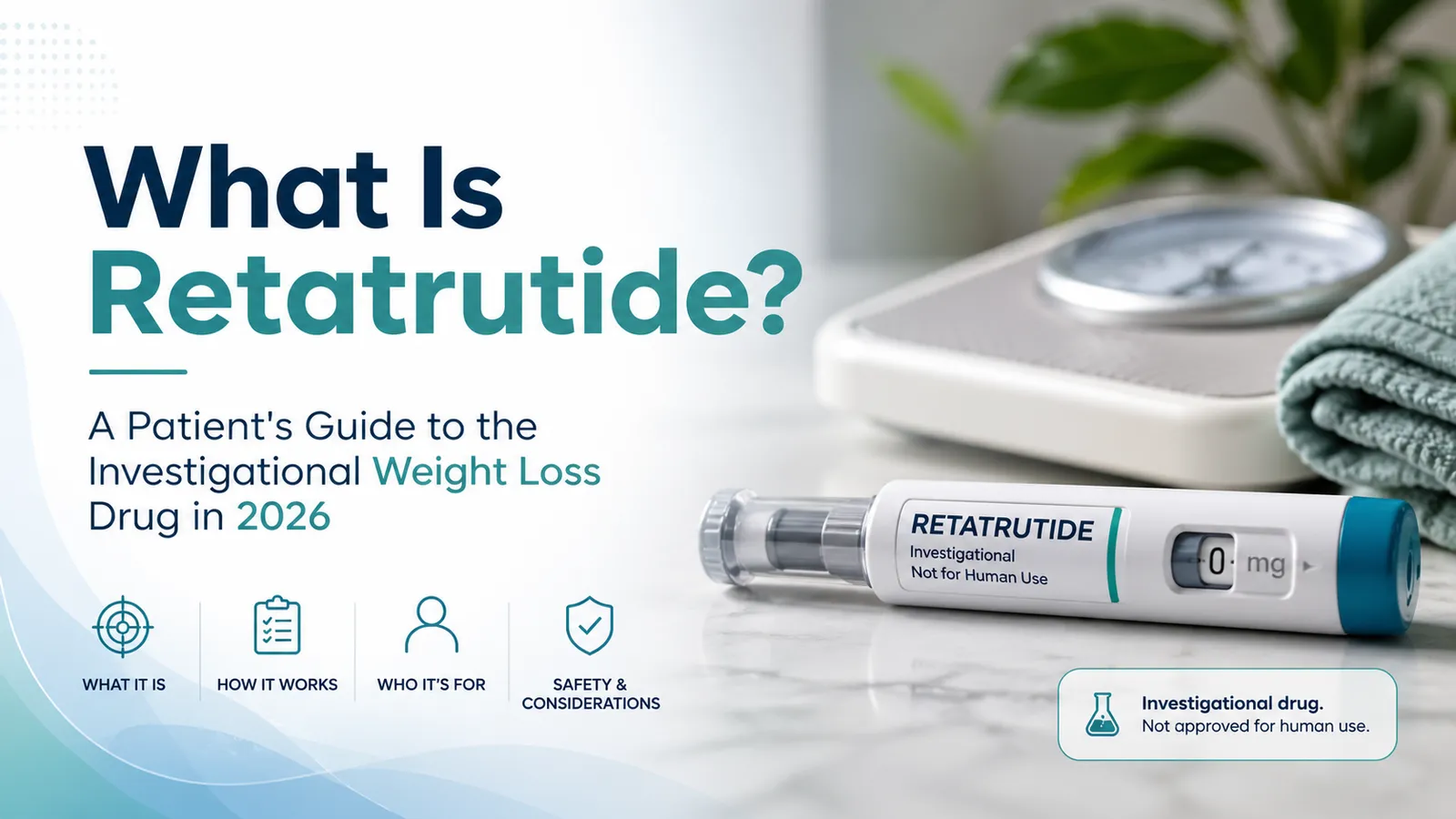

Retatrutide is an experimental once-weekly injectable being developed by Eli Lilly. In plain terms, it causes substantial fat loss while preserving more muscle than dieting alone.
In its published Phase 2 trials, it produced the largest average body-weight reduction ever recorded for a randomized obesity drug, and the loss came predominantly from fat tissue rather than from lean mass.[1]
In short, it cuts fat but keeps muscle.
Wall Street analysts and the broader healthcare industry widely project it to become one of the most prescribed medications in the world once it clears regulatory approval. The global market for this drug class expected to reach over $100 billion in annual sales by the early 2030s.[10]
The drug is not yet approved by the Food and Drug Administration (FDA), which means it cannot be legally prescribed for everyday use in the United States as of 2026. It is in late-stage clinical trials, and an approval decision is anticipated in the coming years.
The two findings driving the buzz are worth zooming in on.
First, in a 48-week Phase 2 trial published in the New England Journal of Medicine, adults with obesity who took the highest dose lost an average of 24.2% of their body weight, roughly 53 pounds for a 220-pound patient.[1] No obesity drug has ever produced larger numbers in a randomized trial.
Second, most of the weight that came off was fat, not muscle. Body composition imaging from the same trial showed that approximately three-quarters of the total weight reduction came from fat tissue, with a smaller share coming from lean mass.[1] That fat-to-lean ratio is more favorable than dieting alone tends to produce and is similar to or slightly better than the ratios reported for semaglutide (the drug in Ozempic and Wegovy) and tirzepatide (the drug in Mounjaro and Zepbound).[6][7]
A Trillion Dollar Class of Drugs
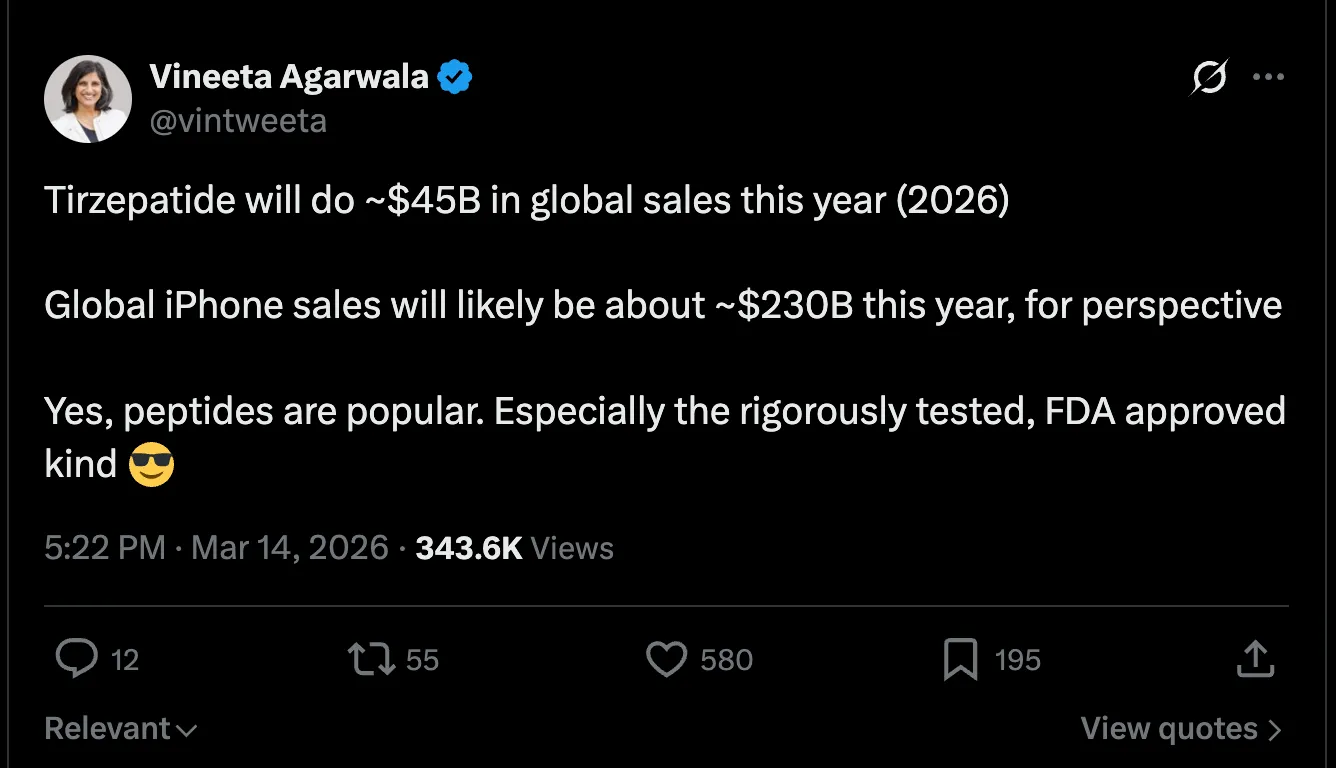
For perspective on the scale, Vineeta Agarwala, a general partner at the venture capital firm Andreessen Horowitz (a16z) who leads the firm's Bio and Health investments, recently noted that tirzepatide (the existing Mounjaro and Zepbound molecule) is on pace for roughly $45 billion in global sales in 2026, against about $230 billion in global iPhone sales the same year.[11] With retatrutide and other next-generation peptides building on top of that base, the GLP-1 and multi-agonist category is on a credible path to becoming a trillion-dollar drug class over the coming decade-plus, a scale only a handful of pharmaceutical categories have ever reached.
What's In This Guide
This article walks through what retatrutide is, what the trials actually showed, how it compares to other weight-loss drugs, who is taking it today, the gray-market problem, what it is likely to cost, and what is still unknown. The sections, in order:
How Retatrutide Compares on Fat Loss vs. Muscle Loss. The body-composition chart, with retatrutide alongside Zepbound, Wegovy, dieting alone, and diet plus resistance training.
What the Phase 2 Trials Actually Showed. The headline studies in obesity, type 2 diabetes, and fat-related liver disease, and how they compare to Wegovy and Zepbound.
What Is Retatrutide? The mechanism behind the results and why a triple-hormone drug works differently from single- and dual-hormone drugs.
The TRIUMPH Phase 3 Program. The larger studies in progress now.
Who Is Actually Using Retatrutide Right Now? The three populations with current access.
The Gray-Market for Retatrutide. Research peptides, online clinics, and the risks.
Side Effects Reported in the Trials. What the studies have flagged so far.
What Retatrutide Will Likely Cost. Pricing context based on Wegovy and Zepbound, and how insurance is likely to handle it.
Why Your Doctor Matters More in the GLP-1 Era. The access angle.
Frequently Asked Questions. The common questions condensed.
How Retatrutide Compares on Fat Loss vs. Muscle Loss
The chart below summarizes how the body-composition split looks across the major weight-loss options. The numbers come from each drug's largest published body-composition substudy and from typical findings in diet-only and diet-plus-training studies.
Approach | Approx. share of weight lost from fat | Approx. share from lean mass | Notes |
|---|---|---|---|
Retatrutide (Phase 2, 12 mg weekly) | ~75-80% | ~20-25% | Highest absolute weight loss recorded for an obesity drug; favorable ratio[1] |
Tirzepatide (SURMOUNT-1 substudy) | ~75% | ~25% | Comparable ratio to retatrutide[7] |
Semaglutide (STEP-1 substudy) | ~60-65% | ~35-40% | Slightly less favorable ratio than the dual or triple agonists[6] |
Dieting alone (typical) | ~70-75% | ~25-30% | Varies widely; rapid or extreme restriction makes muscle loss worse |
Diet + resistance training | ~85-90% | ~10-15% | Best protection of muscle; depends on adequate protein intake |
A few important caveats. "Lean mass" on a DXA scan (the imaging method used in these trials) includes water, organs, and connective tissue, not just skeletal muscle, so the actual muscle-only share is somewhat smaller than the lean-mass figure suggests. None of these drugs actively build or preserve muscle. Resistance training and adequate protein intake (clinicians studying GLP-1 drugs typically target around 1.2 to 1.6 grams of protein per kilogram of body weight per day) are what actually protect muscle mass during weight loss, regardless of which approach you use.
What the Phase 2 Trials Actually Showed
The chart numbers above come from a small set of well-designed studies. Here is the short version of each.
Obesity (NEJM, June 2023). Researchers led by Dr. Ania Jastreboff at Yale randomized 338 adults with obesity to placebo or one of four retatrutide doses (1 mg, 4 mg, 8 mg, or 12 mg) once weekly for 48 weeks. At the highest dose, the average weight loss was 24.2%, compared to 2.1% in the placebo group. About 83% of patients on the 12 mg dose lost at least 15% of their body weight, and 26% lost at least 30%. A body composition substudy using DXA imaging confirmed that most of the loss came from fat mass, with visceral fat (the dangerous fat stored around organs) dropping even more steeply than overall fat mass.[1]
Type 2 diabetes (The Lancet, October 2023). A separate Phase 2 trial in adults with type 2 diabetes (T2D) compared retatrutide to placebo and to dulaglutide (an existing GLP-1 drug). After 36 weeks, the highest retatrutide dose reduced HbA1c (a 3-month blood sugar average) by 2.02 percentage points and produced 16.94% body weight loss, both notably larger than dulaglutide.[2]
Liver disease (Nature Medicine, 2024). A Phase 2a trial in adults with metabolic dysfunction-associated steatotic liver disease (MASLD, a fat-related liver condition formerly called NAFLD) found that retatrutide reduced liver fat content by more than 80% at 48 weeks at the higher doses, with a meaningful share of patients reaching normal liver-fat levels.[3]
For context, here is how those weight-loss numbers compare to the two FDA-approved injectable drugs already on the market:
Drug | Class | Highest reported weight loss in pivotal trial | Status |
|---|---|---|---|
Semaglutide (Wegovy) | Single agonist (GLP-1) | About 14.9% at 68 weeks[6] | FDA approved 2021 |
Tirzepatide (Zepbound) | Dual agonist (GLP-1 + GIP) | About 22.5% at 72 weeks[7] | FDA approved 2023 |
Retatrutide | Triple agonist (GLP-1 + GIP + glucagon) | About 24.2% at 48 weeks[1] | Phase 3 (not yet approved) |
Two important notes. First, head-to-head comparisons across separate trials are imperfect because the studies enrolled slightly different patient populations. Second, Phase 2 results sometimes look better than Phase 3, where the patient pool is larger and more representative.
What Is Retatrutide?
Retatrutide (development name LY3437943) is a synthetic peptide drug developed by Eli Lilly. It is given as a once-weekly subcutaneous injection, the same delivery format as Mounjaro, Zepbound, Wegovy, and Ozempic. It is being studied for obesity, T2D, MASLD, obstructive sleep apnea, and knee osteoarthritis linked to obesity.[4]
Eli Lilly began developing retatrutide after the early commercial success of tirzepatide (the dual-agonist molecule that became Mounjaro and Zepbound) signaled that adding more hormone-receptor targets to a single molecule could push weight loss meaningfully higher than what a GLP-1 drug alone could deliver. Retatrutide is the first triple-hormone candidate to reach late-stage trials for obesity. Eli Lilly is also developing orforglipron, an oral GLP-1 pill, in parallel, so the company is effectively pursuing the next generation of obesity care across both injectable and pill formats. Other drugmakers including Amgen, Boehringer Ingelheim, and Novo Nordisk are working on multi-receptor candidates of their own, which suggests that triple- and even four-receptor designs are likely the future of obesity pharmacology.[4]
What makes retatrutide different from drugs already on the market is that it works on three of your body's natural appetite and metabolism signals at the same time. The simple version:
GLP-1. Tells your brain you are full sooner and slows how fast your stomach empties, so you eat less without feeling forced. This is the same signal Ozempic and Wegovy work on.[6]
GIP. A second hormone that helps your body handle blood sugar more efficiently and appears to add to the weight-loss effect when paired with GLP-1. This is the second signal Mounjaro and Zepbound work on.[7]
Glucagon. Best known for raising blood sugar in emergencies, but it also turns up how much energy your body burns and helps it tap into stored fat. This is the new piece retatrutide adds, and it changes the equation: instead of only eating less, you also burn through fat stores faster. This third lever is the most likely reason the body-composition split favors fat over muscle in the trial.[1]
The shorthand for this is "single agonist" (one signal), "dual agonist" (two), and "triple agonist" (three). Retatrutide is the first triple-hormone candidate to reach late-stage obesity trials, and based on its Phase 2 results, it is widely viewed inside the pharmaceutical industry as the molecule most likely to set the next benchmark for what an obesity drug can deliver.[1]
The TRIUMPH Phase 3 Program
Retatrutide is now being tested in a Phase 3 program Eli Lilly calls TRIUMPH.[4] Phase 3 trials are the larger, longer studies the FDA generally requires before approving a new drug. The program includes several active studies:
TRIUMPH-1: adults with obesity, no diabetes
TRIUMPH-2: adults with obesity and Type 2 diabetes
TRIUMPH-3: adults with obesity and cardiovascular disease
TRIUMPH-4: adults with obesity and knee osteoarthritis
Additional studies in obstructive sleep apnea and MASLD
Top-line readouts from the obesity studies are widely expected through 2026 and into 2027. An FDA decision is not expected before then. Timelines on investigational drugs slip routinely. Treat any specific approval date you see in the press as an estimate.
Who Is Actually Using Retatrutide Right Now?
This is where it gets important.
1. Clinical trial participants. This is the only legal, FDA-monitored way to take retatrutide today. Eli Lilly's TRIUMPH studies enroll adults at sites across the United States and globally. Patients in trials get the drug at no cost, but they may receive placebo, and they have to meet specific inclusion criteria (often a body mass index (BMI) of 30 or higher, or 27 with a related condition).
2. A small number of patients accessing retatrutide through a physician's expanded-access request. This is rare. Expanded access (sometimes called "compassionate use") is an FDA pathway that lets patients with serious conditions receive an investigational drug outside a clinical trial when no comparable approved option exists. For most patients with obesity, approved options like tirzepatide and semaglutide are considered comparable, so this pathway is not commonly granted for retatrutide.
3. A growing population obtaining retatrutide on the gray market. This is the part that worries clinicians the most, and it is where most of the off-trial use is actually happening.
Many of the gray-market participants are located in larger cities like LA, SF, NYC and Miami. This is being used to curb appetite, and enhance physical appearances without losing too much muscle.
The Gray Market for Retatrutide
There are two related but distinct gray-market channels.
Compounded GLP-1 clinics. When the FDA declared semaglutide and tirzepatide on its drug shortage list in 2022 and 2023, federal law opened a temporary window for compounding pharmacies to produce versions of those drugs. That created a sprawling industry of telehealth weight-loss clinics offering monthly subscriptions for "compounded semaglutide" or "compounded tirzepatide" at a fraction of the brand-name price. The FDA later removed both drugs from the shortage list and has been winding down the legal compounding pathway, but enforcement is uneven and many clinics continued operating for months past the deadlines. The FDA has issued repeated warnings about compounded GLP-1s, citing reports of dosing errors, infections, and serious adverse events, and has flagged products containing the wrong active ingredient or salt form (such as semaglutide sodium instead of pharmaceutical-grade semaglutide).[5]
Retatrutide does not have the same legal foundation. It has never been FDA approved, has never been on a shortage list in any approved form (because no approved form exists), and the molecule is patent-protected by Eli Lilly. Any clinic selling "compounded retatrutide" is operating outside the regulatory framework that briefly existed for compounded copies of approved drugs. There is no legal compounding pathway for it.
"Research peptide" sellers. This is the larger and more dangerous channel. Dozens of websites sell vials labeled "retatrutide" alongside other research peptides (BPC-157, tirzepatide, tesamorelin, and others), almost always with a disclaimer that the product is "for research use only" or "not for human consumption." That disclaimer is a legal shield, not a safety claim. The same vials are openly discussed in online communities (subreddits, Discord servers, and Telegram groups) where users share self-titration protocols, reconstitution videos, and dosing spreadsheets. Some of these communities have tens of thousands of members.
The economics drive the behavior. A legal cash-pay prescription for Zepbound or Wegovy typically runs around $1,000 to $1,300 per month in the United States without insurance coverage. Gray-market vials marketed as retatrutide often sell for $150 to $400 per month of equivalent dosing. For patients without coverage, the price gap is large enough that a meaningful number choose to roll the dice.
The risks are concrete, and they are not theoretical.
You cannot verify what is in the vial. Independent testing of research peptide products has repeatedly found vials with the wrong molecule, the wrong concentration, undeclared contaminants, bacterial contamination, or in some cases no active ingredient at all. There is no FDA inspection, no chain of custody, and no product recall mechanism if a batch is contaminated.
Sterility is not guaranteed. These products are typically lyophilized (freeze-dried) powder that the buyer reconstitutes at home with bacteriostatic water sourced separately. A break in sterile technique can introduce skin or environmental bacteria directly into the injection site. Skin and soft-tissue infections from non-sterile injections are a documented complication.
Self-titration without supervision is dangerous. The Phase 2 obesity trial used a slow, supervised dose escalation precisely because nausea, vomiting, and dehydration are most severe during dose increases. Patients self-dosing from a research vial often skip steps in that escalation, push to higher doses faster than the protocol used in trials, or stack retatrutide with other peptides. Severe dehydration, gallstones, pancreatitis, and hospitalization have all been reported in connection with unsupervised GLP-1 use.[5]
Cardiac monitoring is missing. Retatrutide raised resting heart rate by an average of 5 to 7 beats per minute at higher doses in the Phase 2 trial.[1] In a clinical study, that finding is monitored. On the gray market, no one is checking.
Drug interactions go uncaught. GLP-1 drugs slow gastric emptying, which can change the absorption of oral medications including birth control, thyroid hormone, and diabetes drugs. Without a physician reviewing your medication list, those interactions are invisible until something goes wrong.
The FDA has issued warning letters to multiple research peptide vendors and has moved against telehealth clinics misrepresenting compounded products, but the enforcement landscape moves much slower than the supply chain.[5]
If you are considering this route, the honest answer is that you are accepting risks the Phase 3 program is specifically designed to characterize. The headline weight-loss number, however striking, is not worth a contaminated injection, an undetected cardiac issue, or a dosing error that lands you in an emergency room. At minimum, talk to a physician first, ideally one who manages enough metabolic disease to have an informed view on the tradeoffs.
What Side Effects Did the Trials Report?
The most common side effects in the Phase 2 obesity trial were gastrointestinal: nausea, diarrhea, vomiting, and constipation. Most were mild to moderate and tended to occur during dose increases, similar to the pattern seen with semaglutide and tirzepatide.[1]
A finding worth flagging: in the obesity trial, retatrutide produced small increases in heart rate (about 5 to 7 beats per minute on average at the higher doses).[1] Heart rate increases have also been seen with other drugs in this class, but the size in retatrutide was on the higher end. The Phase 3 cardiovascular study (TRIUMPH-3) is specifically designed to look at heart-related outcomes.[4]
Long-term safety data, including effects on bone density, lean muscle mass, and post-stop weight regain, will come from the Phase 3 program and post-market studies. These are open questions today.
What Retatrutide Will Likely Cost
Retatrutide has no list price yet because it is not approved. The two comparable approved drugs in the same class give a reasonable starting estimate.
Without insurance, brand-name Wegovy currently lists at around $1,349 per month in the United States, and Zepbound lists at around $1,059 per month depending on how it is dispensed. Lilly's direct-to-consumer pharmacy program (LillyDirect) has begun selling Zepbound in single-dose vials at lower prices, sometimes in the $349 to $499 per month range for self-pay patients, well below the brand-pen price.
Insurance coverage for the existing GLP-1 drugs is highly inconsistent. Most large commercial health plans cover them for type 2 diabetes. Coverage for obesity without diabetes is the exception more often than the rule, although that is shifting as employer demand grows. Medicare currently does not cover GLP-1 drugs prescribed solely for obesity, though that policy is under active discussion.
Once retatrutide is approved, Lilly is likely to price it in roughly the same range as Zepbound, with a similar mix of brand-pen pricing, lower-priced vials through direct-to-consumer pharmacy programs, and the same patchwork of insurance coverage that varies plan to plan. A reasonable budget assumption for a patient paying out of pocket would be $400 to $1,300 per month depending on dose, format, and any manufacturer assistance programs available at launch.
For context, gray-market vials currently sell for $150 to $400 per month equivalent. The price gap is what is driving so much of the unregulated market, and the price gap is also why the legal market matters: brand-name retatrutide will come with FDA-verified manufacturing, a known dose, and physician oversight that the gray market structurally cannot offer. If price is the reason a patient is considering gray-market access, manufacturer assistance programs and direct-to-consumer pharmacy options for the existing approved drugs are usually a better starting place to discuss with a physician.
Why Your Doctor Matters More, Not Less, in the GLP-1 Era
The class of drugs retatrutide belongs to is rewriting how primary care manages obesity, diabetes, and metabolic disease. That has put primary care doctors in a strange position. Patients are asking about specific molecules by name. Insurance coverage is inconsistent. Compounded products are everywhere. And the standard 7 to 15-minute primary care appointment is not enough time to actually walk through the tradeoffs.[8]
This is one reason interest in concierge and direct primary care has accelerated alongside the GLP-1 boom. When your doctor manages 200 to 600 patients instead of 2,000 to 2,500, the math changes. There is time to discuss whether a GLP-1 makes sense for your specific situation, monitor side effects, manage dose escalations, and adjust if something is not working. Concierge patients also tend to use the emergency room about 40% less often than traditional primary care patients,[9] partly because they can text their doctor when something feels off instead of waiting weeks for an appointment.
If you are managing a metabolic condition and want a doctor who actually has time, see Concierge Medicine for Chronic Conditions. For a broader look at how the model works day to day, see How Concierge Medicine Actually Works Behind the Scenes in 2026. And if you are following the broader wave of metabolic and longevity technology, see What Whoop's $575M Raise Means for Your Concierge Doctor.
You can also browse concierge and direct primary care doctors by city. Miami in particular has become a hub for longevity-oriented concierge practices: see concierge doctors in Miami, Florida. To search nationally, visit nextmd.ai/search.
A Note From the Author
I am not a doctor. Nothing in this article should be considered medical advice.
This piece is intended as a plain-language summary of publicly available clinical research. Before starting, stopping, or asking about any prescription medication, including any drug in the GLP-1 or triple-agonist class, talk to a licensed physician who knows your medical history.
NextMD helps you find and compare concierge medicine and direct primary care practices across the United States. Browse practices by city, compare pricing, and find a doctor who has time for you at nextmd.ai/search.
Sources
Jastreboff, A.M., Kaplan, L.M., Frias, J.P., Wu, Q., Du, Y., Gurbuz, S., Coskun, T., Haupt, A., Milicevic, Z., & Hartman, M.L. (2023). Triple-Hormone-Receptor Agonist Retatrutide for Obesity: A Phase 2 Trial. New England Journal of Medicine, 389(6), 514-526. nejm.org
Rosenstock, J., Frias, J., Jastreboff, A.M., Du, Y., Lou, J., Gurbuz, S., Thomas, M.K., Hartman, M.L., Haupt, A., Milicevic, Z., & Coskun, T. (2023). Retatrutide, a GIP, GLP-1 and glucagon receptor agonist, for people with type 2 diabetes: a randomised, double-blind, placebo and active-controlled, parallel-group, phase 2 trial conducted in the USA. The Lancet, 402(10401), 529-544. thelancet.com
Sanyal, A.J., Kaplan, L.M., Frias, J.P., Brouwers, B., Wu, Q., Thomas, M.K., Harris, C., Schloot, N.C., Du, Y., Mather, K.J., Haupt, A., & Hartman, M.L. (2024). Triple Hormone Receptor Agonist Retatrutide for Metabolic Dysfunction-Associated Steatotic Liver Disease: A Randomized Phase 2a Trial. Nature Medicine, 30, 2037-2048. nature.com
Eli Lilly and Company. (2024-2026). TRIUMPH Phase 3 Clinical Trial Program for Retatrutide. Trial registry entries on clinicaltrials.gov (TRIUMPH-1: NCT05929066; TRIUMPH-2: NCT05931367; TRIUMPH-3: NCT05882045; TRIUMPH-4: NCT05935033).
U.S. Food and Drug Administration. (2023-2025). FDA Warns Consumers Not to Use Counterfeit and Compounded GLP-1 Drugs Including Semaglutide and Tirzepatide. Drug Safety Communications. fda.gov
Wilding, J.P.H., Batterham, R.L., Calanna, S., Davies, M., Van Gaal, L.F., Lingvay, I., McGowan, B.M., Rosenstock, J., Tran, M.T.D., Wadden, T.A., Wharton, S., Yokote, K., Zeuthen, N., & Kushner, R.F. (2021). Once-Weekly Semaglutide in Adults with Overweight or Obesity (STEP 1). New England Journal of Medicine, 384(11), 989-1002. nejm.org
Jastreboff, A.M., Aronne, L.J., Ahmad, N.N., Wharton, S., Connery, L., Alves, B., Kiyosue, A., Zhang, S., Liu, B., Bunck, M.C., & Stefanski, A. (2022). Tirzepatide Once Weekly for the Treatment of Obesity (SURMOUNT-1). New England Journal of Medicine, 387(3), 205-216. nejm.org
Neprash, H.T., Everhart, A., McAlpine, D., Smith, L.B., Sheridan, B., & Cross, D.A. (2023). Measuring Primary Care Exam Length Using Electronic Health Record Data. Medical Care, 61(7), 414-422. Referenced for the average primary care visit length of about 18 minutes (with face time often shorter).
Busch, F., Grzeskowiak, D., & Huth, E. (2020). Direct Primary Care: Evaluating a New Model of Delivery and Financing. Society of Actuaries / Milliman. soa.org. Referenced for the 40% ER reduction in DPC patients.
Goldman Sachs Research. (2023). The Anti-Obesity Drug Market Could Hit $100 Billion By 2030. Goldman Sachs Global Investment Research. Widely cited industry projection covered in Reuters and Bloomberg. goldmansachs.com. Referenced for the GLP-1 / triple-agonist market-size projection.
Agarwala, V. (2026, March 14). Tirzepatide will do ~$45B in global sales this year (2026). Global iPhone sales will likely be about ~$230B this year, for perspective. Post on X (Twitter). General Partner, Andreessen Horowitz (a16z) Bio + Health. x.com/vintweeta. Referenced for the tirzepatide global sales projection and the iPhone scale comparison.