
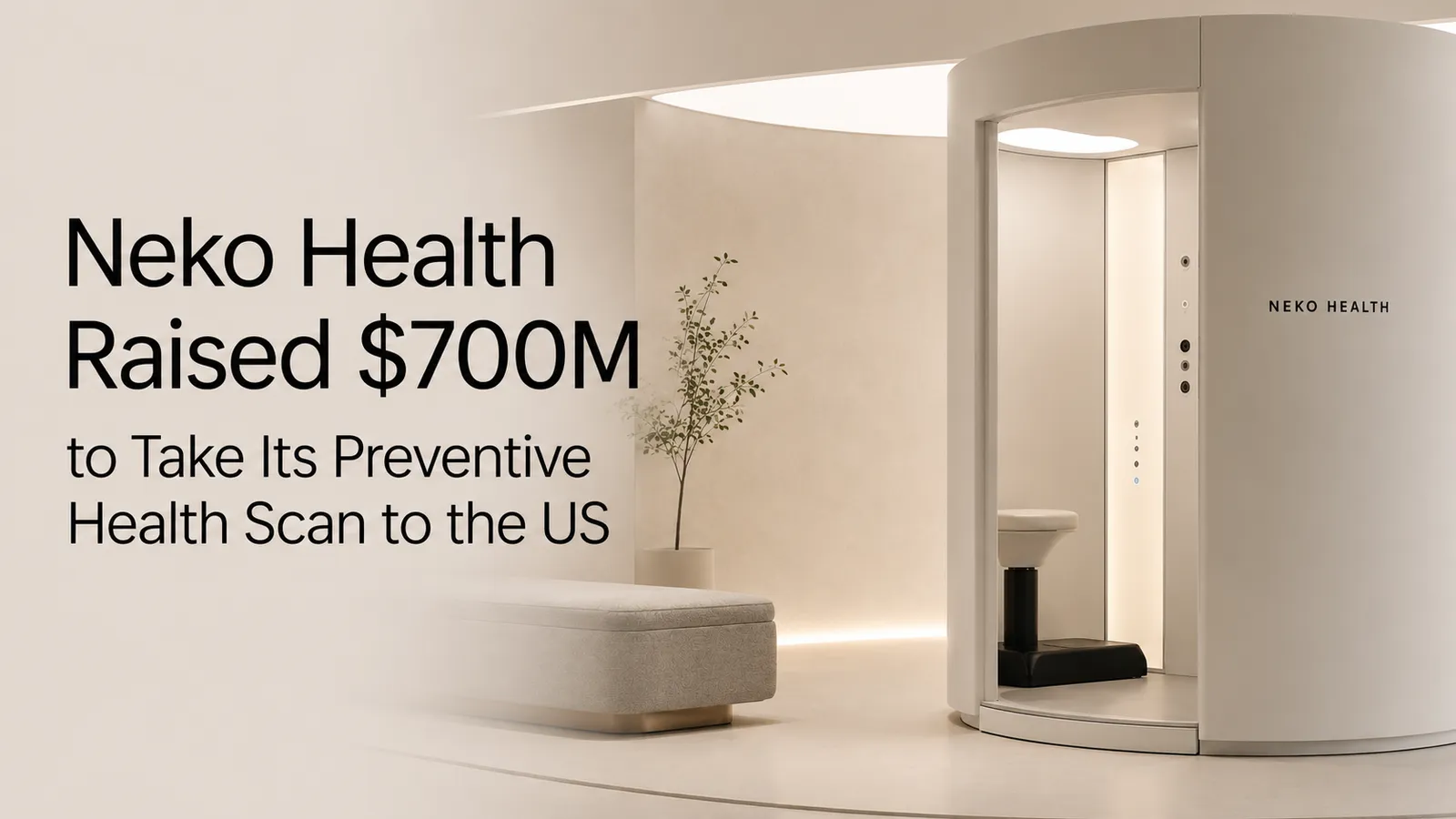

Neko Health operates preventive-health clinics that give paying members a broad, one-hour assessment followed by an in-person clinician consultation. Its radiation-free process combines automated skin imaging, blood tests, cardiovascular measurements, body-composition analysis, and other sensor data. The service costs £299 in the United Kingdom and SEK 2,750 in Sweden [1].
Results are available during the appointment. A clinician reviews the findings, explains what may require follow-up, and gives the member a digital record. Neko encourages people to repeat the assessment annually so that changes in measurements can be tracked over time [1].
One distinction is important. Neko does not provide a whole-body magnetic resonance imaging (MRI) or computed tomography (CT) scan. Its system uses optical and thermal imaging, electrocardiogram data, blood analysis, and other measurements rather than producing detailed images of internal organs. The term “full-body scan” refers to the breadth of Neko's assessment, not a conventional radiology exam [1][2].
On July 15, 2026, Neko announced a $700 million Series C led by Lightspeed Venture Partners. The company plans to use the money to open its first US clinic in New York, add clinics in Europe, fund clinical studies, and develop new versions of its devices [1].
Funding is only part of the story. Neko is testing whether a standardized, consumer-paid health assessment can become a recurring clinical service. Its early demand is clear. Whether the complete screening model improves long-term health outcomes remains an open research question.
Founders and Origin
Daniel Ek and Hjalmar Nilsonne founded Neko Health in Stockholm in 2018. Neko says Ek approached Nilsonne with a question about how healthcare might be designed if it were built around prevention and early detection. Nilsonne now serves as chief executive, while Ek is chairman [3].
Ek is best known as the co-founder and chief executive of Spotify. His role gives Neko a founder with experience building a consumer technology service across markets, but the company is not a side project run from Spotify. Nilsonne leads its operations and has spent his career working on sensor data and applied machine learning [3][4].
Nilsonne grew up in a family of doctors and earned a master's degree focused on industrial engineering, energy systems, and machine learning. Before Neko, he co-founded and led Watty, an energy-data company that used machine learning to analyze household electricity use. Watty was later acquired by Assa Abloy [4].
Lightspeed's account of the company's origin says Ek began studying healthcare after Spotify's 2018 public listing and met Nilsonne through an introduction. The two spent several years developing Neko's technology before opening the first clinic in Stockholm in February 2023 [5].
Their backgrounds help explain the operating model. Neko builds much of its own hardware and software, employs clinicians, and runs the clinics where the assessment takes place [1][3]. That degree of control gives the company one workflow to improve. It also means expansion requires medical staff, equipment, physical sites, and regulatory work in every market.
Who Invested in Neko Health's $700M Series C
Lightspeed led the Series C and O.G. Venture Partners co-led it. Existing investors Atomico, General Catalyst, and Lakestar participated. New institutional investors included Liberty City Ventures, Positive Sum, and BDT & MSD, the merchant bank backed by Michael Dell's family office. The round also included individual investors such as Mark Zuckerberg and Priscilla Chan, Tim Ferriss, Maria Sharapova, Thierry Henry, and will.i.am [1][6].
Neko did not disclose a valuation. The New York Time/s reported a figure of about $7 billion, according to a Techmeme summary of the coverage. That number should be treated as reported, not company-confirmed [7].
This financing follows a $260 million Series B led by Lightspeed in January 2025 and a $65 million Series A announced in July 2023. Neko has therefore announced approximately $1.025 billion across those three rounds [1][8].
Lightspeed's repeat role deserves attention for a practical reason. The firm led the Series B when Neko reported 10,000 completed scans, then led a much larger round after the company had expanded its clinic network and reported 100,000 members [1][8]. That does not validate the medical model, but it does show that an existing investor chose to increase its exposure after observing the company's operations.
Demand Is Strong. The Physical Model Is the Constraint.
Neko says more than 100,000 people have used the service in Sweden and the UK, while more than 350,000 have registered or joined its waiting list. It also reports that 75% of members book and prepay for another scan at the end of their appointment [1]. These are company figures and have not been independently audited in the cited materials.
Reported growth since the Series B has been substantial. In January 2025, Neko reported 10,000 completed scans, a waiting list exceeding 100,000, and an 80% rebooking rate [8]. By July 2026, the reported member count had increased tenfold as the company added locations in London, Manchester, Birmingham, and Stockholm [1]. As of July 2026 it appears they have 8 locations, 6 in the UK and 2 in Sweden. A 9th location is scheduled for NYC this year.
Nilsonne told Sifted that Neko is profitable at the clinic level [9]. That phrase has a narrow meaning. It suggests an established clinic can cover its direct operating costs, but it does not establish that Neko is profitable as a company. Research, engineering, central administration, regulatory work, and the cost of opening new sites sit outside a single clinic's operating result.
Neko is pursuing a healthcare-services expansion alongside a technology rollout. Each location needs suitable space, trained clinicians, equipment, and enough appointments to use that capacity efficiently. The $700 million gives Neko more room to build, but capital does not remove the operational requirements.
If Neko executes well, those requirements may become a competitive advantage. A network that combines proprietary devices, consistent clinical processes, and repeat measurements would take time to reproduce. If utilization or hiring falls short, the same fixed infrastructure could make expansion expensive.
What Neko's Technology May Add
Neko identifies four principal devices in its system: Derma for automated skin imaging, Spectrum for optical measurements of circulation, Echo for cardiovascular data, and Neko Lens for clinical imaging and documentation. Blood tests and conventional measurements are integrated into the same appointment [1][3].
Owning the devices, software, and clinic workflow lets the company change several parts of the service together. New hardware introduced in Stockholm is intended to capture better signals and automate more of the assessment [1]. The business case is straightforward: more automation could increase the number of members a clinic can serve while preserving clinician time for interpretation and decisions.
Annual use could also create a longitudinal record of blood pressure, blood sugar, cholesterol, circulation, body composition, and skin findings. A trend may be more useful than a single reading when a clinician is deciding whether a change is meaningful. Neko's opportunity is to turn those repeated measurements into better follow-up instead of merely collecting more data.
Follow-up matters across the longevity market. Expensive testing can generate attention without establishing what should happen next, as our analysis of Equinox's $40,000 longevity membership found. Neko's clinician consultation and lower price address part of that problem. Evidence about outcomes must address the rest.
What the Early Evidence Shows
Neko has released observational analyses of its members. They provide useful early signals, but neither analysis was a randomized controlled trial.
Its first report covered 2,707 people scanned in Stockholm during 2023. Neko said 78.5% required no additional examination. It classified findings in about 1% of participants as leading to a potentially lifesaving intervention and said 6.6% received a diagnosis of a significant condition. Another 3.5% were cleared after additional testing, illustrating that an initial finding does not always become a diagnosis [10].
A later analysis covered 1,469 members who returned for a second assessment about one year after the first. Neko reported improvements in blood pressure, cholesterol, and blood sugar, particularly among members who had hypertension, prediabetes, or diabetes at the first visit [11].
Neko explicitly said the repeat-scan analysis was not a scientific study. It had no control group, returning members selected themselves, and some people received medication or other care after their first scan [11]. The analysis therefore cannot determine how much improvement came from Neko, conventional treatment, behavior changes, or differences between people who returned and those who did not.
Screening also has tradeoffs. The National Cancer Institute notes that screening can find disease at an earlier and more treatable stage, but it can also produce false positives, anxiety, invasive follow-up procedures, overdiagnosis, and overtreatment [12]. A positive screening result often identifies the need for further evaluation rather than establishing a diagnosis [12].
Neko's in-house follow-up and clinician review may reduce unnecessary referrals by resolving some findings before a member enters the wider health system [10]. The stronger test will be whether the full program produces more benefit than harm for defined groups of people over time.
Neko lists three active Swedish research projects involving its technology, including studies connected to the SCAPIS cardiovascular and pulmonary research program and a study of microvascular complications in Type 1 diabetes [13]. Research on individual measurements can support the technology. Proving that a particular device works, however, is a different question from showing that an annual package of tests improves health outcomes.
The US Launch Will Test More Than Demand
Neko plans to open its first American clinic in New York in 2026 [1]. The city gives the company access to consumers already familiar with executive physicals, longevity programs, and membership medicine. It also introduces a new regulatory and operating environment.
In May 2026, the US Food and Drug Administration granted 510(k) clearance to Neko's Spectrum-2 device [14]. The cleared use is specific: recording and monitoring changes in superficial-tissue oxygenation during circulatory or perfusion examinations where a clinician is assessing potential circulatory compromise [15].
Spectrum-2's clearance does not apply to the complete Neko assessment and does not show that annual screening improves outcomes. A 510(k) clearance means the FDA found the device substantially equivalent to a legally marketed predicate for its stated use [14][15]. Our guide to what “FDA cleared” means for a health product explains that regulatory distinction in more detail.
New York will also test how Neko fits alongside ongoing primary care. A one-hour assessment can surface a risk or measurement. It cannot replace the physician who knows the patient's medical history, decides whether further testing is appropriate, and manages treatment over time. Readers comparing options can review concierge and direct primary care practices in the New York City metro, including physician-led practices such as MD2 Madison Avenue.
The Market Is Already Crowded
Neko is entering a preventive-health market with several well-funded models. Function Health raised a $298 million Series B at a $2.5 billion valuation in 2025 for a membership centered on laboratory testing and health-data analysis [16]. Prenuvo announced a $120 million Series B in 2025 to expand its whole-body MRI service and related imaging technology [17].
Neko's offering sits between a conventional annual physical and a whole-body MRI service. It combines more sensor and imaging data than a typical office visit, includes a clinician consultation, and costs less than the MRI services discussed in the cited reporting [1][2]. Its company-reported rebooking rate also suggests that many members see enough value to return [1].
Those strengths do not settle the medical question. A reported $7 billion valuation implies that Neko can open clinics efficiently, maintain quality as it hires, navigate US rules, and convert early demand into repeat use across markets. A durable healthcare company will also need evidence that its service changes clinical decisions or outcomes in ways that justify the additional screening.
Series C funding gives Neko the resources to pursue both tasks. Clinic growth will show whether the operating model travels. Controlled research and transparent reporting will show whether the health claims travel with it.
FAQ
What does Neko Health do?
Neko Health operates clinics offering a one-hour preventive assessment that combines automated skin imaging, cardiovascular measurements, blood tests, body-composition data, and an in-person clinician consultation. It currently operates in Sweden and the UK and plans to launch in New York [1].
How much did Neko Health raise?
Neko announced a $700 million Series C on July 15, 2026. Lightspeed Venture Partners led the round and O.G. Venture Partners co-led it. Neko has announced approximately $1.025 billion across its Series A, B, and C rounds [1][8].
Who founded Neko Health?
Spotify co-founder Daniel Ek and engineer Hjalmar Nilsonne founded Neko Health in Stockholm in 2018. Nilsonne is the company's chief executive, and Ek serves as chairman [3].
Is the Neko Health scan a whole-body MRI?
No. Neko uses optical and thermal imaging, blood analysis, electrocardiogram data, cardiovascular measurements, and other sensors. It does not provide the detailed internal anatomical imaging produced by MRI or CT [1][2].
Is Neko Health FDA-approved?
Neko's complete assessment is not FDA-approved. The FDA granted 510(k) clearance to Spectrum-2 for a specific use involving superficial-tissue oxygenation during certain circulatory or perfusion exams [14][15].
Do Neko Health scans improve health outcomes?
Neko has published observational member data, including a repeat-scan analysis of 1,469 people. The company said that analysis was not a scientific study, and it had no control group [11]. Controlled outcome evidence for the complete annual screening model is still needed.
Find a Doctor Who Can Put the Data in Context
Preventive testing is most useful when a physician can interpret a result in light of your history and follow it over time. NextMD is a free directory of physician-led concierge and direct primary care practices across the United States. Search by city and compare practices to find a doctor who can manage the decisions that come after a test.
Sources
Neko Health. (2026, July 15). Neko Health raises $700m Series C ahead of US launch. Read the announcement
Axios. (2025, January 23). Full-body scan startup Neko Health raises $260 million. Read on Axios
Neko Health. (2026). About us. Read Neko's company history
SXSW London. (2026). Hjalmar Nilsonne: Co-Founder & CEO, Neko Health. Read the speaker biography
Lightspeed Venture Partners. (2025). Why We're Investing in Neko Health: The Future of Healthcare is Preventive. Read Lightspeed's investment thesis
Reuters. (2026, July 15). Sweden's Neko Health raises $700 million ahead of US launch. Read on Reuters
Techmeme. (2026, July 15). Coverage of Neko Health's Series C and reported valuation. View the coverage
Neko Health. (2025, January 23). Neko Health raises $260m Series B. Read the announcement
Sifted. (2026, July 15). Neko raises $700m Series C: We now have 100k members and are profitable at clinic level. Read on Sifted
Neko Health. (2024, May 28). Neko Data Story: Year One. Read the first-year data
Neko Health. (2025, November 6). Neko Data Story: Repeat Scans Show Health Improvements. Read the repeat-scan analysis
National Cancer Institute. (2023, October 16). Cancer Screening Overview (PDQ): Health Professional Version. Read the evidence overview
Neko Health. (2026). Clinical studies. View the research portfolio
US Food and Drug Administration. (2026, May 22). 510(k) Premarket Notification K254129: Spectrum-2. View the FDA record
US Food and Drug Administration. (2026, May 22). Spectrum-2 510(k) summary. Read the FDA summary
TechCrunch. (2025, November 19). Function Health closes $298M Series B at a $2.5B valuation. Read on TechCrunch
Prenuvo. (2025, February 13). Prenuvo announces $120m Series B and new FDA-cleared products. Read the announcement