
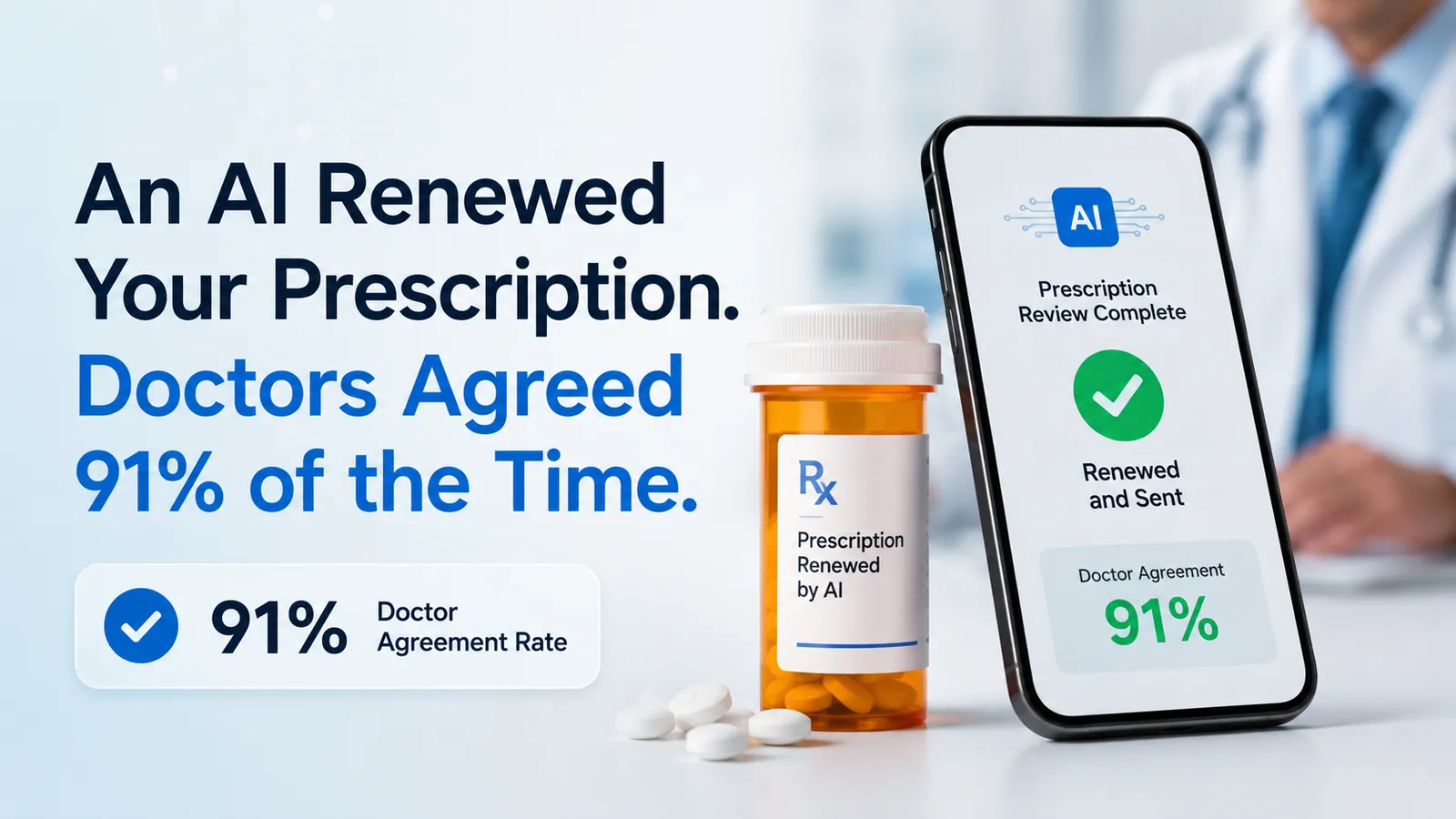

Utah has published the first outcome numbers from its experiment with artificial intelligence (AI) prescription renewals. Doctronic's AI recommended renewing a medication in 72% of requests. In that group, the first reviewing physician agreed 91% of the time.[1]
That sounds like an AI prescribed medication and a doctor later graded the result. The current reality is more controlled. Utah says the pilot remains in Phase 1, so a licensed medical practitioner must authorize every renewal before it reaches the pharmacy.[2]
Our earlier guide to how Utah's AI prescription-refill pilot works covers the legal structure and safety debate that preceded these results.
The early data are encouraging enough to keep watching. They do not yet show that fully autonomous prescribing is safe. The state's two-page report does not disclose the number of requests behind the percentages, the medications involved, or patient outcomes after the prescriptions were filled. It also says the data came from reports by Doctronic physicians and that the state had begun a separate review.[1]
Here is what is actually automated, where a human still intervenes, and what to ask before trusting an AI with your next refill.
The Short Answer
Doctronic's Utah service can verify an existing prescription, interview the patient, run defined safety checks, and recommend either renewal or physician review. It cannot start a new medication, change the dose or frequency, or renew controlled substances under the pilot.[2][3]
The headline numbers mean:
The AI recommended renewal in 72% of cases.
A first physician agreed with 91% of those renewal recommendations.
When a second physician reviewed the disagreements, at least one of the two physicians considered the original AI renewal appropriate in 97% of cases.
The AI declined to recommend renewal and escalated 28% of all requests.
Physicians agreed that 69% of those escalations needed more information. They judged the other 31% overly cautious.[1]
One fact matters more than any percentage: every Phase 1 renewal still gets a human authorization before it is sent to a pharmacy, according to Utah's current pilot page.[2]
What the 91% Agreement Rate Actually Means
The 91% figure applies only to cases in which the AI recommended renewal. It is not an accuracy rate across every request, and it is not a patient-safety rate.
Imagine 100 requests with the same distribution as the report:
Out of 100 requests | Approximate result |
|---|---|
AI recommends renewal | 72 |
First physician agrees with the renewal | 66 |
First physician asks for more information | 6 |
AI escalates instead of recommending renewal | 28 |
Physician agrees the escalation was appropriate | 19 |
Physician considers the escalation overly cautious | 9 |
These are illustrations calculated from Utah's rounded percentages, not actual patient counts. Utah did not publish the denominator needed to reconstruct the real totals.[1]
The 97% figure needs similar care. When the first physician wanted more information, a second physician reviewed the case. In most of those disagreements, the second physician thought the AI's original renewal recommendation was reasonable. Utah therefore reported that either the first or second physician found the renewal appropriate in 97% of cases.[1]
That is evidence of agreement with at least one reviewer. It is not the same as proving the AI was correct 97% of the time. Doctors can reasonably disagree about whether a current laboratory result, a longer history, or a live conversation is necessary before continuing a medication. The state itself says more analysis is needed to separate AI errors from ordinary disagreement between clinicians.[1]
What Doctronic Automates
The Utah pilot is limited to renewing an eligible medication that a licensed clinician previously prescribed. The service costs $4 per renewal, separate from the price of the drug.[8]
The automated workflow can:
Confirm that the patient is in Utah and verify identity.
Check the existing prescription and current dispensing information through Surescripts.
Ask about the medication's dose, purpose, effectiveness, side effects, allergies, other drugs and supplements, new symptoms, health changes, and relevant laboratory monitoring.
Screen for interactions, contraindications, conflicting information, and predefined reasons to stop.
Recommend a 30-, 60-, or 90-day renewal or route the request to a physician.[3]
This is more than an automated pharmacy reminder. The AI is collecting clinical information and making a recommendation about whether continuing treatment appears appropriate.
It is also less than a complete primary-care visit. Utah's own policy memorandum explains that a pharmacy record is not a longitudinal medical record. It may not contain recent kidney function, blood pressure trends, a pregnancy, a hospital discharge summary, a specialist's instruction to stop a drug, or an adverse reaction documented somewhere else.[4]
The AI can ask you to report those changes. It cannot know what you do not tell it and may not see information held in a separate electronic health record.
Who Built Doctronic
Matt Pavelle and Adam Oskowitz, MD, founded Doctronic in 2023. The company describes Pavelle as a technology leader whose own experience with delayed diagnoses led him to explore AI triage. Oskowitz brought clinical experience and a focus on limited physician time and burnout.[9][10]
Doctronic began with a consumer health chatbot and added telehealth visits with human clinicians in January 2025. By March 2026, it had raised $65 million across three rounds, including a $40 million Series B led by Abstract and Lightspeed Venture Partners. Its core service uses AI to gather a patient's history before offering a $39 telehealth visit.[9]
The Utah pilot moves the company into a different category. The AI is not merely explaining health information or preparing a note for a doctor. It is participating in a regulated prescription decision under temporary state permission.
What Still Gets a Doctor's Eyes
As of Utah's current public update, the pilot remains in Phase 1. Every AI-generated renewal must be authorized by a licensed medical practitioner before it is sent to the pharmacy.[2]
A physician also becomes directly involved when:
The AI detects clinical complexity, conflicting information, a possible interaction, or a change in the patient's condition.
The patient needs new laboratory work or has gone too long without a clinical visit.
The patient asks for human review.
A pharmacist has a concern or needs clarification.
The request involves a new drug, a different dose or frequency, or a medication outside the approved formulary.[1][2][3]
When the AI escalated 28% of early requests, a human telehealth appointment was arranged. Physicians said 69% of those escalations were appropriate because more information was needed. Calling the other 31% "overly cautious" does not mean those patients were denied care. It means the AI sent them to a clinician when the clinician later believed renewal could have proceeded without that extra step.[1]
Overcaution is a sensible early failure mode. It also affects the access promise. A service cannot claim that almost every renewal is instant and autonomous if more than one in four requests still requires a physician encounter.
The Next Phase Is Not Simply "10% Human Review"
The pilot's future review structure is easy to compress into a misleading sentence.
The signed agreement describes three phases:[3]
Phase | When the physician review occurs |
|---|---|
Phase 1 | Every AI decision is reviewed before the prescription goes to the pharmacy. |
Phase 2 | The AI may issue the renewal first, but every decision is reviewed retrospectively for the next 1,000 patients. |
Phase 3 | Physicians review a monthly sample of 5% to 10% of renewals, plus escalated cases and broader performance data. |
Utah later tightened the move out of Phase 1. Each medication group must reach 250 completed renewals before that group can become eligible for Phase 2, and the Office of Artificial Intelligence Policy must approve the transition.[2]
So the meaningful change in Phase 2 is not that doctors disappear from quality review. It is that a renewal can reach the pharmacy before a physician reviews that individual decision. Sampling at roughly 10% belongs to the later Phase 3 structure in the signed agreement.[3]
There is also a public-language mismatch patients should notice. Utah's page says the pilot remains in Phase 1 with authorization by a licensed practitioner for every request.[2] Doctronic's consumer FAQ says a human physician does not need to approve each individual renewal, language that appears to describe the broader phased model rather than Utah's stated current phase.[8] Before paying, ask which rule applies to your request today.
Why the Results Are Promising but Incomplete
The results support one practical conclusion: the system appears capable of sorting many routine requests into plausible renewal and escalation pathways under close physician supervision.
They do not yet answer several larger questions:
How many patients were studied? The public report calls the number limited but provides no count.[1]
Which medications were involved? Agreement on a common allergy medicine does not tell you how the system performs on an anticoagulant or diabetes drug.
What happened after dispensing? Physician agreement is a process measure. The report does not provide adherence, symptom, hospitalization, or other patient outcomes.
Were any important problems missed? Utah says no serious safety incidents had been reported, but early surveillance in a small pilot cannot establish a rare-risk rate.[2]
Can independent reviewers reproduce the findings? The published percentages came from Doctronic physician reports. Utah says it initiated its own review.[1]
Does the system have the complete chart? The state's policy memo says prescription history alone can miss laboratory trends, vital signs, hospital events, and specialist decisions that affect whether a drug should continue.[4]
The Utah Medical Licensing Board raised this last concern when it asked the state to suspend the pilot in April. The board argued that renewals require reassessment of effectiveness, side effects, interactions, and changing health conditions.[5] Utah declined to stop Phase 1, pointed to its safeguards, and invited the board into ongoing data review and future proposal evaluation.[6]
This is not a clean fight between innovation and doctors who dislike technology. It is a debate about which evidence should be required before a clinical decision moves from prospective human approval to after-the-fact review.
GLP-1s Are a Roadmap, Not a Current AI-Renewal Option
Doctronic told Fierce Healthcare that glucagon-like peptide-1 (GLP-1) drugs and additional diabetes medications are planned formulary additions.[7] That would make the pilot far more consequential because these medications can require dose changes, side-effect management, laboratory review, insurance authorization, and decisions about whether treatment is working.
They are not part of the current autonomous-renewal permission simply because the company plans to add them. The current Utah materials exclude injectables, and any formulary or protocol expansion would need to fit the state agreement and its approval process.[2][3]
Patients should also distinguish between a GLP-1 refill and GLP-1 management. Continuing a drug is one transaction. Managing nausea, nutrition, muscle loss, weight trajectory, blood sugar, other diabetes medications, and a possible dose change is ongoing care. Our guide to long-term GLP-1 management explains why the prescription is only one part of treatment.
AI Formulary Access Versus Texting Your Own Doctor
Doctronic and direct primary care (DPC) solve the refill-access problem in different ways.
The AI model offers a low-cost transaction. You pay $4, answer a structured set of questions, and the system checks whether your medication fits its formulary and rules.[8]
DPC is a recurring relationship. Patients pay a monthly membership for primary care that can include direct access to their personal physician.[12] In the American Academy of Family Physicians' 2024 survey, 98% of responding DPC practices included phone or text consultations, and 98% included same-day appointments.[11] The physician may already have the patient's chart, laboratory history, blood pressure trend, and earlier conversations.
That does not make every DPC refill automatically better. The model costs more, practices vary, and a responsible DPC doctor may still require testing or a visit. It does mean the access question changes from "Does this medication fit the AI's rules?" to "Can I reach the doctor responsible for my continuing care?"
Patients in Utah can compare the AI service with physician-led options such as Salt Lake Direct Primary Care. NextMD's complete guide to direct primary care explains what a membership covers and why it does not replace insurance.
The best future may combine the two. AI can gather the history, check routine rules, and prepare the request. A patient's own doctor can make the final decision with the longitudinal context the software may not have.
Nine Questions to Ask Before Using an AI Refill Service
Will a physician review my specific request before the prescription reaches the pharmacy? Ask about the current phase, not the eventual program design.
Who is the prescribing clinician? Get the person's name and a way for you or your pharmacist to reach the clinical team.
Does the service have my full medical record or only pharmacy history? Ask whether it can see recent labs, vital signs, hospital records, and specialist notes.
Which changes force human review? New symptoms, pregnancy, a hospitalization, a new diagnosis, an interaction, and overdue monitoring should not be treated as routine.
What happens if I report a side effect? Find out whether the AI stops, schedules a video visit, or gives you another instruction.
Is my exact medication and dose on the approved formulary? A company roadmap or general treatment page does not prove that the state pilot covers your drug.
How many renewals can I receive before a clinical visit is required? Utah says renewals are limited before periodic in-person or telehealth reassessment.[2]
Will my regular doctor receive the renewal record? A separate service can fragment the medication history unless the information returns to the clinician managing the condition.
How do I report a problem? Ask where complaints and adverse events go, what records you can obtain, and who carries responsibility if something goes wrong.
If your health has changed, the right question is not whether the AI can approve the refill. It is whether continuing the same medication without a broader clinical review is still the right plan.
The Bottom Line
Utah's first numbers are a meaningful signal, not a verdict. Doctronic's AI recommended renewal in 72% of requests, and a first physician agreed with 91% of those recommendations. The system also escalated 28% of cases, sometimes more cautiously than a reviewing doctor thought necessary.[1]
The strongest safeguard is also the reason not to overread the result: every request in the current phase still receives human authorization before dispensing, according to the state.[2]
The real test comes when that review moves behind the prescription and eventually becomes a sample. Before using the service, ask who sees your request today, what medical information they can see, and who is responsible for knowing when an apparently routine refill is no longer routine.
NextMD helps patients compare physician-led concierge and direct primary-care practices across the United States. You can search by city, compare pricing, and find a doctor who has time to manage more than the transaction.
A Note From the Author
I am not a doctor. This article provides general educational information and does not replace medical advice. Do not start, stop, change, or renew medication without appropriate guidance from a licensed clinician. Seek prompt care for a suspected medication reaction, severe or new symptoms, or another urgent concern.
Sources
Utah Department of Commerce, Office of Artificial Intelligence Policy. (2026). Key Statistics on the Doctronic Pilot Program: Assessment of the First Five Months from January Through April. Read Doctronic Public Report 1
Utah Department of Commerce, Office of Artificial Intelligence Policy. (2026). Doctronic AI Regulatory Mitigation Agreement and Pilot Status. Read the current Utah pilot page
Utah Department of Commerce, Division of Professional Licensing, Office of Artificial Intelligence Policy, and Doctronic. (2025). Doctronic Regulatory Mitigation Agreement. Read the signed agreement and formulary
Utah Department of Commerce, Office of Artificial Intelligence Policy. (2026). Policy Memorandum: Electronic Health Record Access in the Doctronic Pilot. Read the May 6 policy memorandum
Utah Medical Licensing Board. (2026). Letter to the Utah Office of Artificial Intelligence Policy Regarding the Doctronic Agreement. Read the Medical Board letter
Utah Division of Professional Licensing and Office of Artificial Intelligence Policy. (2026). Response to Board Concerns With Doctronic AI Regulatory Mitigation Pilot. Read the state response
Landi, H. (2026). Deep Dive: Doctronic's AI Prescription Refill Pilot Program in Utah. Fierce Healthcare. Read the Fierce Healthcare report
Doctronic. (2026). Utah AI Prescription Refill Program. Read the patient FAQ and program description
Aguilar, M. (2026). Doctronic Raises $40 Million as Race to Apply AI in Clinical Care Heats Up. STAT. Read on STAT
Doctronic. (2026). About Doctronic. Read the founders' profiles
American Academy of Family Physicians. (2024). 2024 Direct Primary Care Data Brief. Read the AAFP data brief
American Academy of Family Physicians. (2024). Direct Primary Care. Read the AAFP policy