
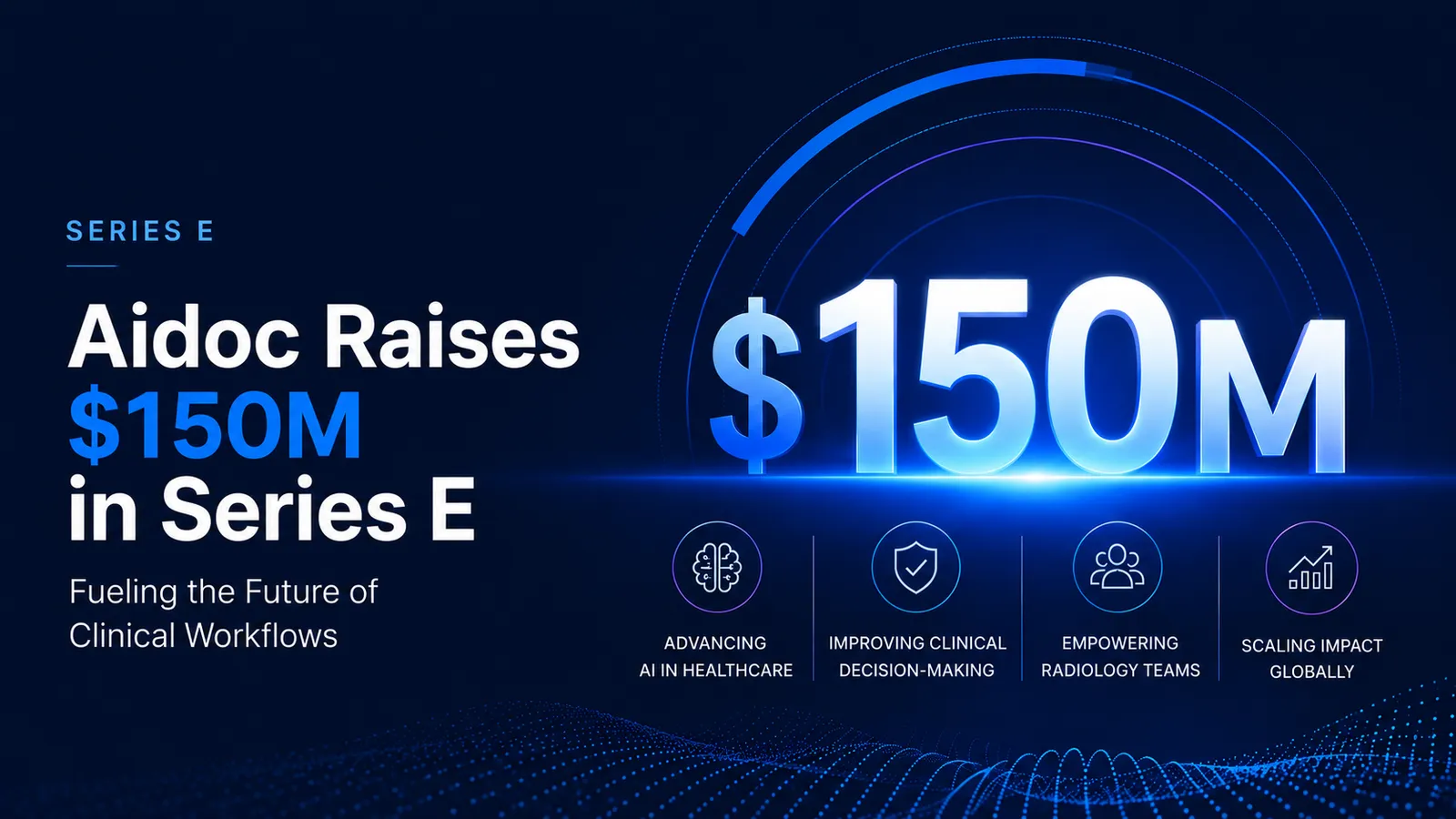

On April 30, 2026, Aidoc closed a $150 million Series E funding round led by Growth Equity at Goldman Sachs Alternatives, with participation from General Catalyst, SoftBank Vision Fund 2, and Nvidia's venture capital (VC) arm NVentures [1]. The round brings Aidoc's total funding to more than $500 million [1]. It is the company's second $150 million round in less than a year, following a July 2025 growth round led by General Catalyst and Square Peg [1].
Aidoc sells clinical artificial intelligence (AI) to hospitals and imaging centers. The flagship product reads computed tomography (CT) scans and X-rays to surface acute findings before a radiologist gets to them. The company has no direct relationship with patients or with primary care practices. Even so, Aidoc's growth has direct consequences for concierge medicine, because concierge physicians order a disproportionate amount of imaging on behalf of their members. When the read happens faster and the false-positive rate falls, the concierge doctor and the concierge patient both benefit.
What Aidoc Actually Does
Aidoc is a clinical artificial intelligence company that builds software hospitals use to read medical imaging scans in real time and flag the most urgent findings for the on-call physician. The platform provides solutions within radiology, cardiology, as well as neurovascular and vascular fields.
In short, it helps doctors understand the most important data in potentially life saving areas.
Aidoc was founded in 2016 by four former officers of Talpiot, the Israeli Defense Forces intelligence unit [2]. The product line started narrow, flagging acute anomalies on head CTs to help emergency departments (EDs) prioritize the most urgent cases first. Ten years later, the platform analyzes 60 million patient cases per year and is deployed across nearly 2,000 hospitals worldwide [1][2].
The company holds 17 Food and Drug Administration (FDA) clearances, which Aidoc identifies as the most of any clinical AI vendor [2]. Coverage now spans radiology, cardiology, neurovascular and vascular indications, with oncology on the near-term roadmap [1].
Earlier in 2026, Aidoc received FDA clearance for the first comprehensive foundation-model-based triage system in clinical imaging. The cleared product, called CARE for Clinical AI Reasoning Engine, combines 11 newly cleared indications with 3 previously cleared ones into a single body computed tomography (CT) workflow [3]. In the FDA-reviewed pivotal study, the 11 new indications achieved a mean sensitivity of 97 percent (up to 98.5 percent) and a mean specificity of 98 percent (up to 99.7 percent), with roughly an order-of-magnitude reduction in false alerts compared with best-in-class single-condition AI [3].
For a concierge patient, those numbers translate to faster identification of acute findings on a routine scan, and fewer follow-up calls about findings that turn out to be artifacts.
Large Funding Rounds Within The Medical Industry
Aidoc is one of three large funding events in the past 12 months that have repriced the clinical AI category. Abridge raised $300 million Series E at a $5.3 billion valuation in April 2026 for ambient AI scribes [4]. Whoop closed a $575 million round at a $10.1 billion valuation in late Q1 2026 for consumer-grade biometric wearables [5]. And Aidoc has now banked $300 million across two rounds in 12 months for diagnostic imaging AI [1].
These three companies sit at three different points in the clinical workflow. Abridge listens during the visit. Whoop measures between visits. Aidoc reads what the visit produced. The capital flowing into all three at the same time tells you investors are funding the full stack rather than betting on a single layer.
Concierge physicians are at the unusual end of the workflow where all three layers matter. The smaller patient panel, typically under 300 in concierge medicine compared with 2,000 to 2,500 in traditional primary care, gives the concierge doctor time to actually use the documentation, biometric, and imaging signal that these tools produce [6]. We covered the implications of the ambient scribe wave in what Abridge's $300M Series E means for concierge medicine and the wearables side in what Whoop's $575M raise means for your concierge doctor. This piece covers the third layer.
Where Concierge Touches Diagnostic AI
Concierge medicine and diagnostic imaging are tightly coupled in practice, even though most concierge marketing material focuses on access, panel size, and time. Three patterns drive the connection.
Concierge programs order more imaging per patient than insurance-default primary care. A typical concierge annual physical includes a comprehensive lab panel and frequently a coronary calcium score, low-dose lung CT for screening-eligible patients, abdominal ultrasound, dermatologic full-body imaging, and in some Ultra Premium programs a full-body magnetic resonance imaging (MRI) scan. Concierge memberships range from $3,000 to over $40,000 per year, and the higher tiers are often calibrated around imaging-heavy preventive packages.
Concierge physicians coordinate care across hospitals and outpatient imaging centers. Members in larger metros use multiple imaging facilities depending on convenience and cost. The concierge physician is the integrator, reading the report behind the report and acting on findings the imaging center may have flagged but the patient may not understand. When AI tools like CARE reduce reporting backlogs and surface critical findings earlier, the concierge physician can act faster on behalf of the member.
Diagnostic errors are the reason this category is being capitalized in the first place. Diagnostic errors and delays are linked to at least 400,000 deaths per year in the United States, driven by rising imaging volumes, workforce shortages, and growing clinical complexity [7]. The Newman-Toker analysis in BMJ Quality & Safety estimates 795,000 Americans suffer permanent disability or death each year from diagnostic error across all clinical settings [8]. These are the numbers that justify a $500 million bet on a single diagnostic AI vendor. They are also the numbers that explain why concierge physicians treat second-opinion radiology review as a routine member service.
The Ambulatory Expansion Is the Concrete Tie
For most of Aidoc's history, the deployment story was about hospitals. That is shifting in 2025 and 2026. The company's January 2026 FDA clearance announcement explicitly extended the CARE safety net to ambulatory settings, "where unexpected critical findings can emerge from routine exams sitting in lengthy backlogs" [3]. The aiOS enterprise platform is now positioned to manage AI across both hospital and outpatient imaging environments.
Two recent partnerships make this concrete. In November 2025, AdventHealth deployed Aidoc across its imaging operation in one of the largest clinical AI rollouts in the United States [9]. In Southern California, physician-led Sol Radiology deployed Aidoc across hospitals and outpatient imaging centers it serves [10]. Concierge patients in California and other markets are increasingly receiving AI-assisted reads regardless of whether they know it.
For concierge programs that emphasize executive-physical or longevity-focused imaging packages, the practical effect is that the same MRI or CT a member receives at an affiliated imaging center is now read with software that will flag a critical finding faster than human-only workflows.
What Concierge Practices Should Watch
Three signals matter most over the next 12 months.
First, automated draft report creation. Aidoc CEO Elad Walach told Fierce Healthcare that the company is building toward "pixel to draft report within two years" [1]. When that ships and gets cleared, radiology turnaround time on outpatient studies could drop further, which directly compresses the diagnostic timeline a concierge physician runs for a member.
Second, expansion to oncology. Aidoc has flagged oncology as the next clinical area, beyond the current radiology, cardiology, and neurovascular footprint [1]. For concierge programs that offer cancer-screening panels, faster and more accurate triage of incidental findings on screening CTs is the most likely first benefit.
Third, geographic depth of ambulatory coverage. AdventHealth's deployment is national in scale; Sol Radiology's is regional. Watch which independent imaging centers in concierge-dense metros, including Naples, Miami, Beverly Hills, and the New York metro area, adopt Aidoc next. The ambulatory map will dictate where the AI-assisted concierge imaging experience is meaningfully different from the human-only one.
What This Means for Patients
If you are a concierge member who orders imaging at a hospital or affiliated imaging center, the read may now be partly AI-assisted whether or not the order form discloses it. That is a net positive on speed and consistency, although the radiologist remains the responsible reader for every study. If you are evaluating a concierge program that markets a heavy preventive-imaging package, ask the practice which imaging facilities they refer to and whether those facilities deploy AI-assisted triage. The answer is increasingly yes, and it should be.
For a starting point on what concierge programs typically include, see how concierge medicine actually works behind the scenes in 2026.
FAQ
Is Aidoc replacing radiologists?
No. Aidoc surfaces and prioritizes findings to help radiologists work faster, but every cleared product positions the radiologist as the responsible reader. The FDA clearance for CARE describes a triage role, not a primary diagnostic one [3].
Does my concierge doctor use Aidoc directly?
Almost certainly not. Aidoc sells to hospitals and imaging centers, not to individual physicians or small practices. Your concierge doctor benefits indirectly when the imaging facility they refer to has Aidoc deployed, because reports come back faster and acute findings are surfaced earlier.
Why is Goldman Sachs investing in clinical AI?
Goldman Sachs Asset Management (GSAM) led the round through its Growth Equity at Goldman Sachs Alternatives platform [1]. GSAM is also a co-owner of MDVIP, the largest concierge medicine network in the United States, which makes their healthcare AI thesis particularly relevant to the concierge category. We covered the cross-portfolio pattern in our analysis of the growth of private equity in concierge medicine.
What does CARE stand for and what does it do?
CARE stands for Clinical AI Reasoning Engine. It is a foundation model built by Aidoc that powers a multi-condition triage workflow on body CT, with FDA clearance covering 14 acute indications combined into a single product [3].
How accurate is CARE in the real world?
In the FDA-reviewed pivotal study, the 11 newly cleared indications achieved a mean sensitivity of 97 percent and a mean specificity of 98 percent, with roughly an order-of-magnitude reduction in false alerts versus single-condition AI tools [3]. Real-world results vary by site, scanner, and case mix.
Does concierge medicine include imaging in the membership fee?
It depends on the practice and tier. Entry Level concierge ($2,500 to $5,000 per year) usually includes basic preventive labs but bills imaging separately. Premium ($5,000 to $12,000 per year) and Ultra Premium ($15,000 and up, commonly over $40,000 per year) programs frequently include comprehensive imaging packages either inside the membership or at a defined add-on price [6].
Sources
Landi, H. (2026, April 30). Aidoc banks $150M backed by Goldman Sachs to scale clinical AI foundation model. Fierce Healthcare. Read on FierceHealthcare.com
Aidoc. Meet Aidoc, About page (company history, founders, deployment scale, FDA clearance count). Read on Aidoc.com
Aidoc. (2026, January). Aidoc Secures FDA Clearance for Healthcare's First Comprehensive Foundation Model AI. Read on Aidoc.com
Fierce Healthcare. Abridge scores $300M series E, boosting valuation to $5.3B. Read on FierceHealthcare.com
The New York Times DealBook. (2026, March 31). Whoop, a Wearable Health Device Maker, Raises $575 Million. Read on NYTimes.com
NextMD. (2026). Pricing tiers and panel-size standards. Internal canonical reference (drawn from the NextMD directory of 4,600+ MD/DO-led practices).
Newman-Toker, D. E., et al. (2025). Just how many diagnostic errors and harms are out there, really? BMJ Quality & Safety, 34(6), 355. Read on BMJ Quality & Safety
Newman-Toker, D. E., et al. (2024). Burden of Serious Harms from Diagnostic Error in the United States. PMC. Read on PubMed Central
ITN Online. (2025, November 20). AdventHealth, Aidoc Collaborate on One of Largest Imaging AI Deployments in U.S. Read on ITNOnline.com
Aidoc. Sol Radiology and Aidoc Partner to Advance AI-Powered Imaging Across Southern California. Read on Aidoc.com