
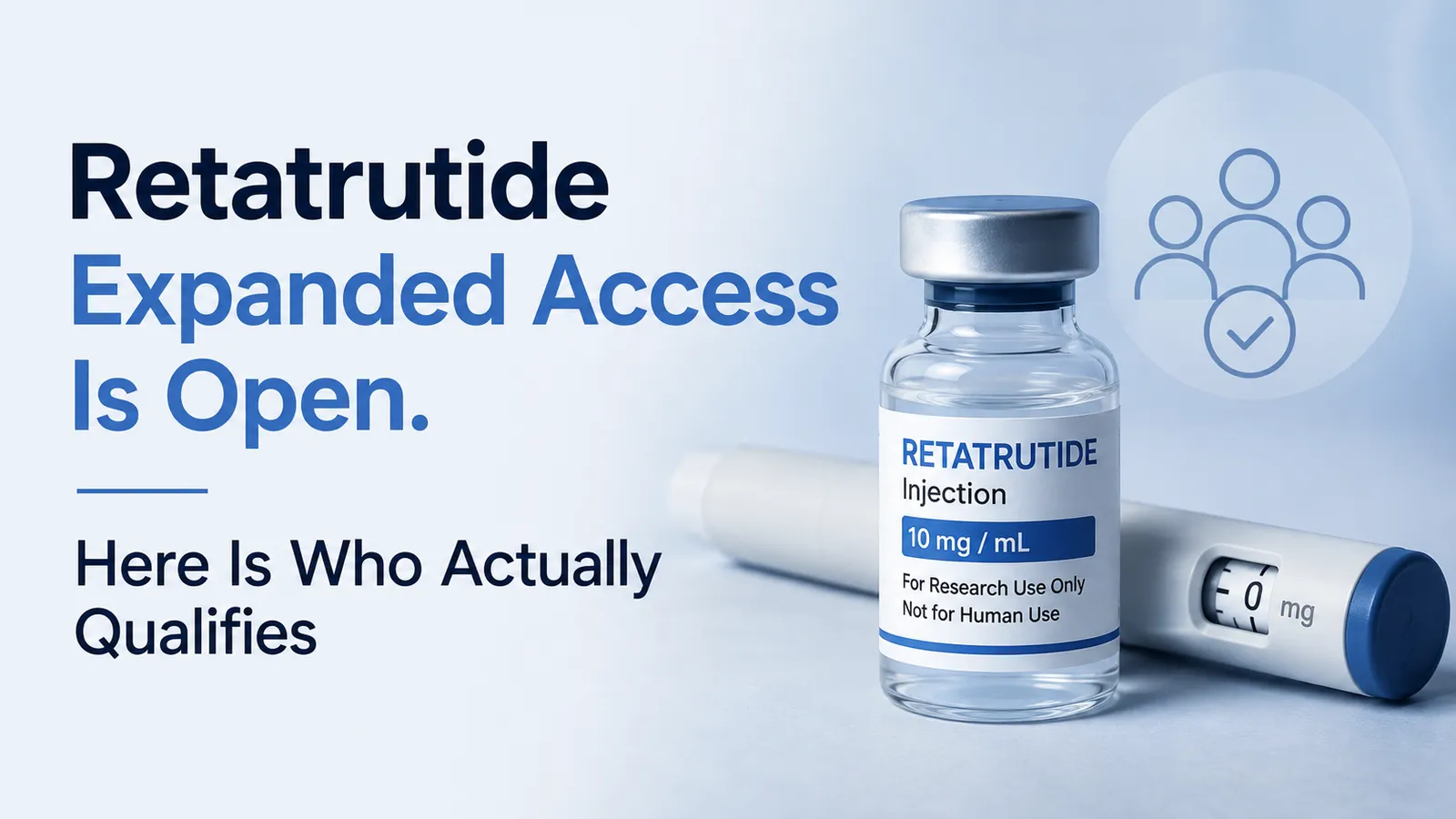

What is retatrutide? Retatrutide is an experimental weight-loss medication being developed by Eli Lilly. It is taken as a once-weekly injection and works on three hormone systems involved in appetite, blood sugar, and how the body uses energy: glucagon-like peptide-1 (GLP-1), glucose-dependent insulinotropic polypeptide (GIP), and glucagon. This is why retatrutide is described as a triple-hormone drug. It has not been approved by the Food and Drug Administration (FDA), so it is not available through a regular prescription.[1]
Who is it for? Lilly is studying retatrutide for adults with obesity or overweight, particularly people who also have conditions such as type 2 diabetes, obstructive sleep apnea, cardiovascular disease, or obesity-related knee pain. It is being developed as another treatment option for people whose weight is affecting their health, rather than as a general-purpose drug for anyone who wants to lose a few pounds.[1]
What do the studies say? In Lilly's large TRIUMPH-1 trial, 2,339 adults received retatrutide or a placebo. After 80 weeks, participants taking the highest dose had lost 28.3% of their starting weight on average, or about 70 pounds. Nearly half lost at least 30% of their starting weight. These are company-reported Phase 3 results, and retatrutide is still being evaluated for safety and effectiveness.[1]
What is new? A small number of patients may now be able to receive authentic retatrutide before FDA approval. Lilly has opened an expanded access program, also known as compassionate use, for adults with severe obesity who have serious related health problems and have exhausted standard treatment options.[2] Medscape reported that clinicians have mixed views: some see a carefully controlled option for very sick patients, while others worry that people who do not qualify will mistake it for an early public launch.[3]
The rest of this guide explains who qualifies, how a doctor submits a request, what risks remain, and why expanded access is completely different from buying a product labeled "retatrutide" online.
Retatrutide Expanded Access in One Table
The official ClinicalTrials.gov record lists five requirements. A patient must meet every one of them.[2]
Requirement | What it means in practice |
|---|---|
Age 18 or older | The program is limited to adults. |
Body mass index (BMI) of at least 35 after treatment | The patient must still have a BMI of 35 or higher despite adhering to and tolerating the highest available dose of an approved chronic weight-management therapy. |
At least two serious complications | The patient must have two or more serious or life-threatening obesity-related complications and already be receiving standard care for them. |
No feasible retatrutide or comparable trial | The patient must be ineligible for a relevant trial or lack a reasonably accessible enrolling site. |
Standard options discussed | The patient and clinician must have discussed all standard treatments, including bariatric surgery, through shared decision-making. |
The record also excludes patients with a medical contraindication to retatrutide.[2]
These criteria close several apparent loopholes. A BMI of 35 by itself is insufficient. Having tried a starter dose of one medication is insufficient. Living far from one trial site may be insufficient if another relevant study is reasonably accessible. The bariatric-surgery requirement calls for a documented discussion; it does not say every patient must undergo surgery.[2]
One important detail remains unpublished: the registry does not provide a list of complications that Lilly will count as serious or life-threatening. Earlier reporting described one individual request involving refractory obesity, obstructive sleep apnea, and pulmonary hypertension, but that case does not establish a universal eligibility list.[4] Lilly says each request depends on a detailed individual assessment, geography, and product supply.[2]
Expanded Access Is Different From FDA Approval
Expanded access, sometimes called compassionate use, allows an investigational drug to be used outside a clinical trial when a patient has a serious or immediately life-threatening condition, lacks a comparable satisfactory treatment, cannot enroll in a trial, and faces risks that are justified by the potential benefit. The FDA must also conclude that the use will not interfere with the studies needed for approval.[5]
An expanded access authorization does not mean the FDA has found retatrutide safe and effective. It means the agency will permit a specific treatment request under investigational-drug safeguards. Whenever possible, the FDA prefers that patients receive experimental products in a clinical trial, where eligibility, dosing, monitoring, and data collection follow a defined protocol.[5]
That difference also affects what the experience can teach us. A single-patient use has no randomized control group and may involve a medically unusual patient. It can generate safety reports and clinical observations, but it cannot show whether retatrutide is better than tirzepatide, bariatric surgery, or another option for the broader public.
How a Legitimate Request Works
Patients do not apply to Lilly or the FDA on their own. The treating physician initiates the request and accepts responsibility for the medical work.[2][5]
The process generally follows five steps:
The physician documents that approved treatments have been exhausted. That includes the medication, dose, adherence, tolerance, response, serious obesity-related complications, current treatment for those complications, and the bariatric-surgery discussion.[2]
The physician checks clinical-trial options. The doctor must establish why a retatrutide or comparable investigational trial is unavailable, inaccessible, or medically unsuitable.[2][5]
The physician asks Lilly to provide the drug. Lilly's registry directs treating physicians to its medical information center. The company says expanded access decisions consider the individual evidence, fairness, patient risk, product supply, and possible effects on ongoing trials.[2][6]
Regulatory and ethics review follows. Depending on how the request is sponsored, the physician or company submits the required investigational new drug paperwork. An institutional review board (IRB) reviews the protocol and consent, and the patient provides informed consent before non-emergency treatment begins.[5]
The physician monitors and reports. The treating doctor manages dosing and follow-up and must report serious safety issues and submit a treatment summary to the FDA.[5]
Lilly says it responds to expanded access requests after receiving the required medical information within five business days. A company approval still requires the relevant regulatory authority to permit treatment before Lilly ships the medicine.[6]
The FDA says an average of 99% of expanded access requests it receives may proceed.[7] That statistic does not mean 99% of patients who ask will get retatrutide. Manufacturer agreement comes first, and requests that Lilly declines never enter the FDA approval denominator. Retatrutide's published eligibility rules create an additional filter before any federal review.
Why Clinicians Disagree About the Program
The disagreement reported by Medscape is about access, evidence, and implementation.[3]
Supporters make two strong points. Severe obesity can be a chronic, serious disease rather than a cosmetic concern. A patient with refractory disease and multiple dangerous complications may have a reasonable case for investigational treatment after approved medication and surgical options have been addressed. Authentic retatrutide supplied by Lilly also removes the uncertainty surrounding online vials sold under the retatrutide name.
Skeptics focus on the same facts from a different angle. Retatrutide remains unapproved, approved obesity treatments already exist, and the new program asks treating clinicians to document trial availability, manage consent and monitoring, and handle requests from patients attracted by a large weight-loss number. The public criteria are narrow, but the publicity around them is broad. That mismatch can generate substantial office work and disappointment.[3]
Both concerns can exist at once. A tightly controlled pathway may be medically defensible for rare cases while still creating fairness questions. Patients with an obesity specialist, an academic center, or a physician who has time to navigate an investigational-drug process may be better positioned to apply than equally sick patients without those resources. Lilly's consistent application of the criteria, its definition of qualifying complications, and eventual reporting on how many requests are accepted will determine whether the program feels clinically principled or selectively accessible.
What the Evidence Shows, and What It Does Not
TRIUMPH-1 randomized 2,339 adults with obesity or overweight to placebo or one of three retatrutide doses. At 80 weeks, average weight loss was 19.0% at 4 milligrams, 25.9% at 9 milligrams, and 28.3% at 12 milligrams, compared with 2.2% on placebo.[1]
The efficacy came with dose-related tolerability costs. In the 12-milligram group, Lilly reported nausea in 42.4%, diarrhea in 32.0%, constipation in 26.1%, and vomiting in 25.3%. Adverse events caused 11.3% of participants at that dose to discontinue treatment, compared with 4.9% on placebo. Lilly also reported altered-sensation events called dysesthesia in 12.5% of the 12-milligram group versus 0.9% on placebo.[1]
Those Phase 3 numbers were released by Lilly as topline results. Detailed peer-reviewed publication remains important for evaluating subgroup effects, uncommon harms, missing data, and how the findings hold up under independent scrutiny.[1] The earlier Phase 2 obesity trial was peer-reviewed and found 24.2% mean weight loss at 48 weeks on the 12-milligram dose. Gastrointestinal events were common, and heart rate rose in a dose-dependent pattern before declining later in the study.[8]
Expanded access does not remove these uncertainties. It places them inside an informed-consent and monitoring structure for a patient whose treating team believes the potential benefit justifies them.
Expanded Access Does Not Make Compounded Retatrutide Legal
The FDA states that retatrutide cannot be used in compounding under federal law. It is not an ingredient in an FDA-approved drug and has not been found safe and effective for any condition. The agency has warned patients about products sold as retatrutide for "research purposes," saying their identity, strength, purity, and sterility may be unknown.[9]
The expanded access program creates a legal route to Lilly-manufactured retatrutide for qualifying patients. It does not legalize pharmacy-made copies, online peptide vials, med-spa sales, or a regular prescription written outside the program.
Anyone considering a gray-market product should pause and discuss approved alternatives with a physician. The practical work continues long after a prescription, including dose changes, side-effect management, nutrition, resistance training, laboratory follow-up, and planning for maintenance. NextMD's guide to long-term GLP-1 care explains that care gap.
Where a Concierge or DPC Doctor Can Help
A concierge or direct primary care (DPC) physician may have more time to assemble medication records, coordinate with an obesity specialist, search for trials, and monitor a complex patient. Membership does not change Lilly's eligibility rules, and paying a retainer does not create access to retatrutide.
The physician must also be willing and equipped to take responsibility for investigational treatment. Some membership practices have obesity-medicine experience; others do not have the institutional review, specialty, or research infrastructure this process may require. A practice such as Beacon Internal and Obesity Medicine in North Carolina illustrates the overlap between longitudinal primary care and obesity medicine, but its NextMD listing does not indicate participation in Lilly's retatrutide program. Patients can compare other physician-led options on NextMD's North Carolina practice directory and use the doctor-selection checklist before joining a practice.
What to Bring to Your Doctor
If you believe you may qualify, bring a factual record rather than a request based only on the headline weight-loss percentage:
Your current height, weight, BMI, and weight trend.
Every approved weight-management medication tried, including dose, dates, adherence, side effects, and reason for stopping.
Documentation of each serious obesity-related complication and the current standard treatment for it.
Prior referrals or discussions about metabolic or bariatric surgery.
Clinical trials you reviewed, with the reason each is unavailable or impractical.
A complete medication list and medical history for contraindication screening.
Ask whether your physician believes you meet all criteria, whether an enrolling trial remains the preferred route, who would serve as the sponsor-investigator, where IRB review would occur, what monitoring would be required, and what costs could fall to you. The public registry and Lilly policy do not provide a patient price or guarantee insurance coverage.[2][6]
The Bottom Line
Retatrutide expanded access is real, available, and exceptionally narrow. It gives a physician-led path to authentic investigational medication for adults with BMI of at least 35 who remain severely affected after the highest tolerated approved therapy, have at least two serious complications under treatment, cannot join a relevant trial, and have discussed every standard option including bariatric surgery.[2]
For everyone else, the lawful choices remain an enrolling clinical trial or an FDA-approved treatment selected with a clinician. A website selling "compounded retatrutide" has no connection to Lilly's expanded access program.[9]
FAQ
Can my doctor prescribe retatrutide now?
No standard retail prescription pathway exists because retatrutide is not FDA approved. A treating physician can request it for an eligible patient through Lilly's expanded access process, followed by the required regulatory and ethics review.[2][5]
Is a BMI of 35 enough to qualify?
No. The patient must meet every published criterion, including persistent BMI of at least 35 after the highest tolerated approved chronic weight-management therapy, at least two serious or life-threatening obesity-related complications under standard care, inability to join a relevant trial, and discussion of all standard options.[2]
Do I have to undergo bariatric surgery first?
The public criteria require bariatric surgery to be discussed through shared decision-making. They do not state that every patient must have surgery before applying.[2]
Can a concierge or DPC doctor submit the request?
A treating physician who believes expanded access is the patient's only reasonable option can contact Lilly. The doctor must be willing to manage the treatment and its regulatory responsibilities. A concierge or DPC membership does not guarantee that the doctor has this capability or that Lilly will approve the request.[5][6]
Is compounded retatrutide legal now that expanded access is open?
No. The FDA says retatrutide cannot be used in compounding under federal law. Expanded access supplies investigational drug through an authorized medical process; it does not authorize copies sold by pharmacies, clinics, or research-peptide websites.[9]
When will retatrutide be available to everyone?
There is no confirmed public launch date. Lilly says availability depends on completing the clinical program and the regulatory approval process.[10]
A Note From the Author
I am not a doctor. Nothing in this article should be considered medical advice. This article summarizes public regulatory records, clinical research, and physician commentary available on August 6, 2026. Do not start, stop, or change a medication without speaking with a licensed clinician who knows your medical history.
NextMD helps patients find and compare physician-led concierge medicine and direct primary care practices across the United States. Browse practices by location, pricing, and clinical focus at nextmd.ai/search.
Sources
Eli Lilly and Company. (2026, May 21). Lilly's Triple Agonist, Retatrutide, Delivered Powerful Weight Loss in Pivotal Phase 3 Obesity Trial. Read the TRIUMPH-1 topline results
Eli Lilly and Company. (2026, updated August 6). Pre-approval Expanded Access of Retatrutide (LY3437943), NCT07629401. ClinicalTrials.gov. Read the official expanded access record
Larkin, M. (2026, August 5). Retatrutide Expanded Access Draws Mixed Clinician Views. Medscape Medical News. Read the Medscape report
Holan, A.D. (2026, July 1). A Patient Got the Weight Loss Medication Retatrutide Before FDA Approval. How Does That Work? PolitiFact. Read the expanded access explainer
U.S. Food and Drug Administration. (2026). Expanded Access: Information for Physicians. Read the FDA physician guidance
Eli Lilly and Company. (2026). Expanded Access. Read Lilly's expanded access policy
U.S. Food and Drug Administration. (2026). Expanded Access: How to Submit a Request. Read the FDA forms and process guide
Jastreboff, A.M., Kaplan, L.M., Frias, J.P., et al. (2023). Triple-Hormone-Receptor Agonist Retatrutide for Obesity: A Phase 2 Trial. New England Journal of Medicine, 389(6), 514-526. Find the peer-reviewed study on PubMed
U.S. Food and Drug Administration. (2026, updated May 31). FDA's Concerns With Unapproved GLP-1 Drugs Used for Weight Loss. Read the FDA safety notice
Eli Lilly and Company. (2026, updated July). What to Know About Retatrutide. Read Lilly's retatrutide FAQ