
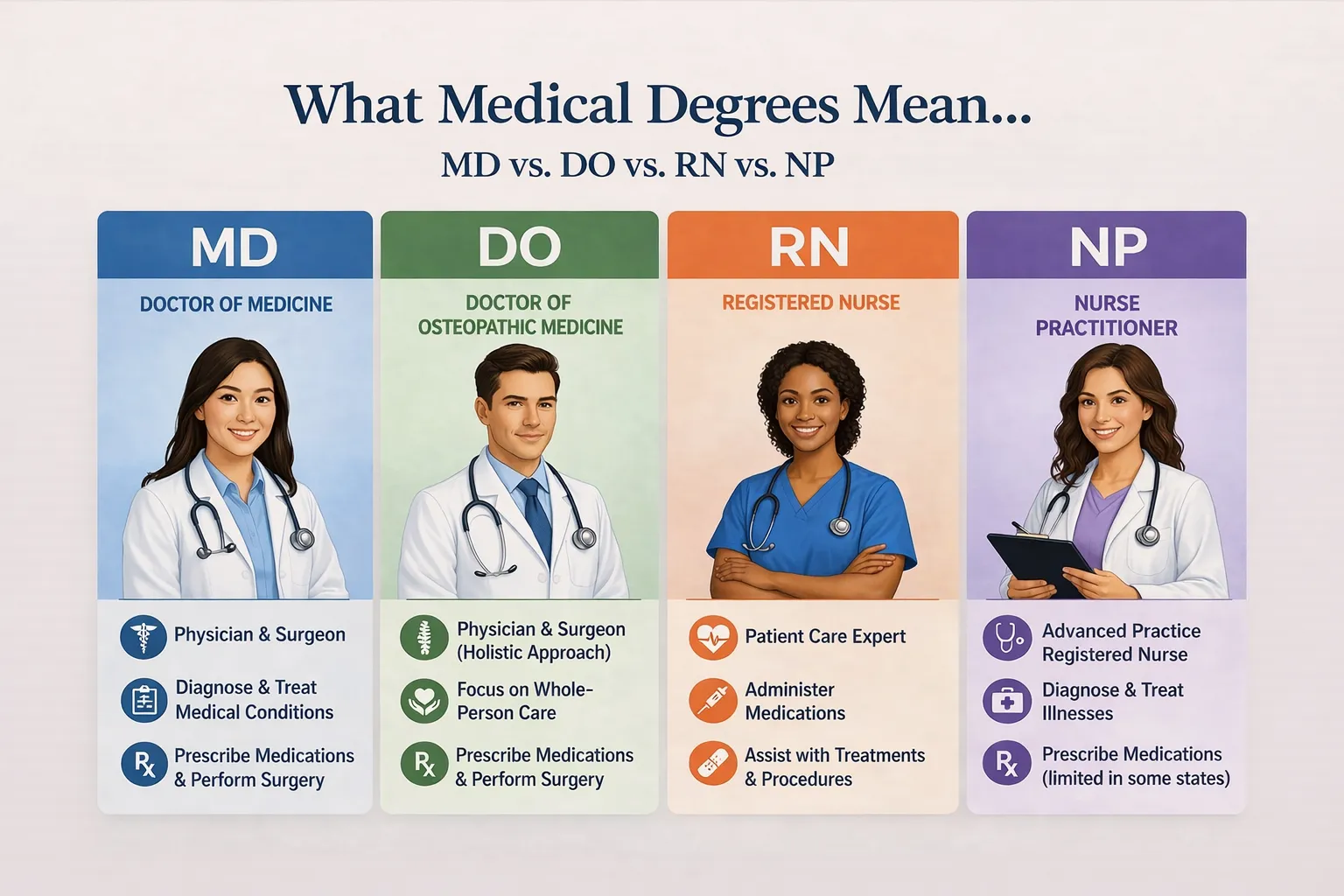

Choosing the right doctor means understanding their education, degrees and background.
At NextMD.ai, we believe informed patients make the best healthcare decisions. Here are what the letters after a doctor or nurses name mean (MD, DO, RN, NP, etc.).
In this guide, we break down the major medical degrees (the physician-level credentials you’ll see on most concierge and DPC doctor profiles) and the major nursing degrees that make up the rest of your care team.
Think of this as a quick guide to help you understand your medical providers educational skillset
Major Medical Degrees: The Physicians (MD & DO)
In the United States, only two degrees qualify someone to practice as a fully licensed physician: MD and DO. Both allow doctors to diagnose, treat, prescribe medications, perform surgery (if they complete the right residency), and lead your care—whether in a traditional clinic or a concierge/DPC setting.
As of March 2026 all practices on our site must have a MD or DO on staff.
MD – Doctor of Medicine (Allopathic Medicine)
What it means: The most common physician degree in the U.S. “Allopathic” simply refers to the conventional, evidence-based approach most people think of when they picture modern medicine: medications, surgery, diagnostics, and specialized treatments.
Training path:
4 years of undergraduate college (usually pre-med).
4 years of medical school.
3–7 years of residency training in a chosen specialty (e.g., family medicine, internal medicine, cardiology).
Optional fellowship for even more subspecialty training.
What you’ll see in practice: MDs make up the majority of practicing physicians. They focus on treating specific diseases and symptoms with the latest research-backed tools. On NextMD, you’ll find many outstanding MDs offering concierge and DPC care.
DO – Doctor of Osteopathic Medicine (Osteopathic Medicine)
What it means: DOs are fully licensed physicians who take a more holistic, whole-person approach. They treat the patient, not just the disease—looking at how lifestyle, environment, and the musculoskeletal system affect overall health.
Training path: Identical to MDs (4 years undergrad + 4 years medical school + residency). The key difference is extra training in Osteopathic Manipulative Treatment (OMT)—hands-on techniques that use gentle pressure and stretching to improve mobility, reduce pain, and support the body’s natural healing.
What you’ll see in practice: DOs can (and do) specialize in every field, from family medicine to surgery. Many patients love the preventive, wellness-focused philosophy that aligns perfectly with concierge and DPC models. Today, more than 1 in 4 U.S. medical students are training to become DOs.
Quick comparison: Both MDs and DOs pass the same licensing exams (or equivalent), complete the same residencies, and hold the same legal rights to practice medicine. The choice often comes down to philosophy and personal connection.
International Medical Degrees (e.g., MBBS, MBChB)
Many excellent concierge and DPC physicians trained outside the U.S. You may see:
MBBS / MBChB / MB BCh BAO (Bachelor of Medicine, Bachelor of Surgery)—the standard undergraduate medical degree in the UK, India, Australia, and many other countries. It is considered equivalent to the U.S. MD after the physician completes any required U.S. residency and licensing steps.
All physicians on NextMD are fully licensed in the United States, regardless of where they earned their initial degree.
Major Nursing Degrees: The Essential Care Team
Physicians don’t work alone. Nurses and advanced practice providers form the backbone of day-to-day care, especially in concierge practices where access and coordination matter most.
Entry-Level Nursing Roles
CNA – Certified Nursing Assistant Short certificate program (4–12 weeks). CNAs help with daily living activities (bathing, mobility, vital signs) in hospitals, nursing homes, or home care. They work under the supervision of nurses and doctors.
LPN / LVN – Licensed Practical Nurse / Licensed Vocational Nurse 12–18 month diploma or certificate program. LPNs can give medications, perform basic wound care, and monitor patients. They work under RNs or physicians in clinics, hospitals, or home health.
Registered Nurse (RN) Pathways
ADN – Associate Degree in Nursing (2–3 years) The fastest path to becoming an RN. Offered at community colleges. Prepares nurses for hospital and clinic roles.
BSN – Bachelor of Science in Nursing (4 years) Preferred by many hospitals and increasingly required for Magnet-designated facilities. BSN programs include more leadership, research, and public-health training. Many concierge practices value BSN-prepared RNs for their broader skill set.
Both ADN and BSN graduates must pass the NCLEX-RN exam to become licensed Registered Nurses. They can assess patients, administer medications, educate families, and coordinate care plans.
Advanced Nursing Degrees
MSN – Master of Science in Nursing (1–2 years after BSN) Prepares nurses for Advanced Practice Registered Nurse (APRN) roles. The most common is the Nurse Practitioner (NP), who can diagnose, prescribe, order tests, and manage chronic conditions—often independently in many states. You’ll also see MSN-prepared nurses in education, administration, or specialized roles (e.g., nurse anesthetist, clinical nurse specialist).
DNP – Doctor of Nursing Practice (2–4 years after MSN or BSN) The highest practice-focused nursing degree. DNPs emphasize leadership, quality improvement, and translating research into better patient outcomes. Many NPs now hold a DNP.
PhD in Nursing (research-focused doctorate) For nurses who want to lead research, teach at universities, or shape healthcare policy. Not a clinical degree like the DNP.
Why These Credentials Matter in Concierge & DPC Care
In a concierge or Direct Primary Care practice, you’re paying for time and access. Knowing the letters helps you:
Understand your doctor’s philosophy (holistic DO vs. traditional MD).
Recognize when an NP or RN is handling routine visits or follow-ups.
Feel confident that every member of the team is highly trained.
All physicians listed on NextMD are board-certified MDs or DOs who have chosen the concierge or DPC model because they want to spend more time with patients—not less.
Ready to find a doctor whose credentials and care philosophy match what you’re looking for?
Browse our directory at NextMD.ai and filter by location, specialty, pricing, and more. Your personalized healthcare journey starts with the right match.