
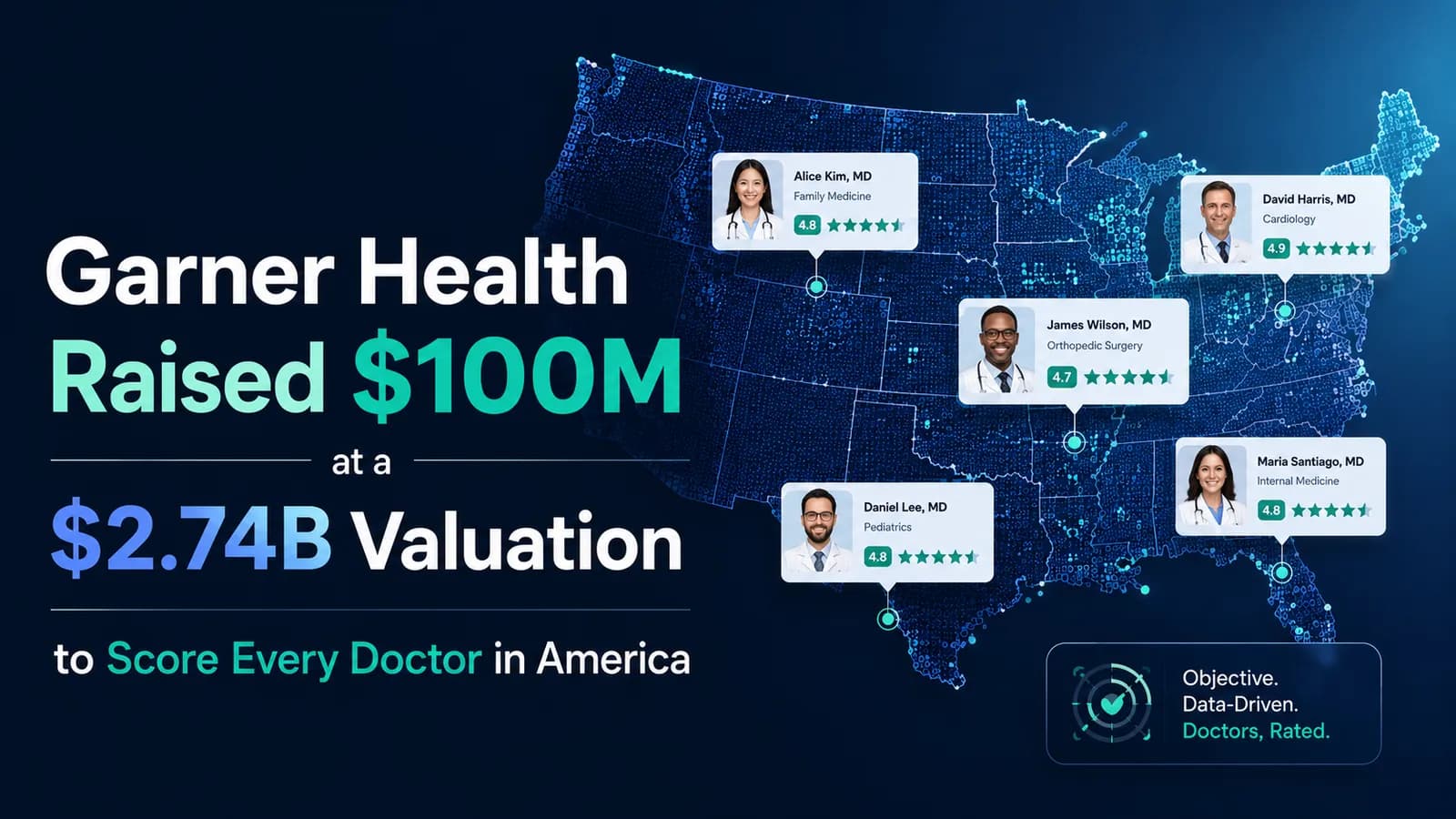

Garner Health just raised $100 million at a $2.74 billion valuation. The company ranks doctors in America by how well they treat patients and how much that care costs, then pays employees of its client companies cash back when they use the top-ranked doctors.[1]
The round was led by Index Ventures. Other backers named in the new round include Kleiner Perkins, Redpoint Ventures, Thrive Capital, Sequoia Capital, Founders Fund, and Kaiser Permanente Ventures.[1]
That valuation more than doubled in three months. Garner closed its previous round at $1.35 billion in February 2026. By May 2026 it was worth $2.74 billion.[1][2] Late-stage healthtech rounds at this pace are rare.
Garner is selling something close in shape to what NextMD is building for patients. The difference is who pays.
What Garner Health Does
Garner runs four pieces of work that, taken together, form a marketplace for doctor quality.
First, it builds the ranking. Garner ingests roughly 60 billion deidentified medical records covering about 320 million patients and scores U.S. doctors on outcomes, cost, adherence to current research, and avoidance of unnecessary procedures.[1]
Second, it sells that ranking to employers. Garner has about 800 enterprise clients and reaches roughly 2.5 million covered members through their employer-sponsored health plans.[1] The companies signing on are large self-funded employers paying the medical bills for their workforce.
Third, it pays the patient. An employee using a Garner-enabled plan can see any doctor in the network. If they pick one of Garner's top-ranked providers, Garner credits cash back to a dedicated account the employee can spend on healthcare. The patient sees the ranking and the reward inside the Garner app at the moment of choice.
Fourth, it owns the routing. Garner has signed direct partnerships with health systems and care platforms so the top of its rankings is also bookable from inside its app. Named partners include Mercy, Atlantic Health, Teladoc Health, and Marathon Health.[1]
Garner says employers who deploy it see a 12 percent annual healthcare-spend reduction. That number is Garner's own claim and is repeated in both Series D and Series E press, but it has not been independently audited in a public filing.[1][2]
The History of Garner Health
Nick Reber founded Garner Health in 2019 and runs it as chief executive officer.[3][4] His path into the problem set is unusually direct.
Reber studied at Brown University, then spent roughly a decade at Bridgewater Associates, the macro hedge fund, working on systematic investing and data analysis.[3] Bridgewater later wrote about him in its alumni series under the headline that his startup "diagnosed a three-trillion-dollar inefficiency."[3]
After Bridgewater, Reber joined Oscar Health and ran the provider-network function as Vice President of Provider Network.[4][5] That role is where the thesis behind Garner came together. Insurer networks are organized around contract economics, not patient outcomes. The data needed to rank doctors on outcomes exists. It is just not being used that way.
Reber incorporated Garner Health in 2019 to do exactly that ranking, and the company is headquartered in New York.[4]
The current senior team listed on Garner's About page is Reber as chief executive, Phil Salinger as chief product and data officer, Steve Santangelo as chief revenue officer, Jake Shuster as chief financial officer, and Emily Hayne as senior vice president of provider partnerships.[4]
The Employer Healthcare Bill
Garner is selling into one of the largest pools of money in the U.S. economy. American employers spent more than $1.4 trillion on healthcare benefits for their workers in 2024.[6] The bill is forecast to rise sharply in 2026. Mercer's annual employer survey projects a 6.5 percent per-employee increase, the highest in 15 years.[7] Aon projects 9.5 percent, with per-employee cost exceeding $17,000.[8] That spend is paid by self-funded employers (large companies pay the medical bills directly out of corporate cash) and by fully insured plans, with the largest companies almost always in the self-funded category Garner sells to.
A 12 percent reduction at a single enterprise client of any meaningful size pays for the product many times over. The math is why Index, Sequoia, Kleiner, Founders Fund, and Kaiser Permanente Ventures are paying $2.74 billion to back a company that uses data to point people at better doctors.[1]
The trend is also why a non-traditional venture-capital investor sits on Garner's own logo wall. Optum, the services arm of UnitedHealth Group and the largest of the insurer-owned care delivery companies in the country, was on the Garner About page logo wall as an earlier-round investor as of May 2026.[4] An insurer-owned services company funding a startup whose job is to route patients away from the bottom of insurance networks is worth watching.
What It Means for Concierge and DPC Practices
Garner's ranking universe is commercial-insurance doctors. The ranking method is built on insurance-claims data and the procedures and codes that flow through it. Concierge and DPC doctors who do not bill insurance do not show up in those claims feeds. That is structural, not a strategic choice. As of mid-2026, Garner does not publish a quality ranking of concierge or DPC physicians.
That has two implications for the concierge and DPC market.
First, Garner is not a near-term competitor. A patient buying a concierge membership for $1,500 to $25,000 a year is not the same patient choosing in-network doctors through a corporate benefits portal. The acuity and the price point and the relationship are different.
Second, the thesis underneath Garner just got a $2.74 billion vote of confidence from the largest names in venture capital. The thesis is that doctor quality is measurable, that patients should see the measure, and that paying patients to choose the highest-quality doctors changes outcomes and cost. The same logic supports NextMD's existence. Patients paying for concierge or DPC care are choosing a higher-quality relationship and a higher-quality access tier with their own money. They deserve a real way to compare practices.
The longer-term watch item is whether Garner ever layers a concierge tier on top of its employer product. That would be a credible competitor inside the employer channel. As of May 2026 it has not.
The Bottom Line
A near-doubling of Garner's valuation in three months shows the company is getting massive traction in the investment space. Index Ventures, Sequoia, Kleiner Perkins, Founders Fund, and Kaiser Permanente Ventures all think a ranked, outcomes-based marketplace for physicians is an important application of artificial intelligence in healthcare today.[1] Garner is building that for employers. NextMD is building it for patients who already know they want more than the in-network commercial-insurance option.
You can search physician-led concierge and DPC practices by city, compare pricing, and view doctor credentials at nextmd.ai/search.
FAQ
What does Garner Health do?
Garner Health uses about 60 billion deidentified medical records covering roughly 320 million patients to score U.S. doctors on outcomes and cost. It sells the resulting ranking to large self-funded employers and pays employees cash back when they choose a top-ranked doctor.[1]
How much did Garner Health raise and at what valuation?
Garner raised $100 million in May 2026 at a $2.74 billion valuation. The round was led by Index Ventures, with Kleiner Perkins, Redpoint Ventures, Thrive Capital, Sequoia Capital, Founders Fund, and Kaiser Permanente Ventures also named in it. The previous round was a $118 million Series D at a $1.35 billion valuation in February 2026.[1][2]
Who founded Garner Health?
Nick Reber founded Garner Health in 2019 and remains chief executive officer. He studied at Brown University, then worked at Bridgewater Associates for roughly a decade before joining Oscar Health as Vice President of Provider Network. Garner is headquartered in New York.[3][4]
Does Garner rank concierge or Direct Primary Care doctors?
No, as of mid-2026 Garner's published rankings cover doctors who bill commercial insurance. Concierge and DPC physicians who do not bill insurance are not in the claims data Garner uses to score outcomes, so they do not appear in the ranking. That is a structural limit of the data source, not a stated policy choice.
How is Garner Health different from NextMD?
Garner sells to self-funded employers and routes their employees through commercial-insurance networks toward top-ranked in-network doctors. NextMD is a patient-facing directory of physician-led concierge and DPC practices, paid out of pocket, and is free to use for patients. The shape of both is a quality-ranked marketplace for doctors. The customer, the price point, and the kind of doctor being ranked are different.
Sources
Gleeson, C. (2026). Care navigation startup Garner Health banks $100M series E at $2.74B valuation. Fierce Healthcare. Read on Fierce Healthcare
Care navigation startup Garner Health scores $118M series D at $1.35B valuation. (2026). Fierce Healthcare. Read on Fierce Healthcare
Bridgewater Associates. How Nick Reber's healthcare startup diagnosed a three-trillion-dollar inefficiency. Read on Bridgewater
Garner Health. About Garner Health. Read on Garner Health
Reber, N. Nick Reber profile. LinkedIn. Read on LinkedIn
Kaiser Family Foundation. (2024). 2024 Employer Health Benefits Survey. Read on KFF
Mercer. (2025). Employers prepare for the highest health benefit cost increase in 15 years. Read on Mercer
Aon. (2025). U.S. Employer Health Care Costs Expected to Rise 9.5 Percent in 2026. Read on Aon