
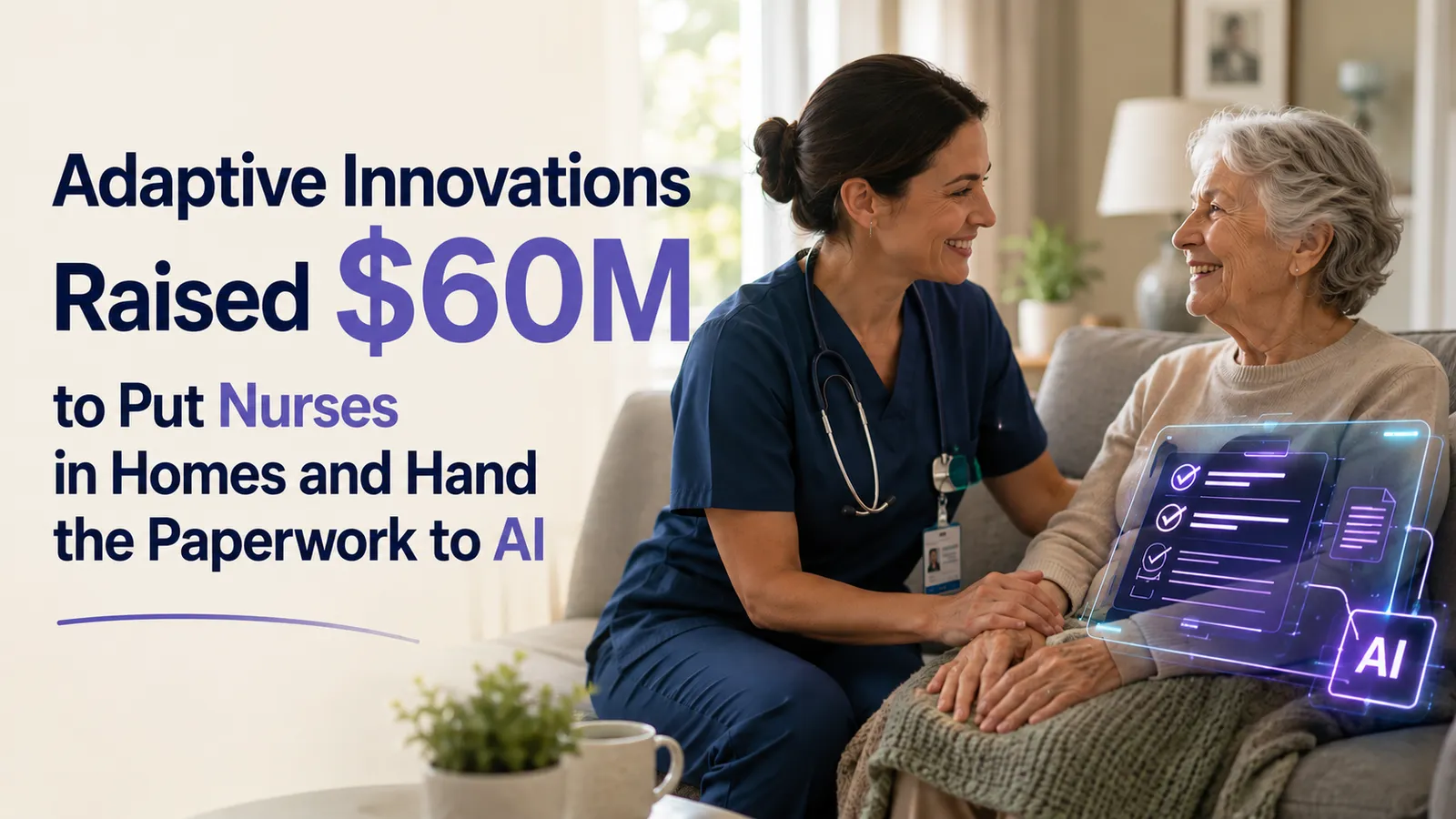

Adaptive Innovations has just closed their $50 million Series A. This brings their total funding to $60 million [1][2]. The company sends nurses and therapists into patients' homes while handing the surrounding paperwork to artificial intelligence (AI).
The round was led by Felicis and Bain Capital Ventures, with participation from Optum Ventures, Sunflower Capital, Conviction, BoxGroup, SV Angel, Dorm Room Fund, Constellation, and angel investors from the frontier AI labs [1][2].
The problem Adaptive is chasing is not a clinical one. It is the same administrative weight that crushes independent doctors' offices, showing up in another corner of medicine. And the way the company is attacking it says a lot about where care delivery is heading.
What Adaptive Innovations Actually Does
Adaptive Innovations employs the nurses and therapists, takes the referral, and delivers the visit, then runs everything around that visit on their own AI platform [3]. "We're not a vendor, we're the actual healthcare provider," co-founder Logan Stinson said [3].
The AI is pointed at the bureaucracy, not at the bedside. Intake, eligibility, scheduling, charting, medical coding, quality assurance, and billing all run through the platform, which the company says cuts the time clinicians spend on documentation by roughly 80 percent [1][3]. Co-CEO Alex Wendland frames the strategy as aiming AI at the paperwork that gets in the way of human interaction rather than at the human interaction itself [2]. The numbers behind that pitch are stark: in home health, coordination overhead costs 60 to 90 cents for every dollar of actual clinical labor, which is why an estimated $40 billion in home health referrals get rejected every year [1].
By driving that overhead down, Adaptive says they can profitably accept patients other agencies turn away, including the roughly 40 percent of referrals the legacy system declines [1]. Since launching in 2025, the company has completed more than 100,000 home visits with over 200 clinicians, and partnered with 500-plus referring organizations, including every major Texas hospital system [1][2]. They now operate in all of the state's major metros, from Dallas and Houston to Austin, San Antonio, Fort Worth, Waco, and Temple, and have become the leading home health provider for Blue Cross Blue Shield of Texas patients [3]. The company reports a rehospitalization rate below 5 percent, against an industry average that runs roughly 11 to 13 percent [1][3].
Who Built Adaptive Innovations
Adaptive was created in 2025 by four founders who split the work between technology and care delivery: Ryan Tolsma, the chief technology officer; Logan Stinson and Alex Wendland, co-chief executives; and Hunter Stinson, a registered nurse who holds a Bachelor of Science in Nursing and serves as chief operating officer [1][3]. Pairing a working nurse with engineers at the founder level is the whole thesis in miniature: someone who has done the visits, alongside people who can automate everything around them.
The team they assembled leans on that same split. Adaptive's engineers come from places like Scale, Palantir, and Jane Street, while their clinical and operating side draws on people from McKinsey, Harvard, Stanford, and the U.S. Army Rangers, with a 30-plus person engineering group building the tooling in house [1][3]. Based in New York City and Dallas, the company spent their first 18 months operating quietly in Texas before going public with the raise, and grew to roughly 400 employees, about 300 of them in the state [3]. Wendland is blunt about the business model that made investors comfortable: "What we're doing is simple: it's driving the admin costs to zero, and then recycling those savings into higher clinician pay and a compounding flywheel that lets us serve the entire home health market" [2].
Why This Matters Beyond Home Health
Home health care is a massive industry that helps millions of people per year. One of the largest challenges is managing the paperwork and Adaptive massively helps with this problem.
This appears to be a pattern we are seeing repeat itself as AI becomes more advanced. We covered Commure raising $70 million to automate medical billing with AI, and the through-line is consistent: the paperwork that makes practicing medicine feel impossible is being absorbed, function by function, into software that does the work rather than just organizing it.
Adaptive simply takes the idea to its logical end by owning the whole operation, technology and clinicians together, instead of selling a tool into someone else's broken back office.
The Limits Worth Naming
Adaptive's most specific claims, including the 100,000 visits, the 80 percent documentation savings, and the sub-5 percent rehospitalization rate, come from the company and their investors, not an independent audit [1][3]. They operate in one state so far, and the leap to "every patient in Texas," let alone nationwide, is real work they have not yet proven [2]. Home health is also a capital-heavy, tightly regulated business that has humbled well-funded startups before, and an AI platform does not change the fact that a nurse still has to drive to the house. What Adaptive is betting is that if you make the paperwork nearly free, you can afford to send that nurse to far more homes. The early results are promising, but they are early.
For patients, the takeaway is the one we keep coming back to. The work of medicine that matters, a clinician giving you real time and attention, gets easier to deliver every time the busywork around it shrinks. That is true whether the clinician is a nurse arriving at your door or a doctor in a practice that gave up insurance billing to give you a longer visit. The job left to you is finding the one who has time.
FAQ
What is Adaptive Innovations?
Adaptive Innovations is an AI-native home health care provider based in New York City and Dallas. They employ nurses and therapists who deliver care in patients' homes, and run the surrounding work, intake, scheduling, charting, coding, and billing, on their own AI platform [1][2].
How much did Adaptive Innovations raise, and who led the round?
Adaptive raised a $50 million Series A and disclosed a previously unannounced $10 million seed round, for $60 million total. The funding was led by Felicis and Bain Capital Ventures, with participation from Optum Ventures, Sunflower Capital, Conviction, BoxGroup, SV Angel, Dorm Room Fund, and Constellation [1][2].
Is Adaptive Innovations a concierge or direct primary care practice?
No. Adaptive is a home health provider that delivers skilled nursing and therapy at home, usually paid through insurance. Concierge and direct primary care practices are physician-led membership practices that charge a flat fee for ongoing primary care. They solve the same administrative problem from different directions.
Why does an AI home health company matter for concierge and DPC patients?
Because administrative overhead is the main cost of delivering care in any setting. Tools and models that automate that overhead make independent, physician-led practices cheaper to run and easier to keep open, which means more of them survive and open near you.
Find a Doctor Who Has Time for You
Less paperwork only helps you if it leads to a clinician who has time to listen. NextMD is the free directory of concierge and direct primary care doctors across the country. Search NextMD to find a physician-led practice near you.
Sources
Adaptive Innovations. (2026). Introducing Adaptive Innovations and $60M raised in Series A and Seed. Read the announcement on adaptive.co
Gonzales, M. (2026). AI-Powered Home Health Provider Adaptive Innovations Lands $50M Series A. Home Health Care News. Read on Home Health Care News
Praytor, L. (2026). After Raising $50M, This Company Is Betting AI Can Solve Home Healthcare's Administrative Burden. D CEO / D Magazine. Read on D Magazine