
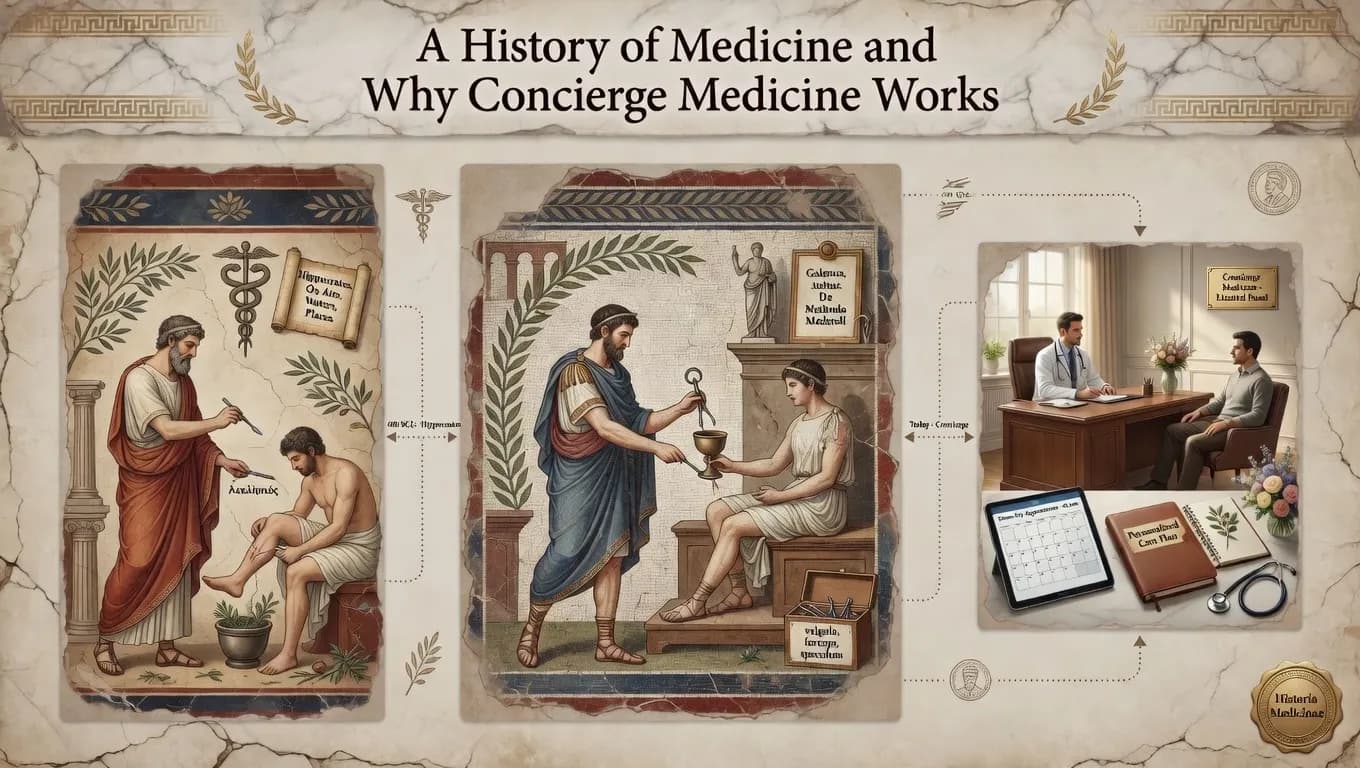

Concierge medicine and Direct Primary Care (DPC) work because they restore the small patient panels that defined medicine for most of its history. A typical primary care doctor today manages 2,500 patients and spends half the day on paperwork. Concierge and DPC doctors hold panels to 600 or fewer, offer same-day access and 30–60 minute visits, and produce measurably better outcomes — including 96% preventive screening rates versus 84–89% nationally and, by year three, downstream savings that exceed the membership fee for a majority of patients.
The Physician's Panel Was Always Small
Ancient Medicine
In the Greek and Roman world, the physician was a known figure in the community. Private physicians attended the households of wealthy patrons and a smaller circle of local families. Even public physicians, who were retained by cities to treat citizens at no charge, worked in populations where a single practitioner could reasonably be known by name.
The Roman encyclopedist Aulus Cornelius Celsus, writing around 30 AD, devoted long passages of his De Medicina to how treatment had to be adjusted to the individual patient's age, constitution, and mode of life. That kind of judgment only works if the physician already knows the person in front of them. It is not a protocol you apply to a stranger in a 15 minute visit.
Medieval and Early Modern Europe
Through the medieval and early modern periods, the practice of medicine remained highly personal.
Physicians, barber-surgeons, and apothecaries served small local populations.
University-trained physicians were a small minority, usually retained by courts, religious houses, or wealthy merchants. Care was continuous, long-term, and tied to the household.
The 19th and Early 20th Century American Family Doctor
In the late 1800s and early 1900s in the United States, the family doctor was a familiar figure.
A general practitioner in a small town or urban neighborhood typically cared for a few hundred families. House calls were standard.
The doctor delivered babies, treated grandparents, and knew who was reliable with medication and who was not.
Panel sizes in that era are difficult to pin down with modern precision, but the structure of the work limited them naturally. Without insurance billing, without electronic charting, and with many visits taking place in the home, a single doctor simply could not see thousands of distinct patients a year while doing the job well.
How the 2,500-Patient Panel Happened
Two mid-20th century shifts changed the shape of primary care.
First, employer-sponsored health insurance became the dominant way Americans paid for medical care after World War II. This decoupled the patient from the price of a visit and created a new financial customer for the physician: the insurer.
Second, the shift to fee-for-service billing under Medicare, Medicaid, and commercial insurance rewarded volume. Physicians were paid per coded visit, per procedure, per billable encounter. Longer visits did not pay better. Shorter visits, repeated more often, did.
Over several decades, primary care practices responded rationally to these incentives. Panels grew. Visit times shrank. Administrative work expanded. The patient relationship got thinner.
By the 2010s, the average American primary care physician was responsible for more than 2,000 patients and was spending roughly half of the workday on documentation and administrative tasks rather than direct patient care.
What Happens When Panels Get Too Big
The consequences are measurable.
Primary care physicians reported the highest burnout of any medical specialty in every year of a 2018 to 2023 longitudinal study, rising from 46.2% to 56.5% [2].
Across the full study population of more than 120,000 health care workers per year, overall burnout climbed from 30.4% in 2018 to a peak of 39.8% in 2022 [2].
Average primary care visit lengths in the US hover around 15 to 18 minutes, a fraction of what is needed to meaningfully address a complex patient [1].
Patients in traditional primary care often wait days or weeks for an appointment, and that wait is now a leading reason people delay care or use the emergency room instead [3].
The high-panel model is failing both the doctor and the patient.
Concierge and DPC Return to Smaller Panels
Concierge medicine and Direct Primary Care (DPC) are structured around a simple rearrangement. The physician accepts a membership fee directly from the patient and, in return, reduces their panel to a size that allows longer visits, faster access, and a real relationship.
Based on NextMD research of over 4,500 practices and 7,000 doctors here is a good guideline for panel sizes of private medicine vs traditional primary care
Model | Typical Panel Size | Typical Annual Fee |
|---|---|---|
Traditional primary care | Up to 2,500 | Insurance-based, no direct fee |
Direct Primary Care (DPC) | 300 to 600 | $1,000 to $3,000 |
Concierge medicine | 50 to 300 | $2,000 to $45,000 |
These numbers are not arbitrary. They are roughly the panel sizes a physician can serve well while providing same-day access, 30 to 60 minute visits, and direct communication by phone or email.
The published outcomes line up with the theory.
In a propensity-matched study of more than 10,000 MDVIP concierge members, 96% of members with cardiovascular conditions received LDL ("bad") cholesterol screening, compared to an 84 to 89 percent national benchmark. 69 percent of MDVIP members were at cholesterol goal, compared to 37 to 52 percent nationally [4].
Urgent care use among MDVIP members was significantly lower than among matched nonmembers in every year of the three-year study. Emergency room use was significantly lower in years two and three [4].
By year three, 63 percent of MDVIP members had downstream medical savings that exceeded their membership fee [4].
In a comparison of concierge and traditional practice, concierge patients reported significantly better care coordination, access to care, and physician time allocation [3].
A separate study documented a 40 percent reduction in door-to-doctor time when a concierge physician was involved in an emergency room encounter [3].
The story these studies tell is consistent. When you lower the panel size, physicians have the time to do the preventive and coordinating work that primary care is supposed to do in the first place.
Why We Believe Private, Physician-Led Care Is the Future
At NextMD we believe concierge and DPC are not a niche. They are the next major form factor for American primary care. Five forces point in that direction.
1. Physicians are leaving high-volume primary care. Burnout is not improving meaningfully, and a growing share of early and mid-career physicians are opting for private, membership-based models rather than staying in high-panel systems [2]. The supply of physicians willing to run a 2,500-panel practice is shrinking.
2. Patients are already direct payers. High-deductible health plans (HDHPs) mean that a typical insured patient is paying cash for most routine care until they hit a deductible. When patients pay directly for most visits anyway, a membership model that guarantees access starts to look both cheaper and better.
3. Employers are adopting it. Direct Primary Care and concierge medicine are being offered as a benefit by a growing number of self-funded employers because they lower downstream costs. Roughly half of MDVIP members are funded by an employer [4].
4. Technology finally makes small panels scalable. Telemedicine, asynchronous messaging, and modern practice management tools let a small-panel physician provide a level of access that used to require a full house-call schedule. The constraints that pushed panels up no longer apply in the same way.
5. The model matches what patients actually want. Patients consistently say they want to know their doctor, be seen quickly, and not feel rushed. Traditional primary care cannot deliver on this at scale. Concierge and DPC can, and they already do.
Put these together and the direction is clear. The mid-20th century experiment in high-panel, insurance-coded primary care was a departure from a much longer historical norm. Concierge and DPC are the return.
How to Find a Concierge or DPC Doctor
You can search concierge and Direct Primary Care practices by city, compare pricing, and view doctor credentials at nextmd.ai/search.
Sources
Elation Health. "How Many Patients Are Most Primary Care Physicians Seeing?" elationhealth.com.
Mohr DC, Elnahal S, Marks ML, Derickson R, et al. "Burnout Trends Among US Health Care Workers." JAMA Network Open 2025; 8(4):e255954.
Alhawshani S, Khan S. "A Literature Review on the Impact of Concierge Medicine Services on Individual Healthcare." Journal of Family Medicine and Primary Care 2024; 13:2183-2186. (Summarizes Ko et al. 2009 and Mandel et al. 2020.)
Musich S, Wang S, Hawkins K, Klemes A. "The Impact of Personalized Preventive Care on Health Care Quality, Utilization, and Expenditures." Population Health Management 2016.